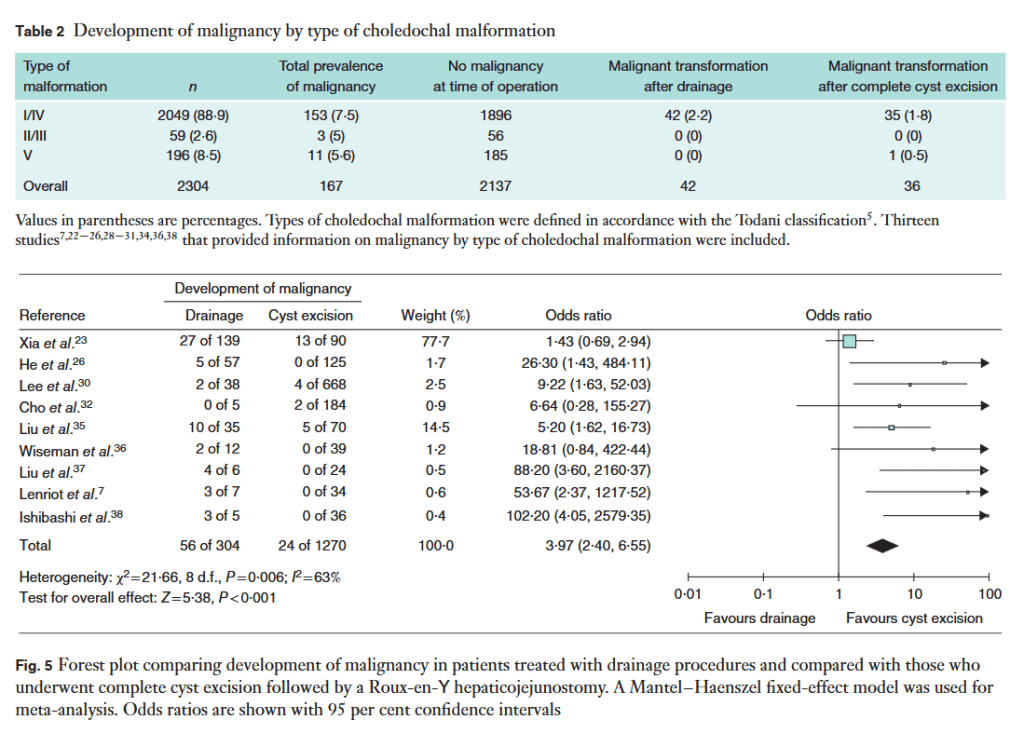
“Malignancies develop in 2⋅5–26 per cent of patients with choledochal malformation. Choledochal malformations are classified according to Todani and colleagues.
Several authors consider the development of malignancy in choledochal malformations to be related to the aetiology of the different types of malformation. It could be speculated that prolonged reflux of pancreatic secretions into the biliary tract occurs in Todani types I and IV,
which frequently present with abnormal pancreaticobiliary duct junctions. Prolonged reflux might lead to malignant degeneration of the biliary epithelium. The situation is supposedly different in types II and III choledochal malformations, which might be true congenital malformations in which reflux is absent”