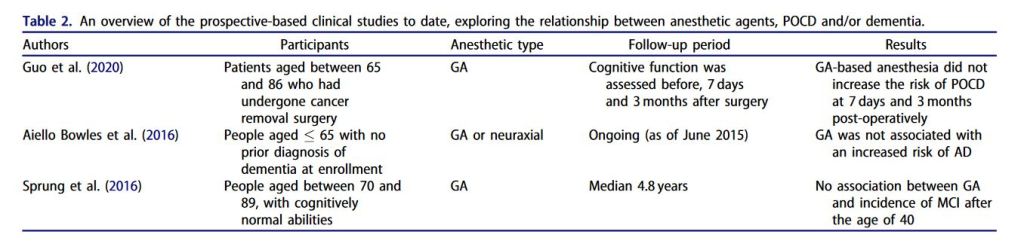
“Although the authors acknowledge that cognitive deterioration following surgery is a common phenomenon, there is little evidence that anesthesia itself or other surgical and patient factors can cause or accelerate cognitive decline and AD. The existing controversy in the field between animal and human studies highlights the need for transitioning from population-based studies to high-quality clinical studies especially with regards to dementia.” (Tsolaki)

Tsolaki

Continue reading

Cognitive decline of elderly patients after anesthesia

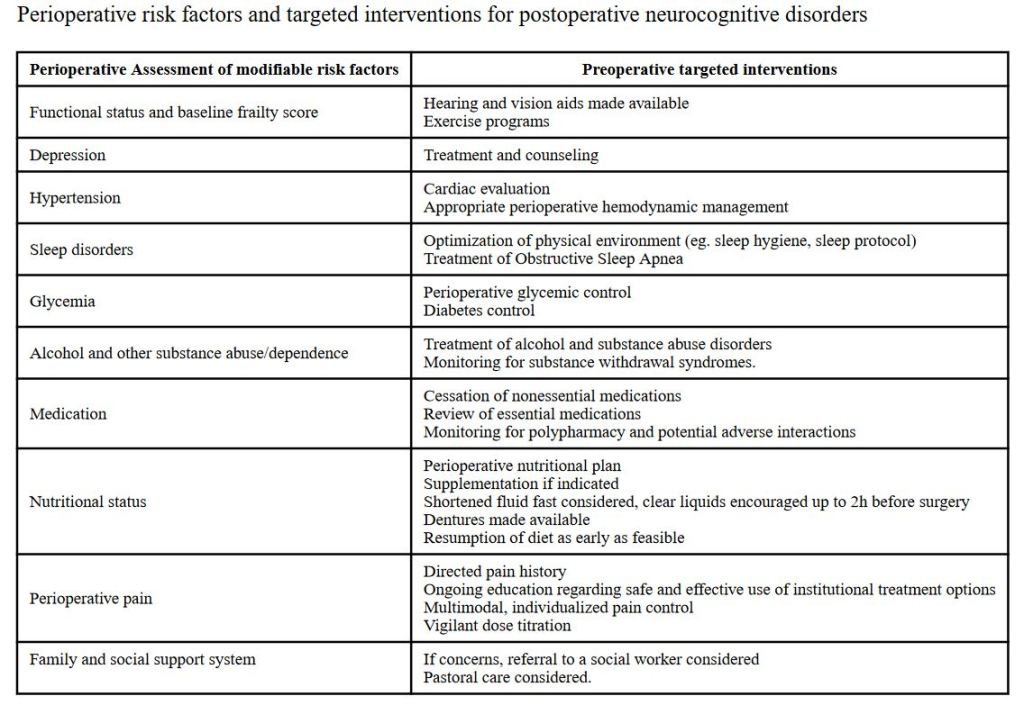
“Postoperative neurocognitive decline is a meaningful concern to patients and represents a significant and expanding challenge to health care in the US and worldwide. Surgeons and anesthesiologists should assess, discuss, and optimize associated potential risks for each patient before surgery. Best practices and interventions can begin before surgery and extend well into the recovery period. To be most effective, these strategies require family engagement and the involvement of an interdisciplinary health care team and comprehensive systems of care.” (Vacas)

Vacas

Continue reading

Diagnosis and Management of Morel-Lavallée Lesion

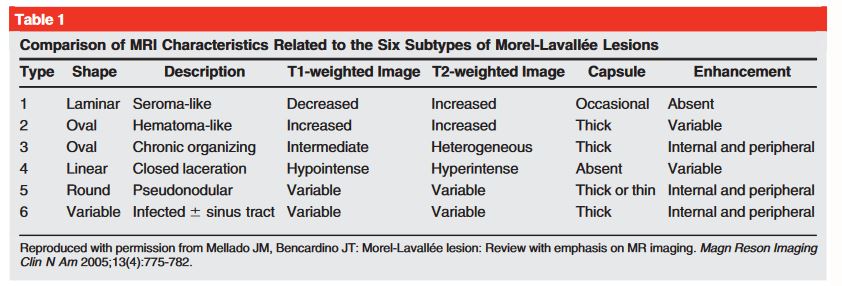
“The diagnosis of an MLL ideally is made by physical examination of the patient, but advanced imaging modalities can be used to provide additional information. Typically, CT of the area of interest is obtained, especially when a pelvic or acetabular injury is present. Small and large lesions often can be identified in this manner.”

Continue reading

Overview of Morel Lavallee Lesion

“The Morel-Lavallee lesion clinically presents as a painful fluctuant swelling at the site of involvement. Concerning the recent literature available, this lesion is also termed as Morel-Lavallée seroma, posttraumatic soft tissue cyst, post-traumatic extravasation, or Morel-Lavallée effusion. This lesion may be missed at the time of initial assessment and can present later, potentially leading to increasing difficulty in management and long-term morbidity.”

“The most common causes of Morel-Lavallee lesions are high-velocity trauma, crush injuries, and blunt trauma. Overall, approximately twenty-five percent of all patients who develop Morel-Lavallee lesions have been involved in a road traffic accident. This lesion is commonly associated with underlying fractures, especially of the proximal femur, pelvis, and acetabulum. One of the most commonly involved regions is the greater trochanter, accounting for more than sixty percent of the cases”

Continue reading

Operative Outcomes for Polycystic Liver Disease:

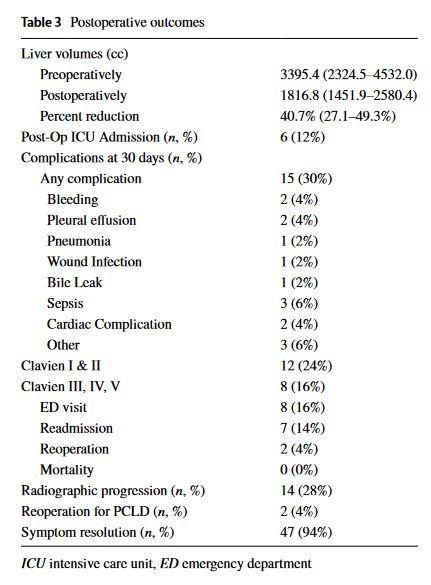
“Given the relative rarity of PCLD, current data on the outcomes of surgical debulking for advanced PCLD are scarce, particularly within the realm of laparoscopic hepatic
resection techniques. We therefore sought to evaluate the characteristics of patients undergoing operative debulking for advanced PCLD and analyze the perioperative and long-
term postoperative outcomes of hepatic resection for PCLD.”

Continue reading

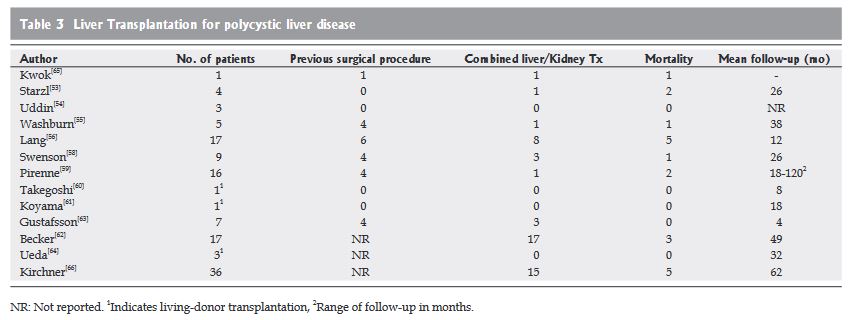
Polycystic Liver Disease: Surgical Management and the role of transplant

“Adult polycystic liver disease (PCLD) is an autosomal dominant condition commonly associated with autosomal dominant polycystic kidney disease (ADPKD). However
in the last decade, it has been recognized that there is a distinct form of autosomal dominant PCLD that arises without concomitant ADPKD. Early knowledge of the pathogenesis was gained from the study of hepatic cysts in patients with ADPKD.”

Continue reading

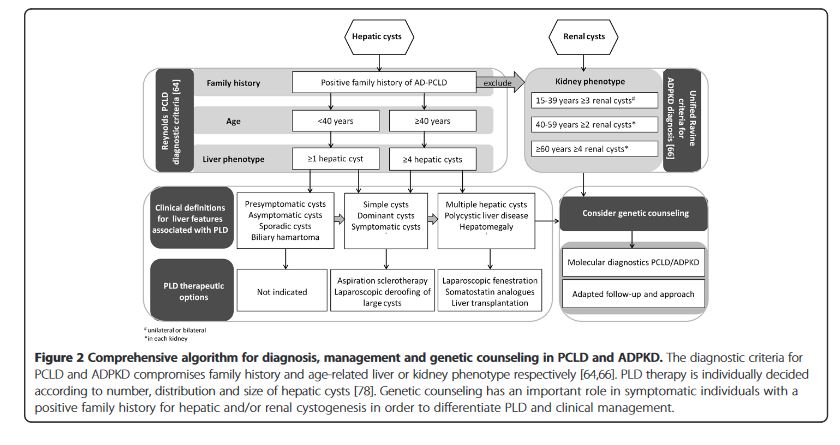
Pathogenesis and management of Polycystic liver disease

“Polycystic liver disease (PLD) is the result of embryonic ductal plate malformation of the intrahepatic biliary tree.The phenotype consists of numerous cysts spread throughout the liver parenchyma. Cystic bile duct malformations originating from the peripheral biliary tree are called Von Meyenburg complexes (VMC). In these patients embryonic remnants develop into small hepatic cysts and usually remain silent during life. Symptomatic PLD occurs mainly in
the context of isolated polycystic liver disease (PCLD) and autosomal dominant polycystic kidney disease (ADPKD).”
“Management of adult PLD is based on liver phenotype, severity of clinical features and quality of life. Conservative treatment is recommended for the majority of PLD patients. The primary aim is to halt cyst growth to allow abdominal decompression and ameliorate symptoms. Invasive procedures are required in a selective patient group with advanced PCLD, ADPKD or
liver failure. Pharmacological therapy by somatostatin analogues lead to beneficial outcome of PLD in terms of symptom relief and liver volume reduction.”

Continue reading