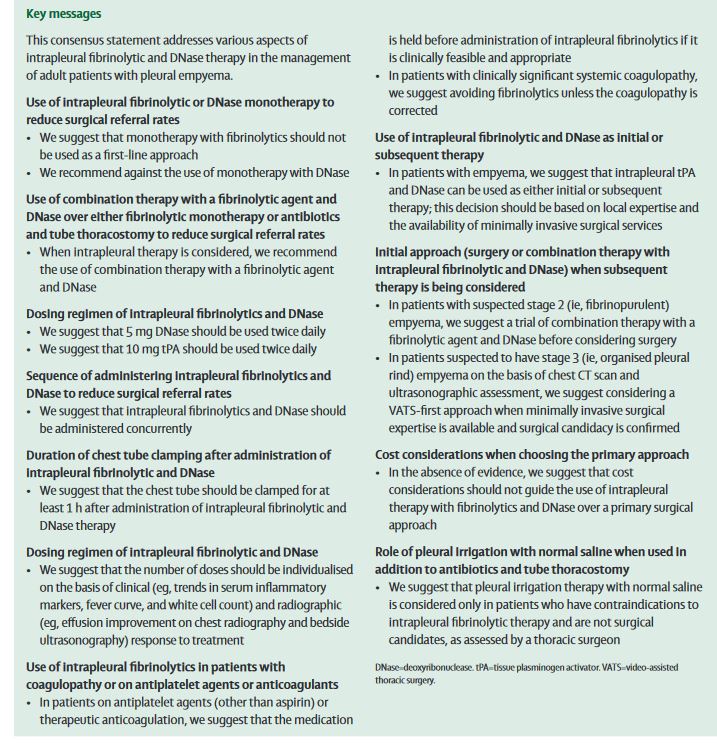
Use of lytics in patients with pleural empyema

“Parapneumonic effusions evolve through a spectrum of three stages. The initial exudative stage (stage 1; analogous to simple parapneumonic effusion) is characterised by an increased outpouring of fluid into the pleural space mediated by capillary permeability. If left
untreated, persistent inflammation with the associated rise in fluid plasminogen activator inhibitor causes a decrease in fluid fibrinolytic concentrations. During this second stage (stage 2; fibrinopurulent stage), as the effusion becomes infected, septations and adhesions
induced by fibrin deposition divide the space into pockets or locules. With the proliferation of fibroblasts and the formation of a pleural peel, lung expansion becomes restricted and can result in a non-expandable lung. It is important to initiate all medical treatment before this
final so-called organising stage (stage 3) ensues.”
Continue reading

Management of Empyema

“Empyema thoracis, from the Greek, is defined as ‘‘pus in the chest.’’ The most common precursor of empyema is bacterial pneumonia and subsequent parapneumonic effusion. Other causes of empyema include bronchogenic carcinoma, esophageal rupture, blunt or penetrating chest trauma, mediastinitis with pleural extension, infected congenital cysts of the airway and esophagus, extension from sources below the diaphragm, cervical and
thoracic spine infections, as well as postsurgical etiologies.”

Continue reading

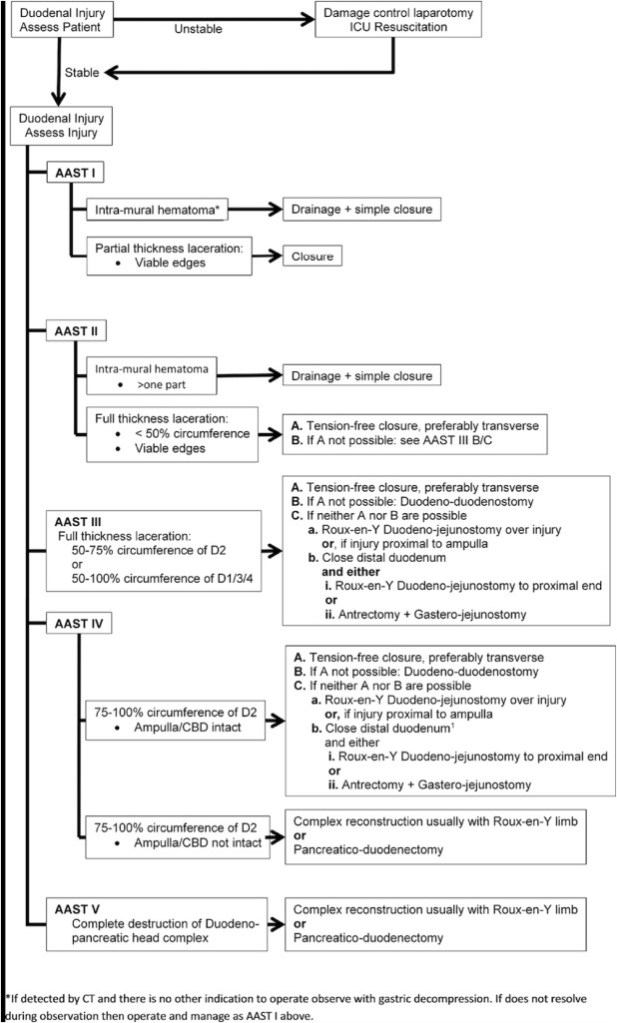
Management of the complex duodenal injury

“Duodenal trauma is a rare occurrence existing in 1–4.7% of all abdominal trauma. Its posterior and partially retroperitoneal location shields it from most traumatic mechanisms. Colloquially referred to as the ‘surgical soul’, its proximity to complex regional anatomy makes duodenal trauma particularly at risk for biliary, pancreatic and major vascular injury with 68–86.5% of patients sustaining an associated injury.”

Continue reading

Damage control in penetrating duodenal trauma

“The overall incidence of duodenal injuries in severely injured trauma patients is between 0.2 to 0.6% and the overall prevalence in those suffering from abdominal trauma is 3 to 5% 1,2. Approximately 80% of these cases are secondary to penetrating trauma, commonly associated with vascular and adjacent organ injuries. These associated injuries create a significant challenge towards the early diagnosis and appropriate management. Therefore, defining the best surgical treatment algorithm remains controversial. Mild to moderate duodenal trauma is currently manage via primary repair and simple surgical techniques. However, severe injuries have required complex surgical techniques (duodenal diverticulization, pyloric exclusion with or without gastrojejunostomy and pancreatoduodenectomy) without significant favorable outcomes and consequential increase in the rates of mortality.”

Continue reading

Vascular injury in hernia repair

“Complications are known to occur at each and every step of hernia surgery. Applying caution while performing each step can save the patient from a lot of morbidity. One starts by applying strict patient selection criteria for endoscopic hernia repair, especially in the initial part of ones learning curve. A thorough knowledge of anatomy goes a long way in avoiding most of the complications seen in hernia repair. This anatomy needs to be relearned from what one is used to, as the approach is totally different from an open hernia repair. And finally, learning and mastering the right technique is an essential prerequisite before one ventures into inguinal hernia repair.”

“The most important preoperative precaution is proper patient selection prior to surgery, especially in the initial part of the learning curve. Ideally, direct or small indirect hernias are best. Large hernias, obese patients and irreducible, obstructed hernias are best avoided. An absolute contraindication is strangulated hernia. Also a detailed work-up of elderly patients to assess cardiorespiratory status is mandatory to ensure a safe outcome.”

Continue reading

Splenic injury grades & management

“Management of blunt spleen injuries has evolved from mandatory splenectomy to non-operative management (NOM) allowing for splenic salvage. The Eastern Association for the Surgery of Trauma (EAST) practice management guideline for the management of blunt solid organ injury recommends NOM in splenic injury regardless of age, grade, or associated injuries.”

“Splenectomy continues to be the treatment of choice in patients with unstable hemodynamics and a known splenic injury. In the hemodynamically normal patient, current practice is to observe the patient and treat with NOM to save the patients the complications associated with surgery.”

Continue reading

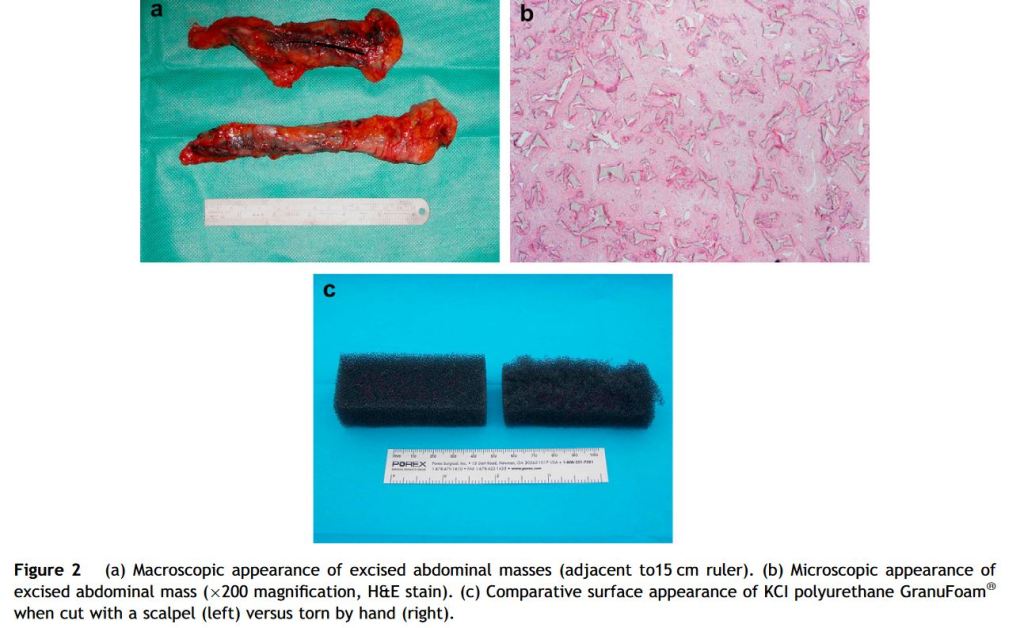
Retained wound VAC material as complication of abdominoplasty

With large cavitating wounds, there is a risk of sponge retention that may be all too easily
overlooked, particularly with the surgeons’ habit of cutting the sponge to the desired shape and the use of multiple fragments. We therefore recommend that a count is made of the number of sponges used – as is standard practise for swabs, needles and instruments.

Continue reading