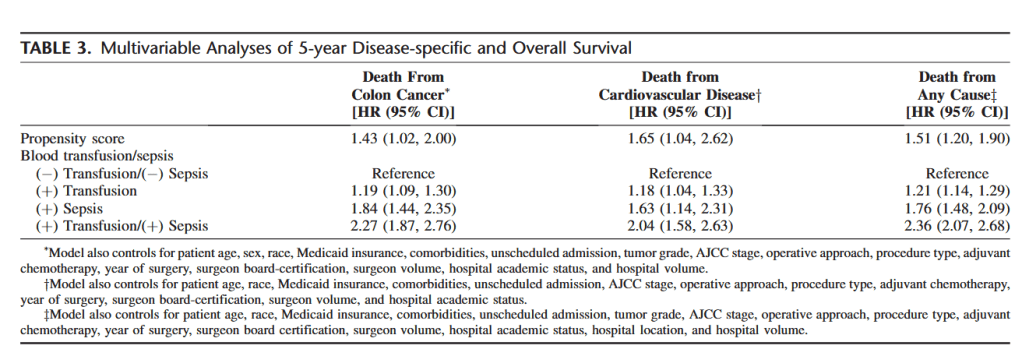
Association Among Blood Transfusion, Sepsis, and Decreased Long-term Survival After Colon Cancer Resection

“Colorectal cancer is the second-leading cause of cancer-related mortality in both the United States and Europe. With respect to prognosis, increasing evidence has suggested that systemic inflammation is a key predictor of disease progression and survival for colorectal cancer patients undergoing surgery. Furthermore, whereas red blood cell (RBC) transfusions may be life-saving in some circumstances, there has been growing evidence that transfusions are associated with adverse postoperative outcomes, including infectious complications and cancer recurrence. These detrimental effects are thought to be related to systemic inflammation and transfusion-related immunomodulation (TRIM). Whereas the exact mechanisms remain unknown, TRIM seems to be related to various immunologic changes, including decreased interleukin (IL)-2 production, monocyte and cytotoxic cell activity inhibition, increased suppressor T-cell activity, and immunosuppressive prostaglandin release.”
Continue reading

Is Linitis Plastica a Contraindication for Surgical Resection?

“The diagnosis of LP carries significant controversy regarding its surgical management.
Lymph node involvement is almost always present at the time of diagnosis, and due to its
diffuse nature, microscopic disease is often found at the resection margins. Peritoneal
dissemination is frequently encountered at the time of surgery or as the main site of
recurrence. As such, curative resection is possible in less than half of patients and early
recurrence is common, leading to a dismal median survival, ranging from 6 to 12 months,
and 5-year survival between 8 and 13 %.”

Continue reading

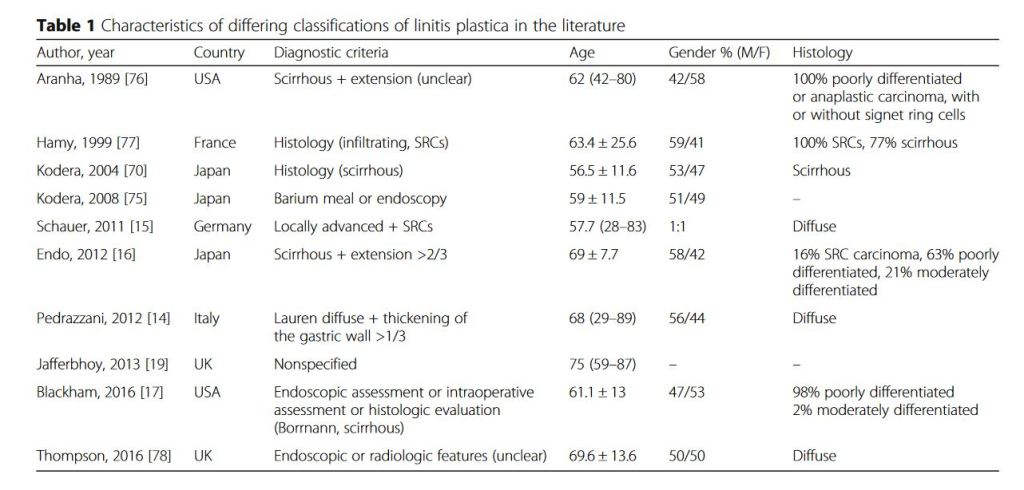
Clinicopathologic features and survival outcomes of patients with Linitis Plastica

“Linitis plastica (LP) is a distinct phenotype of gastric cancer. Macroscopically, it is characterized as a thickened stomach, with prominent diffusion of the tumor into the submucosal and muscular layers; microscopically, it is often associated with signet ring cell features and diffuse and scirrhous (referring to the histologic characteristic of abundant stromal cells) histologic types.”

Continue reading

Linitis plastica definitions

“Linitis plastica due to gastric adenocarcinoma is a condition with a long history, but still lacks a standardized definition and is commonly confused with Borrmann type IV, Lauren diffuse, and signet-cell type gastric cancer. The absence of a clear definition is a problem when investigating its biological characteristics and role as a possible independent factor for prognosis. Nevertheless, the biological behavior for linitis plastica, which is unique, may be valuable in risk stratification and have implications for treatment. A definition of linitis plastica
based on molecular or genomic criteria could represent a useful starting point for investigating new targeted therapies.”

Continue reading

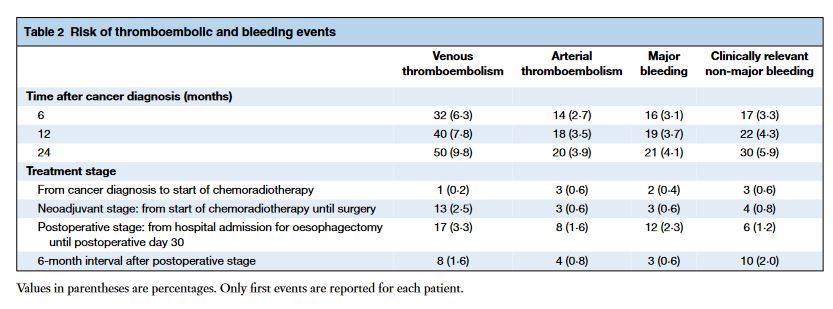
Risk of thromboembolic and bleeding complications in patients with oesophageal cancer

“Patients with oesophageal cancer undergoing neoadjuvant chemoradiotherapy and surgery
are at substantial risk of thromboembolic and bleeding events throughout all stages of treatment. Survival is worse in patients with thromboembolic events during follow-up.”

Continue reading

Role of Deficient DNA Mismatch Repair Status in Patients With Stage III Colon Cancer Treated With FOLFOX Adjuvant Chemotherapy

“While most studies have found that patients with dMMR (vs proficient MMR [pMMR]) tumors have a more favorable stage-adjusted prognosis, other studies have not detected a significant difference in clinical outcome or have suggested that any favorable prognostic effect of dMMR is limited to patients with earlier-stage tumors. Furthermore, studies have shown that dMMR tumors may not benefit from fluorouracil-based adjuvant chemotherapy. However, the impact of MMR status remains controversial in the era of the standard FOLFOX adjuvant chemotherapy.
In a pooled analysis, we examined the association of MMR status with disease-free survival (DFS) in patients with stage III colon cancer treated with FOLFOX from 2 phase 3 randomized clinical trials.”

Continue reading

Graft reconstruction in pancreaticoduodenectomy: outcomes and survival

One discussion this week included use of prosthetic graft reconstruction …


Reference: Chu CK, et al. Prosthetic graft reconstruction after portal vein resection in pancreaticoduodenectomy: a multicenter analysis. Journal of the American College of Surgeons. 2010 Sep;211(3):316-324. doi: 10.1016/j.jamcollsurg.2010.04.005

Summary: Use of prosthetic grafts for reconstruction after portal vein (PV) resection during pancreaticoduodenectomy is controversial. This paper (by Emory authors) review 33 patients who underwent pancreaticoduodenectomy (PD) with vein resection and reconstruction using PTFE grafts between 1994 and 2009. Patient, operative, and outcomes variables were studied. Graft patency and survival were assessed using the Kaplan-Meier technique.

Continue reading