
“Patients and families who are language discordant with their clinical teams report lower
patient satisfaction, worse health status, and lower rates of having a regular healthcare
provider and obtaining preventive care services. When patients and parents with
a non-dominant language preference access care, they report difficulty communicating
and understanding medical information from providers, comprehending written medical
information, reading prescription bottles, and accessing interpretation services.
Individuals with non-dominant language preferences have also been shown to experience
more medical errors and adverse health events.”
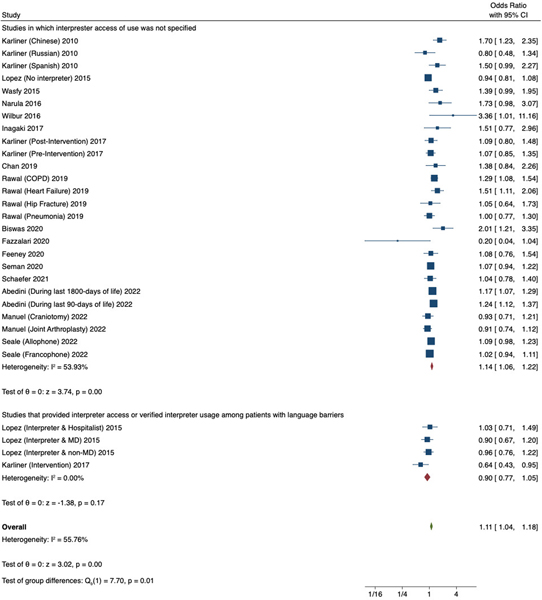
Meta-analysis of studies that evaluated differences in 28-day or 30-day hospital readmission
rate among adult patients with versus without a dominant langauge preference, stratified
by studies that provided interpreter access or verified interpreter usage among patients with
non-dominant language preference versus studies in which interpreter access or use was not
specified. COPD, chronic obstructive pulmonary disease.
 Surgical Focus