
The Carotid Revascularization Endarterectomy vs Stenting Trial (CREST)

One discussion this week involved the Carotid Revascularization Endarterectomy vs. Stenting Trial (CREST).


Reference: Brott TG, et al. Stenting versus endarterectomy for treatment of carotid-artery stenosis. New England Journal of Medicine. 2010 Jul 1;363(1):11-23. doi:10.1056/NEJMoa0912321.

Summary:  CREST is an RCT with blinded end-point adjudication whose aim was “to compare the outcomes of carotid-artery stenting with those of carotid endarterectomy among patients with symptomatic or asymptomatic extracranial carotid stenosis” (p.12).

Between December 2000 through July 2008, 2522 patients were enrolled in 108 centers in the US and 9 in Canada. Of those, 1271 patients were randomly assigned to undergo carotid-artery stenting.

Primary findings include (p.18):

  • Carotid revascularization performed by highly qualified surgeons and interventionists is effective and safe.
  • Stroke was more likely after carotid-artery stenting.
  • Myocardial infarction was more likely after carotid endarterectomy, but the effect on the quality of life was less than the effect of stroke.
  • Younger patients had slightly fewer events after carotid-artery stenting than after carotid endarterectomy.
  • Older patients had few events after carotid endarterectomy.
  • Low absolute risk of recurrent stroke suggests that both carotid-artery stenting and carotid endarterectomy are clinically durable and reflect advances in medical therapy.
The Asymptomatic Carotid Atherosclerosis Study (ACAS)

One discussion this week included the Asymptomatic Carotid  Atherosclerosis Study (ACAS).

Reference: Endarterectomy for asymptomatic carotid artery stenosis. Executive Committee for the Asymptomatic Carotid Atherosclerosis Study. JAMA. 1995 May 10;273(18):1421-1428.

Summary: ACAS was a prospective, randomized trial conducted at 39 sites in the US and Canada between December 1987 and December 1993. Its purpose was to “determine whether the addition of carotid endarterectomy to aggressive medical management can reduce the incidence of cerebral infarction in patients with asymptomatic carotid artery stenosis” (p.1421).

The primary finding was that the risk of ipsilateral stroke and any periopoerative stroke or death over 5 years was 5.1% for surgical patients and 11.0% for medically treated patients (p.1425). Furthermore, those who are good candidates for elective surgery and have carotid artery stenosis of 60% or greater reduction in diameter will have a significantly reduced 5-year risk of ipsilateral stroke “if carotid endarterecomy performed with less than 3% perioperative morbidity and mortality is added to aggressive management of modifiable risk factors” (p.1421).

Additionally, ACAS concluded that CEA reduces the relative stroke risk 66% for men and 17% for women. This difference is perhaps due to higher rates of perioperative complications in women.When arteriographic and perioperative complications are excluded, the risk reduction was 79% for men and 56% for women (p.1427).

The North American Symptomatic Carotid Endarterectomy Trial (NASCET)

One discussion this week involved the North American Symptomatic Carotid Endarterectomy Trial (NASCET).

Reference: Barnett HJM, et al. Benefit of carotid endarterectomy in patients with symptomatic moderate or severe stenosisNew England Journal of Medicine. 1998 Nov 12;339(20):1415-1425.

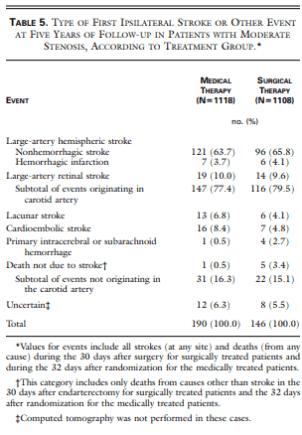
Summary: NASCET involved 2226 patients with stenosis of less than 70 percent. They were randomly assigned to treatment groups: 1118 to medical therapy, 1108 to surgical therapy (p.1417).

Four patient characteristics are associated with greater benefit from surgery: male sex, recent stroke, recent hemispheric symptoms, and taking 650 mg or more of aspirin per day (p.1419).

NASCET authors explain that the lack of significant benefit for women may be due to their low risk of stroke. Among participants with 50-69% stenosis, the risk of any ipsilateral stroke at 5 years in the medically treated group was 15% for women, and 25% for men. Endarterectomy reduced the risk to 14% for women and 17% for men (p. 1421).

The table below shows the rate of events at 5-year followup:

table5