Diverting Ostomy: For Whom, When, What, Where, and Why

“Fecal diversion is an important tool in the surgical armamentarium. There is much controversy regarding which clinical scenarios warrant diversion. Some of the most common applications for the use of a diverting stoma include construction of diverting ileostomy or colostomy, ostomy for low colorectal/coloanal anastomosis, inflammatory bowel disease, diverticular disease, and obstructing colorectal cancer with the conclusion that diverting loop ileostomy is preferred to loop colostomy” (Plasencia)

Continue reading

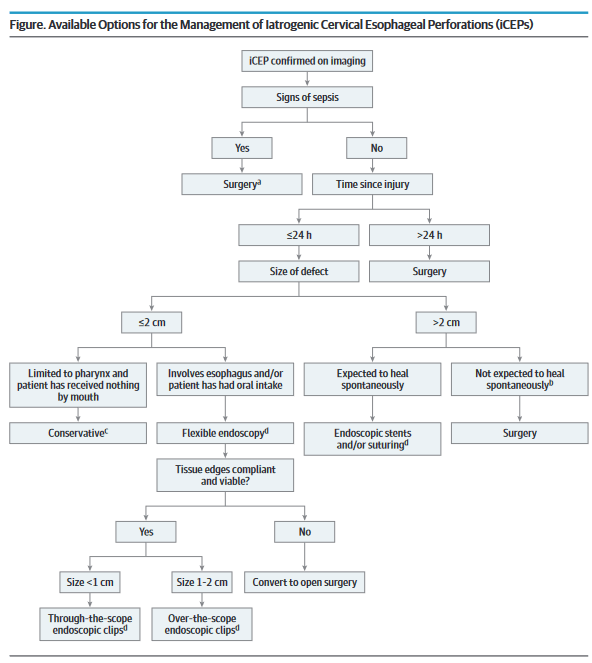
Management of Iatrogenic Cervical Esophageal Perforations

“Esophageal perforations are difficult to diagnose and have a high mortality rate. The existing studies on esophageal perforations address treatment by anatomic location and by cause, but few focus specifically on iCEPs. The management of iCEPs is controversial. There is a need for additional prospective studies comparing treatment options for iCEPs to establish a gold standard treatment and to assess for the expanding role of endoscopic interventions.” (Chen)

(Chen)
Continue reading

Salvage rate of infected prosthetic mesh

“Mesh properties and position within the abdominal wall are the primary determinants in the ability to salvage mesh in the event of PMI. Mesh placed in an intraperitoneal position is rarely salvageable. Similarly, microporous, multifilament, and composite mesh constructs required complete mesh removal in most cases. However, macroporous, monofilament PP mesh in an extraperitoneal position can be salvaged in 72.2% of cases, positively impacting both the need for reoperation for mesh removal and subsequent hernia
recurrence.” (Warren)

Continue reading

Antibiotic irrigation for decreasing the incidence of infection from ventral hernia repair.

“Surgical site infections (SSI) are common complications after open ventral hernia repair (OVHR), potentially requiring further intervention. Incidence of surgical site occurrence was significantly lower after G 1 C irrigation (Grp 1, 28.1%; Grp 2, 35.4%; Grp 3, 19.7%; P < 0.001). Incidence of SSI was significantly lower after G 1 C irrigation, but not G
alone (Grp 1, 16.5%; Grp 2, 15.2%; and Grp 3, 5.4%; P < 0.001). Multivariate logistic regression demonstrated significantly increased SSI with contaminated wounds (OR 2.96; 95% confidence interval (CI) 1.39–6.21), dirty wounds (OR 3.84; 95% CI 1.49–9.69), and chronic obstructive pulmonary disease (OR 3.70; 95% CI 2.16–6.38), as expected. Use of G 1 C was an independent predictor of decreased SSI (OR 0.33; 95% CI 0.16–0.67). Irrigation with a combined G 1 C antibiotic irrigation significantly reduces the incidence of surgical site infection after OVHR with mesh.” (Fatula)

Continue reading