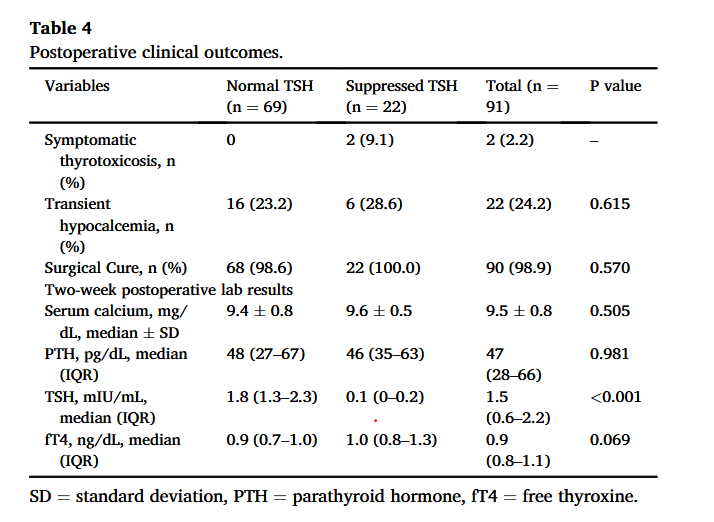
Retracting the thyroid matters: Who develops asymptomatic transient thyrotoxicosis after parathyroidectomy

“Thyrotoxicosis has been reported as a postoperative complication of parathyroidectomy
(PTx), attributed to palpation thyroiditis. Palpation thyroiditis was first described by Carney et al., in 1975 as a pathologic response to the traumatic injury of thyroid follicles, characterized by multifocal granulomatous folliculitis. The existing cohort studies in post-PTx thyrotoxicosis are limited. A prospective study of patients who underwent PTx for primary and secondary HPT reported that the incidence rate of thyrotoxicosis after PTx was 31.2 % and 77 %, respectively. The clinical significance of post-PTx thyrotoxicosis remains controversial. While
various manifestations of thyrotoxicosis, including tremors, palpitations, new-onset atrial fibrillation, and angina pectoris mimicking myocardial infarction, were described by case reports, Stang et al. in a cohort study reported that only 15 % of patients developed symptoms of thyrotoxicosis 1–2 weeks after the operation. They further concluded
that the degree of neck dissection appeared explanatory but did not specify which maneuvers were contributory.”
Continue reading

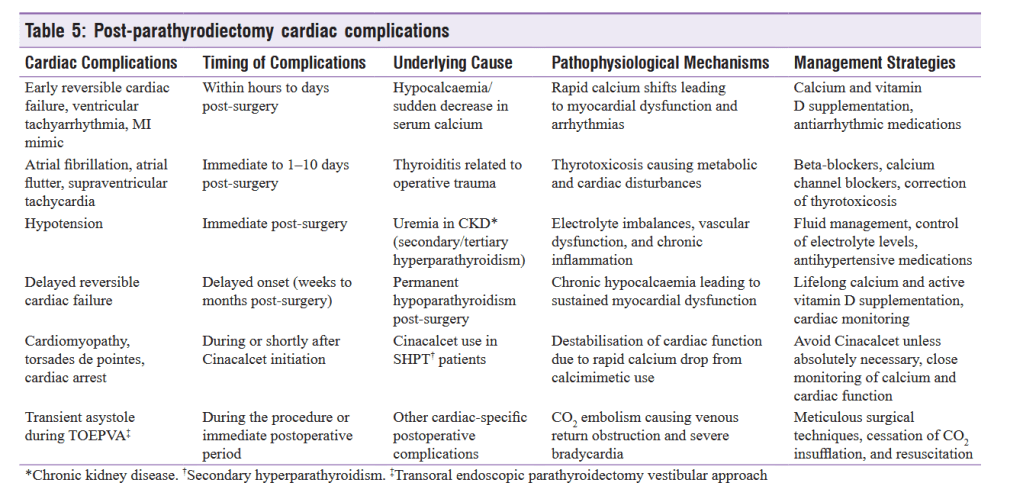
Cardiac Complications Post Parathyroidectomy

“Parathyroidectomy (PTX) is primarily performed to treat primary and secondary hyperparathyroidism (HPT) and has been shown to reduce cardiac risk factors, including ECG abnormalities, 2D-echo abnormalities, arrhythmias, and NT-proBNP levels Cardiac complications, though rare, can occur in patients undergoing thyroidectomy. In a US-based cohort of 3,575 patients, approximately 0.2%–0.3% developed congestive heart failure (CHF) during follow-up. A study by Kravietz et al. found that while readmission rates were lower in primary HPT (PHPT) patients (5.6%) compared to secondary HPT (SHPT) patients (19.4%), heart failure was more prevalent in PHPT patients (10.8%) compared to SHPT patients (3.9%). Additionally, patients with existing CHF undergoing PTX have a higher likelihood of readmission. Although cardiac complications are rare, they can occasionally be fatal.”

Continue reading

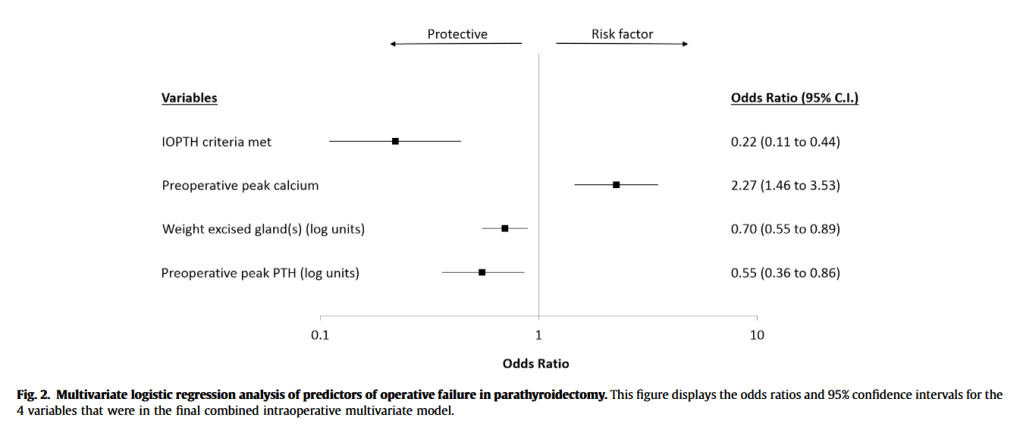
Predictors of operative failure in parathyroidectomy for primary hyperparathyroidism

“Little is known about patient-level predictors of operative failure and persistent primary hyperparathyroidism (PHPT). Previous studies have attributed operative failure to inadequate preoperative imaging localization. Achievement of IOPTH criteria is a known predictor of operative success, though the final target IOPTH level is not agreed upon. Some researchers contend that final IOPTH levels should fall into the normal range, while others recommend lower levels. The independent contributions of preoperative localization, IOPTH biochemical cure, and preoperative biochemical severity to operative success are unclear. Better understanding of the relationship.”

Continue reading

Risk factors for postoperative cervical haematoma in patients undergoing thyroidectomy (REDHOT)

“In endocrine surgery, thyroidectomy is the most frequently performed surgical procedure.
Morbidity related to thyroidectomy is mainly represented by hypoparathyroidism, recurrent laryngeal nerve injury, and cervical haematoma. These complications can occur at a
considerable rate even if thyroid surgery is performed by highly experienced surgeons.
Obtaining accurate haemostasis during thyroidectomy is crucial to prevent the occurrence of postoperative bleeding and, allowing adequate vision of the anatomical structures, is also important to avert the onset of the other complications.”

Continue reading

Permanent Hypoparathyroidism After Thyroidectomy

“Hypoparathyroidism (HP) is a recognized but serious complication of thyroidectomy. Conventional techniques for parathyroid autograft (PA) occur with the insertion of parathyroid slices in muscle pockets and have a published incidence of HP of 4%–8%. The purpose of this study was to analyze the incidence of HP after thyroidectomy at our center, where we have used a modified technique for PA.”

Continue reading

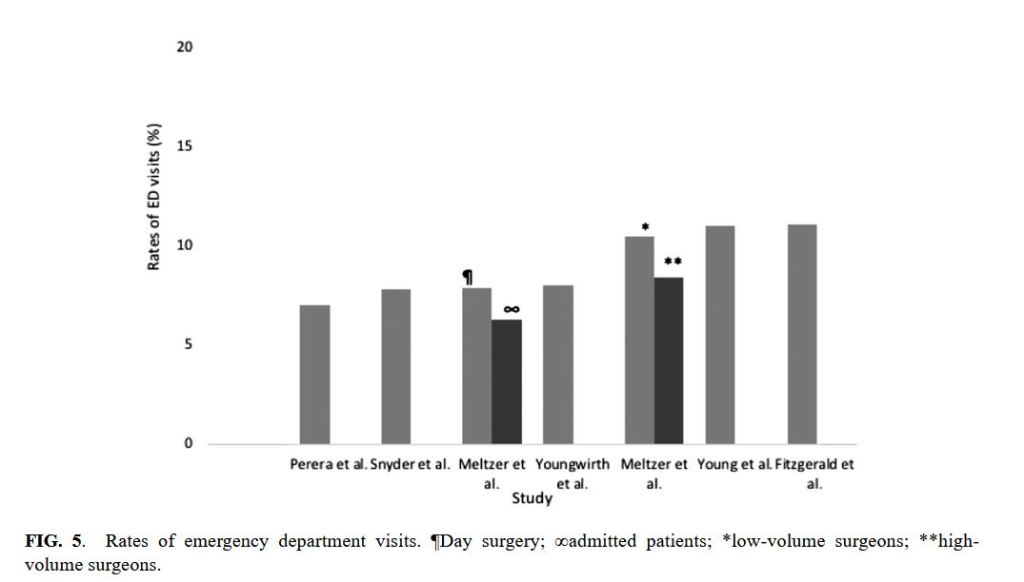
Unplanned Reoperations, Emergency Department Visits and Hospital Readmission After Thyroidectomy

“Emergency Department visits and hospital readmission after thyroidectomy are common, and there are several practices that can reduce their occurrence. Routine postoperative calcium and vitamin D supplementation may reduce rates of postoperative hypocalcemia, and avoiding postoperative hypertension may decrease the risk of neck hematoma development and the need for reoperation. Older age, thyroid cancer, dependent functional status, higher ASA score, diabetes, chronic obstructive pulmonary disease, steroid use, hemodialysis, and recent weight loss increase the risk of hospital readmission after thyroid surgery. By further identifying risk factors for reoperation, ED visits, and readmission, this review may assist practitioners in optimizing perioperative care and therefore reducing patient morbidity and mortality after thyroid operations.”

Continue reading

Direct Anastomosis of Recurrent Laryngeal Nerves Injured During Thyroidectomy

“Recurrent laryngeal nerve (RLN) paralysis is the most common and significant complication of thyroid or parathyroid cancer surgery. Unilateral RLN paralysis is often due to the adhesions that accompany thyroid cancer. Even with no signs of paralysis preoperatively, a cancerous thyroid gland may be found firmly adherent to RLN intraoperatively, in which case a segment of RLN must be sacrificed for the sake of cancer eradication.””Recurrent laryngeal nerve (RLN) paralysis is the most common and significant complication of thyroid or parathyroid cancer surgery. Unilateral RLN paralysis is often due to the adhesions that accompany thyroid cancer. Even with no signs of paralysis preoperatively, a cancerous thyroid gland may be found firmly adherent to RLN intraoperatively, in which case a segment of RLN must be sacrificed for the sake of cancer eradication.”

Continue reading