Clinical Practice Guidelines for Preventing Surgical Site Infection

“A surgical site infection (SSI) is defined as an infection of the incision (superficial SSI), the
tissue below the incision (deep SSI), or within the abdominal cavity (organ space SSI). SSI
accounts for more than 20% of all health care-associated infections and is the most common
infection after surgery, affecting an estimated 300,000 patients annually. Compared with
other surgical subspecialties, patients undergoing colorectal surgery are at the highest risk
for developing an SSI with an estimated incidence of 5% to 30%. Patients undergoing
emergency colorectal surgery with colon perforation have an SSI incidence as high as 80%.”

TABLE 2.

Summary and strength of GRADE recommendations for preventing SSIs

SummaryRecommendation
strength
GRADE quality
of evidence
1Implementing an SSI bundle for patients undergoing colorectal surgery can decrease the incidence of SSIStrongModerate
2Oral antibiotics in combination with mechanical bowel preparation have been shown to decrease the incidence of SSI after elective colorectal resectionStrongModerate
3In circumstances where a mechanical bowel preparation is contraindicated or otherwise omitted, preoperative oral antibiotic preparation alone can reduce the incidence of SSIConditionalModerate
4Showering with chlorhexidine before colorectal surgery does not significantly impact SSI ratesStrongModerate
5Smoking cessation before surgery may be recommended to reduce the risk of SSIConditionalModerate
6On the day of colorectal surgery, patients should have their hair removed from the surgical site using a clipper or not removed at all. Shaving with a razor before surgery is discouragedStrongModerate
7Patients undergoing colorectal resection should have parenteral antibiotics administered within 60 min of incision. Dosing and redosing should be based on the pharmacokinetic profile of the antibioticStrongLow
8Patients who report a penicillin allergy may be evaluated for having true hypersensitivity and high-risk reactions to penicillin. Delabeling a penicillin-allergic patient can facilitate the appropriate use of a preoperative prophylactic beta-lactam antibiotic and improve outcomesConditionalLow
9For most clean and clean-contaminated cases, prophylactic parenteral antibiotics should be limited to the initial 24 h postoperativelyStrongModerate
10Cleansing the surgical site with chlorhexidine–alcohol-based preparation is typically recommended for patients undergoing colorectal surgeryStrongModerate
11Hyperglycemia on the day of surgery and in the immediate postoperative period may increase the risk of SSI after elective colorectal resectionConditionalModerate
12Maintaining intraoperative normothermia may decrease the incidence of SSI in patients undergoing colorectal surgeryConditionalLow
13High-fractionated oxygen is not routinely recommended to prevent SSIConditionalModerate
14Wound protectors can decrease the incidence of SSI after colorectal surgeryStrongHigh
15Minimally invasive colorectal surgery can decrease the incidence of SSI compared to open surgeryStrongHigh
16Topical antimicrobial agents applied to the surgical incision are not recommendedStrongLow
17NPWT for primarily closed incisions may decrease the incidence of SSIConditionalModerate
18Advanced silver or antimicrobial dressings are not routinely recommended for clean or clean-contaminated wounds after colorectal surgeryConditionalModerate

GRADE = Grading of Recommendations, Assessments, Development, and Evaluation; NPWT = Negative pressure wound therapy; SSI = surgical site infection.

Continue reading
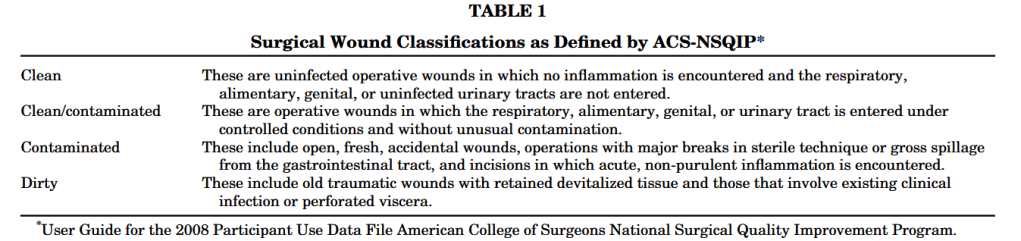
Evaluation of Surgical Site Infections by Wound ClassificationSystem Using the ACS-NSQIP

“The wound classification system is an important predictor of postoperative outcomes. Recent studies have focused on elements such as preoperative risk factors and co-morbidities, operative time, prophylactic antibiotic use, and the American Society of Anesthesiology (ASA) physical status score, along with wound classification to predict postoperative surgical outcomes”

Continue reading

Timing and type of surgical treatment of Clostridium difficile associated disease

“Findings in the literature suggest that prompt surgical treatment of patients with fulminant Clostridium difficile-associated disease (CDAD) is necessary to ensure patient survival. However, controversy remains regarding the best surgical approach and timing. Recent efforts have been made in the creation of a scoring system to predict deterioration and improve patient care. New surgical approaches such as ileostomy and washout have shown promising results, but more rigorous data and longer follow-up, especially with regard to
disease recurrence after ileostomy reversal, are needed to evaluate the true value of these techniques regarding mortality.”

Continue reading

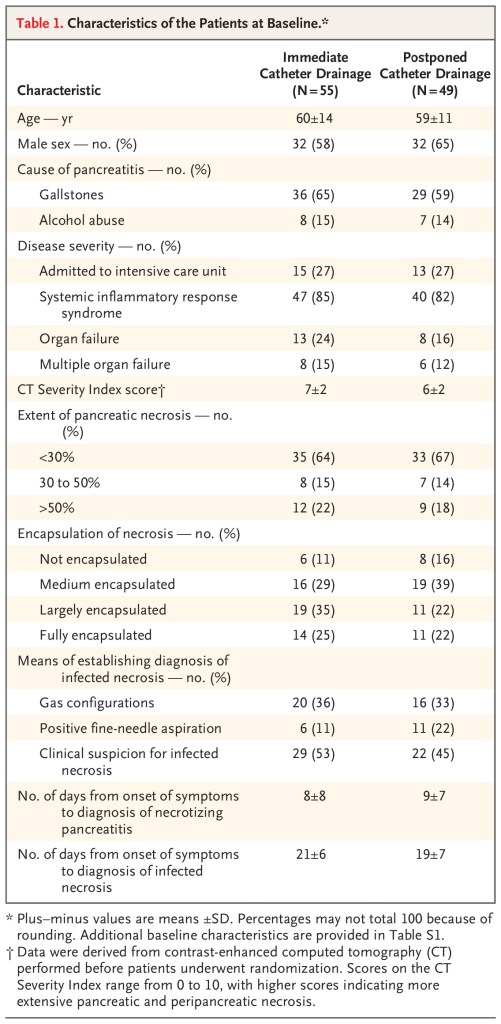
Immediate versus Postponed Intervention for Infected Necrotizing Pancreatitis

“Acute pancreatitis is the most common pancreatic disease worldwide. Necrotizing pancreatitis develops in approximately 20 to 30% of patients with acute pancreatitis. Pancreatic and peripancreatic necrosis that becomes infected nearly always leads
to invasive intervention. The current standard approach for infected necrotizing pancreatitis is a minimally invasive step-up approach with catheter drainage as the first step. International guidelines advise postponement of catheter drainage and administration of antibiotics until the infected pancreatic and peripancreatic necrosis has become encapsulated; such walled-off necrosis usually takes 4 weeks to develop.”

Continue reading

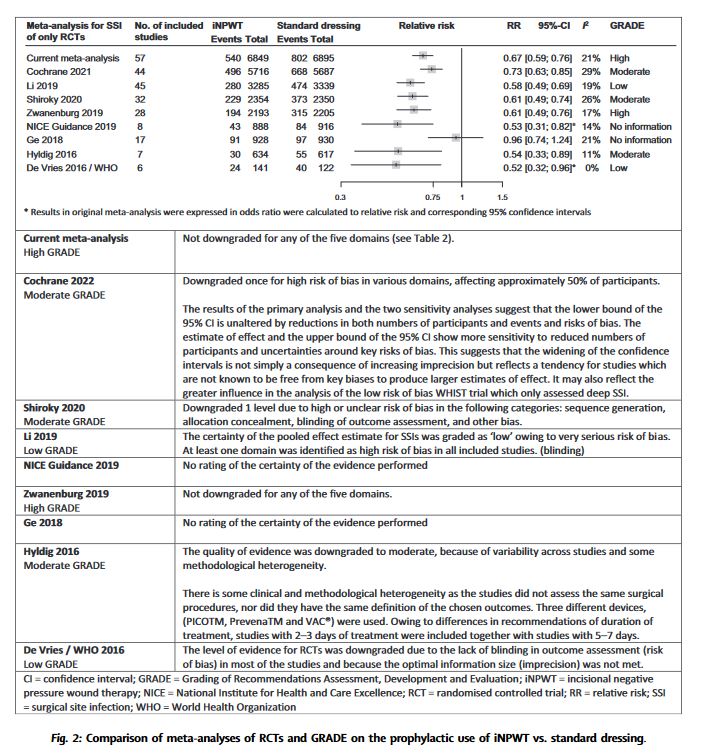
Incisional negative pressure wound therapy for the prevention of surgical site infection

“The evidence on prophylactic use of negative pressure wound therapy on primary closed incisional wounds (iNPWT) for the prevention of surgical site infections (SSI) is confusing and ambiguous. Implementation in daily practice is impaired by inconsistent recommendations in current international guidelines and published meta-analyses. More recently, multiple new randomised controlled trials (RCTs) have been published. This study aimed to provide an overview of all meta-analyses and their characteristics; to conduct a new and up-to-date systematic review and meta-analysis and Grading of Recommendations Assessment, Development and Evaluation (GRADE) assessment; and to explore the additive value of new RCTs with a trial sequential analysis (TSA).”

Continue reading

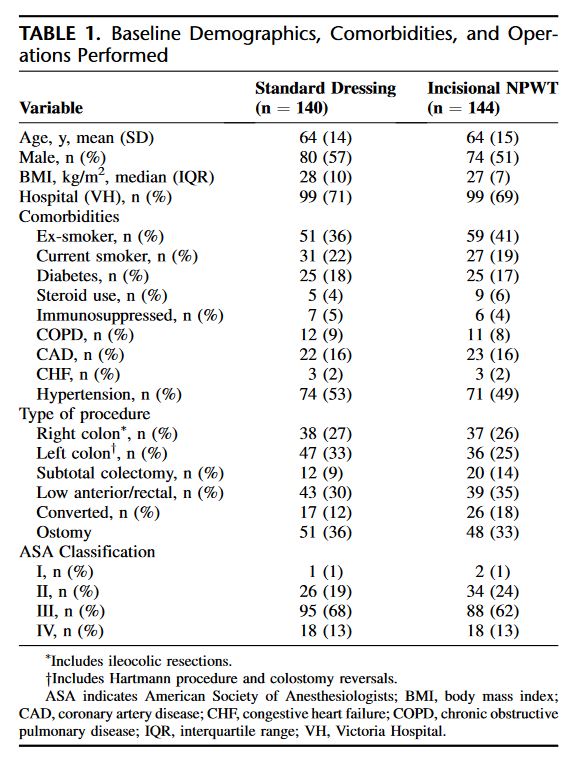
Negative Pressure Wound Therapy Use to Decrease Surgical Nosocomial Events in Colorectal Resections

“Surgical site infection (SSI) is one of the most common complications following open colon and rectal surgery. Significant morbidity—secondary to increased length of stay, delay in adjuvant treatments, and psychosocial effects—has been well established in the literature. Further, SSIs confer additional monetary costs to the healthcare system.6 Despite best practice recommendations including prophylactic antibiotics and aseptic technique, SSIs remain common in open colorectal surgery. Rates of SSI in the literature range between 15
and 30%. Increased use of laparoscopy in colorectal surgery has significantly impacted rates of SSI but the uptake of laparoscopy has not been complete as certain patients are not candidates and conversion to open is required in approximately 15% of cases.”

Continue reading

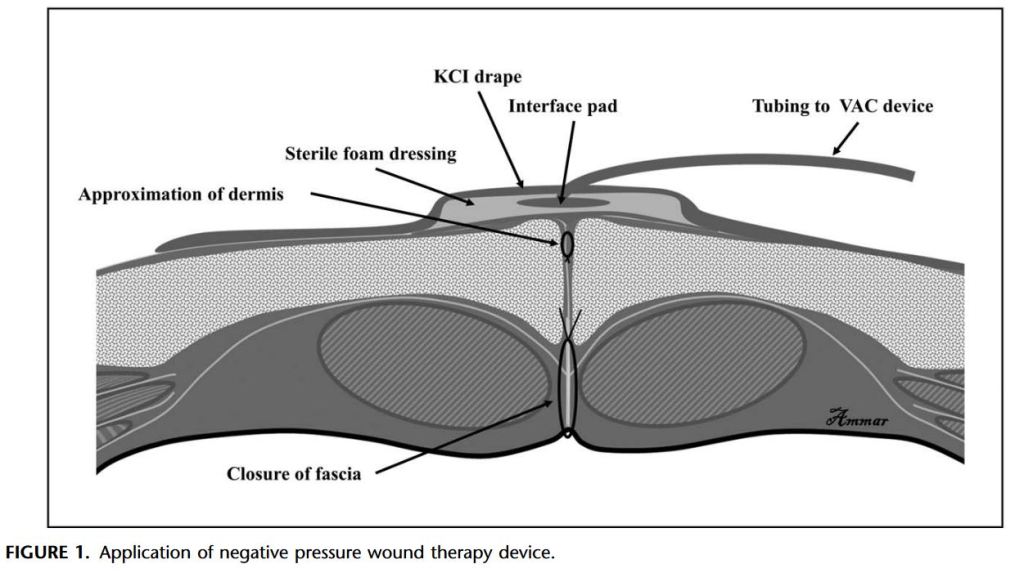
Negative Pressure Wound Therapy for Surgical-site Infection

“Despite improvement in infection control, SSIs remain a common cause of morbidity after abdominal surgery. SSI has been associated with an increased risk of reoperation, prolonged hospitalization, readmission, and higher costs. Recent retrospective studies have suggested that the use of negative pressure wound therapy can potentially prevent this complication.”

Continue reading