
Open vs endovascular revascularization for acute limb ischemia: a review of major trials

One discussion this week involved open surgical versus endovascular revascularization for acute limb ischemia (ALI).


Reference: Wang JC, Kim AH, Kashyap VS. Open surgical or endovascular revascularization for acute limb ischemia. Journal of Vascular Surgery. 2016 Jan;63(1):270-278. doi:10/1016/j.jvs.2015.09.055.

Summary: Peripheral arterial disease affects approximately 10 million Americans. It can lead to lower extremity ischemic rest pain or tissue loss (Rutherford classification 4 to 6, or Fontaine classification III and IV). Acute limb ischemia (ALI) is defined as the presence of symptoms within 2 weeks of onset. ALI pathogenesis includes vascular stenoses with subsequent in situ thrombosis or thromboembolism from a cardiac or aortoiliac source. Stenotic lesions may indicate untreated comorbidities (eg, hypertension, hypercholesterolemia, diabetes, or tobacco use), whereas thromboembolisms implicate undiagnosed cardiac arrhythmias, myocardial infarction (MI), or mural thrombus. Limb loss risk due to ALI can be as high as 40% with an attendant mortality rate of 15% to 20% (p.270).

Continue reading

What is the risk of rupture for type II endoleaks?

One discussion last week included the risk of rupture with type II endoleaks.

Reference: Brown A, et al. Type II endoleaks: challenges and solutions. Vascular Health Risk Management. 2016;12:53-63.

Summary:  Although type II endoleak appears to be associated with sac expansion (volume changes), the significance of this expansion on risk of aneurysm rupture remains unclear.

Wyss et al found a significant association between sac expansion and rupture.Twenty-seven ruptures occurred in an EVAR population of 848 patients, with an average follow-up of 4.8 years. Sixty-three percent of these ruptures occurred more than 30 days post-repair and were associated with prior complications detected on follow-up imaging. Five of these 17 ruptures demonstrated evidence of type II endoleak with associated sac expansion (four were isolated type II endoleaks and one was associated with a concomitant type Ib endoleak).

Conversely, other authors have shown no correlation. Van Marrewijk et al demonstrated that sac expansion was significantly associated with type II endoleaks; however, there was no correlation with rupture or increase in aneurysm-associated mortality. A recent systematic review reported a low incidence of rupture in patients with isolated type II endoleaks (under 1%) of which 57% were associated with sac expansion.

Sac expansion may therefore be a poor marker of risk in this population of patients; however, we do not currently have a more sensitive way of monitoring risk of rupture. As such, some authors suggest that consideration should be given to prevention of/or treatment for type II endoleak.

Outcomes of and predictors for bowel ischemia after AAA repair: a study of 7312 patients

One discussion this week included AAA repair. The article cited here was provided by the chief resident.

Reference: Ultee KH, et al. Incidence of and risk factors for bowel ischemia after abdominal aortic aneurysm repair. Journal of Vascular Surgery. 2016 Nov;64(5):1384-1391. doi: 10.1016/j.jvs.2016.05.045.

Summary: Bowel ischemia is a rare but devastating complication after abdominal aortic aneurysm (AAA) repair. Its rarity has prohibited extensive risk-factor analysis, particularly since the widespread adoption of endovascular AAA repair (EVAR); therefore, this study assessed the incidence of postoperative bowel ischemia after AAA repair in the endovascular era and identified risk factors for its occurrence

METHODS: A total of 7312 patients undergoing intact or ruptured AAA repair in the Vascular Study Group of New England (VSGNE) January 2003 – November 2014 were included. Patients with and without postoperative bowel ischemia were compared and stratified by indication (intact and ruptured) and treatment approach (open repair and EVAR). Criteria for diagnosis were endoscopic or clinical evidence of ischemia, including bloody stools, in patients who died before diagnostic procedures were performed. Independent predictors of postoperative bowel ischemia were established using multivariable logistic regression analysis.

RESULTS: Postoperative outcomes (p.1389):

AAA repair

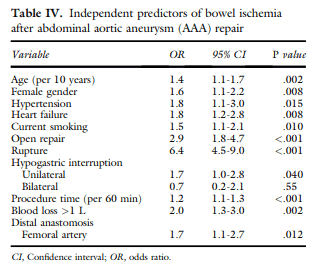
RESULTS: Predictors of bowel ischemia after AAA repair (p.1390):

AAA predictors

CONCLUSIONS: The authors state that “these date should be considered during operative planning in an effort to adequately assess patient risk for bowel ischemia and undertake efforts to reduce it” (p.1391).

Chemical VTE prophylaxis after cardiovascular surgery: how soon is too soon?

One discussion this week involved how soon after cardiovascular surgery to restart VTE prophylaxis heparin.

Reference: Ho KM, Bham E, Pavey W. Incidence of venous thromboembolism and benefits and risks of thromboprophylaxis after cardiac surgery: A systematic review and meta-analysis. Journal of the American Heart Association. 2015 Oct 26;4(10):e002652. doi: 10.1161/JAHA.115.002652.

Summary: A systematic review and meta-analysis (Ho et al, 2015) found no evidence to support the notion that use of low-dose UFH or LMWH for VTE prophylaxis would increase risk of cardiac tamponade, pericardial effusion, or bleeding after cardiac surgery. Though these complications are not rare after surgery, whether low-dose UFH or LMWH would substantially increase such risks remains scientifically unproven (p.21).

Bleeding after cardiac surgery is mainly related to systemic overanticoagulation or concurrent use of systemic anticoagulation and platelet agents. The AHA document concludes that, unless proven otherwise by adequately powered RCTs, initiating low-dose UFH or LMWH as soon as possible or on postoperative day 1 after cardiac surgery for patients who have no active bleeding is highly recommended, especially if they have multiple risk factors for VTE.

Additional Reading: Agnelli G. Prevention of venous thromboembolism in surgical patients. Circulation. 2004;110(24, supp1):IV-4-IV-12. doi: 10.1161/01.CIR.0000150639.98514.6c


Bloodstream infection rates: PICC vs CVC

One discussion this week involved the comparison of bloodstream infection rates with PICCs vs CVCs.

Reference: Chopra V, et al. The risk of bloodstream infection associated with peripherally inserted central catheters compared with central venous catheters in adults: a systematic review and meta-analysisInfection Control and Hospital Epidemiology. 2013 Sep;34(9):908-918. doi:10.1086/671737.

Summary: In 23 studies involving 57,250 patients, pooled meta-analyses revealed that PICCs were associated with a lower risk of central line-associated bloodstream infection (CLABSI) than were CVCs. A subgroup analysis further showed that CLABSI reduction was greatest in outpatients (RR [95% CI], 0.22 [0.18-0.27]) compared with hospitalized patients who received PICCs (RR [95% CI], 0.73 [0.54-0.98]).

The authors conclude that although PICCs are associated with a lower risk of CLABSI than CVCs in outpatients, hospitalized patients may be just as likely to experience CLABSI with PICCs as with CVCs. Consideration of risks and benefits before PICC use in inpatient settings is warranted.

AHA Guidelines on post-cardiac stent operations: post-stent dual antiplatelet therapy (DAPT)

One discussion last week included the AHA guidelines on post-stent DAPT.

Reference: Levine GN, et al. ACC/AHA Guideline Update on Duration of Dual Antiplatelet Therapy in CAD Patients. American College of Cardiology. Retrieved from https://www.acc.org/latest-in-cardiology/ten-points-to-remember/2016/03/25/14/56/2016-acc-aha-guideline-focused-update-on-duration-of-dapt.

Additional Reading: Capodanno D, et al. ACC/AHA versus ESC guidelines on dual antiplatelet therapy: JACC guideline comparison. Journal of the American College of Cardiology. 2018 Dec 11;72(23 Part A):2915-2931.  doi: 10.1016/j.jacc.2018.09.057.

Summary: Published on the website in March 2016, the following are “key points to remember about the updated guideline on duration of dual antiplatelet therapy (DAPT) in patients with coronary artery disease (CAD)”.

  1. The scope of this focused update is limited to addressing recommendations on duration of DAPT (aspirin plus a P2Y12 inhibitor) in patients with coronary artery disease (CAD).
  2. Intensification of antiplatelet therapy, with the addition of a P2Y12 inhibitor to aspirin monotherapy, and prolongation of DAPT, necessitate a fundamental tradeoff between decreasing ischemic risk and increasing bleeding risk. Decisions regarding treatment with and duration of DAPT require a thoughtful assessment of the benefit/risk ratio, integration of study data, and patient preference.
  3. Recommendations in the document apply specifically to duration of P2Y12 inhibitor therapy in patients with CAD treated with DAPT. Aspirin therapy should almost always be continued indefinitely in patients with CAD.
  4. Lower daily doses of aspirin, including in patients treated with DAPT, are associated with lower bleeding complications and comparable ischemic protection compared with higher doses of aspirin. The recommended daily dose of aspirin in patients treated with DAPT is 81 mg (range 75–100 mg).
  5. In patients with stable ischemic heart disease (SIHD) treated with DAPT after drug-eluting stent (DES) implantation, P2Y12 inhibitor therapy with clopidogrel should be given for at least 6 months (Class I). In patients with SIHD treated with DAPT after bare-metal stent (BMS) implantation, P2Y12 inhibitor therapy (clopidogrel) should be given for a minimum of 1 month (Class I).
  6. In patients with SIHD treated with DAPT after BMS or DES implantation who have tolerated DAPT without a bleeding complication and who are not at high bleeding risk (e.g., prior bleeding on DAPT, coagulopathy, oral anticoagulant use), continuation of DAPT with clopidogrel for longer than 1 month in patients treated with BMS or longer than 6 months in patients treated with DES may be reasonable (Class IIb).
  7. In patients with acute coronary syndrome (ACS) (non-ST elevation [NSTE]-ACS or ST elevation myocardial infarction [STEMI]) treated with DAPT after BMS or DES implantation, P2Y12 inhibitor therapy (clopidogrel, prasugrel, or ticagrelor) should be given for at least 12 months (Class I).
  8. In patients with ACS (NSTE-ACS or STEMI) treated with coronary stent implantation who have tolerated DAPT without a bleeding complication and who are not at high bleeding risk (e.g., prior bleeding on DAPT, coagulopathy, oral anticoagulant use), continuation of DAPT (clopidogrel, prasugrel, or ticagrelor) for longer than 12 months may be reasonable (Class IIb). A new risk score (the “DAPT score”), derived from the Dual Antiplatelet Therapy study, may be useful for decisions about whether to continue (prolong or extend) DAPT in patients treated with coronary stent implantation.
  9. In patients with ACS (NSTE-ACS or STEMI) treated with DAPT after coronary stent implantation and in patients with NSTE-ACS treated with medical therapy alone (without revascularization), it is reasonable to use ticagrelor in preference to clopidogrel for maintenance P2Y12 inhibitor therapy (Class IIa). Among those who are not at high risk for bleeding complications and who do not have a history of stroke or transient ischemic attack, it is reasonable to choose prasugrel over clopidogrel for maintenance P2Y12 inhibitor therapy (Class IIa).
  10. In patients with ACS (NSTE-ACS or STEMI) being treated with DAPT who undergo coronary artery bypass grafting (CABG), P2Y12 inhibitor therapy should be resumed after CABG to complete 12 months of DAPT therapy after ACS (Class I).
  11. In patients with STEMI treated with DAPT in conjunction with fibrinolytic therapy, P2Y12inhibitor therapy (clopidogrel) should be continued for a minimum of 14 days and ideally at least 12 months (Class I).
  12. Elective noncardiac surgery should be delayed 30 days after BMS implantation and optimally 6 months after DES implantation. In patients treated with DAPT after coronary stent implantation who must undergo surgical procedures that mandate the discontinuation of P2Y12 inhibitor therapy, it is recommended that aspirin be continued if possible and the P2Y12 platelet receptor inhibitor be restarted as soon as possible after surgery (Class I).

(Levine et al, 2016)


AHA Guidelines on post-cardiac stent operations: Perioperative risk assessment

A discussion last week included the AHA Guidelines for post-cardiac stent operations.

Reference: Fleisher LA, et al. 2014 ACC/AHA Guideline on Perioperative Cardiovascular Evaluation and Management of Patients Undergoing Noncardiac Surgery: Executive Summary: A Report of the American College of Cardiology/American Heart Association Task Force on Practice Guidelines. Circulation. 2014 Dec 9;130(24):2215-45. doi: 10.1161/CIR.0000000000000105.

Summary: Below are ACC/AHA recommendations on perioperative risk assessment, section 5.2 of the guidelines linked above.

5.2. Timing of Elective Noncardiac Surgery in Patients With Previous PCI

Class I

  1. Elective noncardiac surgery should be delayed 14 days after balloon angioplasty (Level of Evidence: C) and 30 days after BMS implantation. (Level of Evidence B)

  2. Elective noncardiac surgery should optimally be delayed 365 days after drug-eluting stent (DES) implantation.(Level of Evidence: B)

Class IIa

  1. In patients in whom noncardiac surgery is required, a consensus decision among treating clinicians as to the relative risks of surgery and discontinuation or continuation of antiplatelet therapy can be useful. (Level of Evidence: C)

Class IIb

  1. Elective noncardiac surgery after DES implantation may be considered after 180 days if the risk of further delay is greater than the expected risks of ischemia and stent thrombosis. (Level of Evidence: B)

Class III: Harm

  1. Elective noncardiac surgery should not be performed within 30 days after BMS implantation or within 12 months after DES implantation in patients in whom dual antiplatelet therapy will need to be discontinued perioperatively. (Level of Evidence: B)

  2. Elective noncardiac surgery should not be performed within 14 days of balloon angioplasty in patients in whom aspirin will need to be discontinued perioperatively. (Level of Evidence: C)