Mesh Suture and Mesh Strips to Prevent Incisional Hernia Following Abdominal Wall Closure or Ventral Hernia Repair

“Incisional hernias are an increasingly common complication encountered by surgeons and their patients, as survival rates from major abdominal surgery continue to improve. The
incidence of incisional hernia after midline laparotomy is estimated to be 9%–20% after 1 year, resulting in approximately 8000 UK repairs annually. While patient factors such as obesity, smoking and diabetes certainly contribute, excessive suture tension during the critical wound healing period causes local ischaemia at the suture-tissue interface and may initiate incisional hernia. Subsequent suture “cheese-wiring” through fascia creates small linear defects that enlarge over time with repeated abdominal wall straining. The clinical
and economic implications of incisional hernia have precipitated preventative research, including Jenkins rule, small-bite closure, and prophylactic mesh implantation which are
discussed in recent high-profile international guidelines. However, many surgeons continue to adopt suture closure over prophylactic planar mesh since this prolongs surgery and risks
infection in a contaminated field.”

Nip, Lawrence et al. “Mesh Suture and Mesh Strips to Prevent Incisional Hernia Following Abdominal Wall Closure or Ventral Hernia Repair: Systematic Review.” Journal of abdominal wall surgery : JAWS vol. 4 14573. 14 May. 2025 Free Full Text

Prevention of Parastomal Hernia

“Parastomal hernia, defined as an incisional hernia at the abdominal wall defect resulting from stoma formation, is a frequent complication of enterostomy (ileostomy and jejunostomy), colostomy, and urostomy. A growing body of evidence supports the use of prophylactic mesh at the time of stoma creation to prevent the development of PSH. In particular, the use of permanent mesh has been supported in the creation of an end colostomy, and prophylactic mesh has been studied for use in other types of stoma.”

Continue reading

Laparoscopic mesh versus suture repair of hiatus hernia

“Hiatus hernia contributes to the pathophysiology of gastroesophageal reflux disease (GERD). Mesh-augmentation of surgical repair might be associated with a reduced risk of recurrence and GERD. However, recurrence rates, mesh-associated complications and quality of life after mesh versus suture repair are debated. The aim of this meta-analysis was to determine HH recurrence following mesh-augmentation versus suture repair.”

Continue reading

Mesh placement in ventral hernia repair

Abdominal wall reconstruction is a relevant and important topic not only in plastic and reconstructive surgery, but in the practice of general surgeons. The ideal anatomic location for mesh placement during the repair of ventral hernias has been debated; however, the most common anatomic locations include onlay, inlay, sublay-retromuscular, sublaypreperitoneal, and sublay-intraperitoneal techniques (Alimi)

(Alimi)
Continue reading

Mesh sutured repairs of the abdominal wall

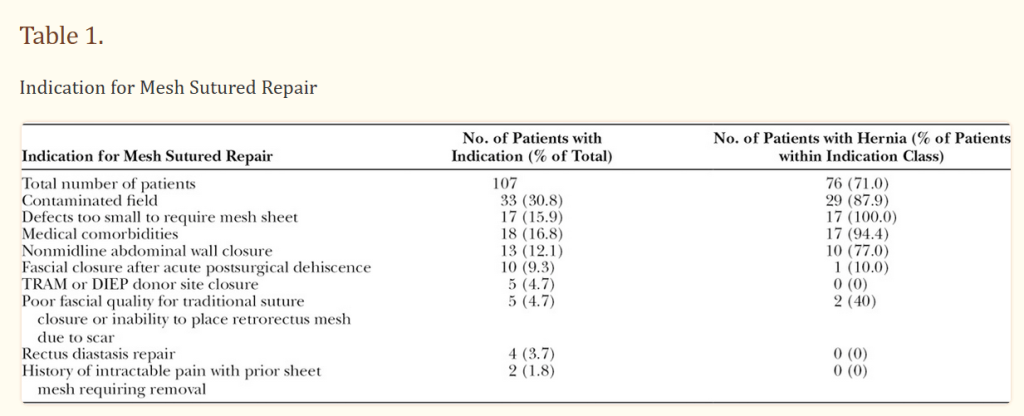
“All high-tension internal surgical closures require that the ultimate tensile strength (UTS) of the repair remains greater than the forces applied. Otherwise, changes at the suture/tissue interface (STI) will lead to acute or chronic suture pull-through and surgical failure. For the abdominal wall, prophylactic flat meshes have been shown to improve outcomes of laparotomy closures and hernia repairs. Unfortunately, flat planar meshes have their own drawbacks, including increased time for placement, increased foreign material, increased tissue dissection, pain, infection, and cost.”

“One hundred and seven patients underwent a mesh sutured abdominal wall closure. Seventy-six patients had preoperative hernias, and the mean hernia width by CT scan for those with scans was 9.1 cm. Forty-nine surgical fields were clean-contaminated, contaminated, or dirty. Five patients had infections within the first 30 days. Only one knot was removed as an office procedure. Mean follow-up at 234 days revealed 4 recurrent hernias.”

Lanier, S. T., et al (2016). Mesh Sutured Repairs of Abdominal Wall Defects. Plastic and reconstructive surgery. Global open, 4(9), e1060. Free Full Text

Salvage rate of infected prosthetic mesh

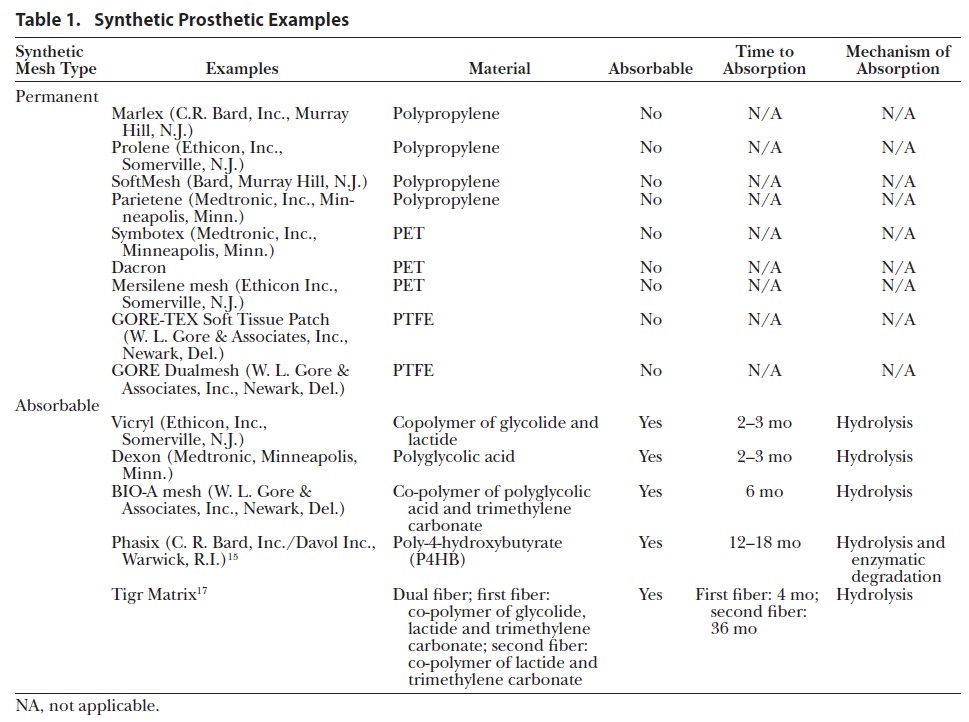
“Mesh properties and position within the abdominal wall are the primary determinants in the ability to salvage mesh in the event of PMI. Mesh placed in an intraperitoneal position is rarely salvageable. Similarly, microporous, multifilament, and composite mesh constructs required complete mesh removal in most cases. However, macroporous, monofilament PP mesh in an extraperitoneal position can be salvaged in 72.2% of cases, positively impacting both the need for reoperation for mesh removal and subsequent hernia
recurrence.” (Warren)

Continue reading