
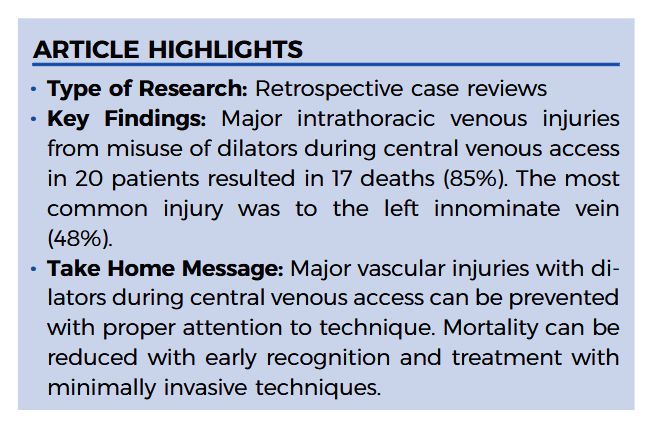
Prevention and treatment of dilator injuries during central venous catheter placement

“Accessing central veins is a common procedure that is performed in many clinical settings. Complications are not infrequent events. Local complications have been reduced by the utilization of ultrasound guidance; however, this practice does not prevent injuries to the deep, intrathoracic veins.
Major venous injuries that occur within the thorax secondary to misuse of the dilator have been reported. The majority of these reports have been anecdotal case reports. There is very little evidence to suggest that a flexible, spring-loaded guidewire could perforate a
major vein. The dilator is the only instrument that has the stiffness and point that is capable of perforating a central vein.”
Continue reading

Warren Lecture: “Understanding and Preventing Bile Duct Injury”

Dr. Steven M. Strasberg referenced the following citations during his presentation, “Understanding and Preventing Bile Duct Injury” on November 14, 2019.


Cho JY, Baron TH, Carr-Locke DL, et al. Proposed standards for reporting outcomes of treating biliary injuries. HPB (Oxford). 2018 Apr;20(4):370-378.

Strasberg SM. A three-step conceptual roadmap for avoiding bile duct injury in laparoscopic cholecystectomy: an invited perspective review. J Hepatobiliary Pancreat Sci. 2019 Apr;26(4):123-127.

Strasberg SM. Error traps and vasculo-biliary injury in laparoscopic and open  cholecystectomy. J Hepatobiliary Pancreat Surg. 2008;15(3):284-92.

Continue reading

Bile duct injuries: classification & repair

One discussion last week included classification of bile duct injuries.

Seeras K, Kalani AD. Bile Duct Repair. 2018 Nov 24. StatPearls [Internet]. Treasure Island (FL): StatPearls Publishing; 2019 Jan-.

Free full-text.

Clinical Significance: “Many major bile duct injuries will require surgical repair. There are many described techniques for complex biliary injury repairs including primary repair or primary end to end anastomosis of bile ducts, choledochoduodenostomy, and cholecystojejunostomy. The most popular surgical repair is the Roux-en-Y hepaticojejunostomy. This operation has been consistently superior to the other methods when considering long-term outcomes. There are many different techniques described to perform an RYHJ, and the operating surgeon should choose the method with which he or she is most comfortable or experienced.”

Continue reading