Mortality risk reduction associated with PTH reduction for Secondary Hyperparathyroidism

One discussion this week included parathyroid hormone (PTH) levels.


Reference: Komaba H, et al. Parathyroidectomy and survival among Japanese hemodialysis patients with secondary hyperparathyroidism. Kidney International. 2015 Aug;88(2):350-359. doi: 10.1038/ki.2015.72

Summary: In a nationwide study of 114,064 hemodialysis patients, Komaba et al asked if PTx for severe SHPT improves survival of dialysis patients.  They compared patient outcomes by PTH levels, and by those with a history of parathyroidectomy (PTx) (6,6280) and those without PTx (107,436).

fig2

(p.353)

Excess PTH is shown to increase cardiac fibrosis; elevations in serum calcium, phophorus, and PTH levels are associated with death and cardiovascular events primarily due to vascular calcification (p.350).

fig4

(p.355)

For cardiovascular death, there was a significant increase in the multivariate-adjusted HR for patients with intact PTH levels < 60 pg/ml (HR, 1.11; 95% CI, 1.02–1.20) and those with intact PTH levels >500 pg/ml (HR, 1.41; 95% CI, 1.20–1.64). In contrast, such an increased risk of mortality was not observed in patients with a history of PTx, despite the fact that these patients had severe SHPT preoperatively.

 

Metabolic effects of octreotide

One discussion this week involved the effects of octreotide.

Reference: Octreotide: a drug often used in the critical care setting but not well understood. Chest. 2013 Dec;144(6):1937-1945. doi:10.1378/chest.13-0382.

Summary: While a majority of octreotide is metabolized by the liver, 30-35% of octreotide acetate is excreted in the urine. Thus, octreotide accumulates in patients with moderate to severe renal or hepatic insufficiency.

Compared with SST-14, it exhibits 45-fold more potent inhibition of growth hormone, 11-fold more of glucagon, and 1.3-fold more insulin secretion.

octreotide

(p.1940)

Octreotide inhibits insulin secretion in the following ways (p.1943):

  • Binds to SSTR-5 present on pancreatic B islet cells, inhibiting the formation of cAMP and reducing influx of calcium into the cytoplasm, thus preventing insulin secretion.
  • Inhibition of direct phosphorylation of specific proteins required for secretion of insulin-containing vesicles.

Additional reading:  Adabala M, et al. Severe hyperkalaemia resulting from octreotide use in a haemodioalysis patient. Nephrology, Dialysis, Transplantation. 2010 Oct;25(10):3439-3442. doi:10.1093/ndt/gfq381.

Cytoreductive surgery (CRS) with hyperthermic intraperitoneal chemotherapy (HIPEC) for colorectal cancer

One discussion this week involved the PCI cutoff for CRS/HIPEC for colorectal cancers.

References: Faron M, et al. Linear relationship of Peritoneal Cancer Index and survival in patients with peritoneal metastases from colorectal cancer. Annals of Surgical Oncology. 2016 Jan;23(1):114-119. doi:10.1245/s10434-015-4627-8.

Klaver CEL, et al. Recommendations and consensus on the treatment of peritoneal metastases of colorectal origin: a systematic review of national and international guidelines. Colorectal Disease. 2017 Mar;19(3):224-236. doi:10.1111/codi.13593

Summary: A diagnosis of peritoneal metastases (PM) is generally poor, approximately 5 months if untreated; however, CRS/HIPEC has been shown to increase median survival up to 22 months (Klaver et al, 2017).

Faron et al (2016) explored the relationship between the peritoneal cancer index (PCI) and overall survival in the setting of complete cytoreductive surgery (CCRS) with hyperthermic intraperitoneal chemotherapy (HIPEC). In reviewing the literature, they found that CCRS/HIPEC is indicated for a PCI <12 and not appropriate for a PCI >17. There is an area of indecision in PCIs 12-17.

To bridge this PCI indecision gap, Faron et al (2016) recommend considering the following parameters (p.118):

  1. Presence of other site of metastases besides peritoneum
  2. General performance status and patient age, linked to morbidity and mortality
  3. Response to neoadjuvant chemotherapy, because progression of disease while receiving systemic chemotherapy reflects aggressive tumor behavior

In a systematic review of 21 guidelines, Klaver et al (2017) found a 71% consensus that CRS/HIPEC is the recommended treatment for PM. There is a need not only for additional evidence, but also an international platform for more trials on CRS/HIPEC and the overall treatment of PM (Klaver et al, 2017).

To drain or not to drain…the GRECCAR 5 randomized trial

One discussion this week focused on pelvic drains.

Reference: Denost Q, et al. To drain or not to drain infraperitoneal anastomosis after rectal excision for Cancer: The GRECCAR 5 randomized trial. Annals of Surgery. 2017 Mar;265(3):474-480. doi:10.1097/SLA.0000000000001991.

Summary: The GRECCAR 5 randomized trial sought to explore the benefit of a drain for postoperative pelvic sepsis, overall morbidity and mortality, rate of re-operation, length of stay, and rate of stoma closure at 6 months (p.474). It involved 469 patients (236 with drains, 233 without) between 2011 and 2014.

Ultimately, the trial did not find any benefit of the pelvic drain after low anterior resection for rectal cancer. Thus, the authors “recommend not using pelvic drain after rectal excision for cancer, except in case of operative bleeding or beyond TME surgery” (p.480).

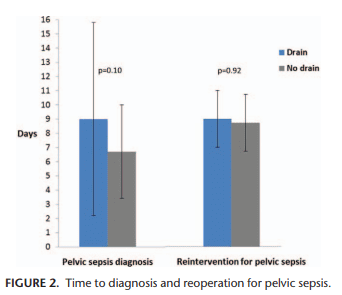
The drain did not contribute to an efficient diagnosis of sepsis, for the time to diagnosis of pelvic sepsis was an average of 7.8 days, yet the drain was removed at 5.5 days postop (see figure below; p.1478).

pelvic sepsis

There was no significant difference between the two groups for any of the noted measurements. Pelvic sepsis occurred in 16.1% of those with the drain and 18.0% of those without drain. Re-operation for pelvic sepsis was done in 10.2% of those with drain and 12.0% of those without drain.

Additional reading: Placer C. To drain or not to drain infraperitoneal anastomosis after rectal excision for cancer: an unclosed debate [Letter to the Editor]. Annals of Surgery. 2018. doi:10.1097/SLA.0000000000003005. [Epub ahead of print]

Risk of postoperative wound infections in neck dissections

One discussion this week focused on complications after neck dissections.


Reference: Man LX, Beswick DM, Johnson JT. Antibiotic prophylaxis in uncontaminated neck dissection. Laryngoscope. 2011 Jul;121(7):1473-1477. doi:10.1002/lary.21815.

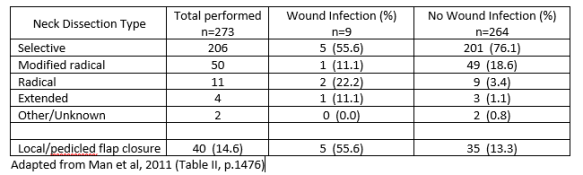
Summary: Man et al (2011) performed a retrospective chart review of 273 uncontaminated neck dissections in order to identify risk factors for postoperative wound infections and to describe the outcomes of antibiotic prophylaxis use. Only 15%

Wound infection was not associated with age, sex, tobacco and alcohol use, history of head/neck surgery, history of radiation/chemotherapy, or number of drains placed during surgery.

Wound infection was independently associated with longer operative time, local/pedicled flap closure and radical or extended neck dissection (p.1474).

Their results for risk of wound infection by type of dissection are below. All 9 wound infections occurred in those receiving intraoperative antibiotics only (4) or intra- and postoperative antiobiotics (5).

neck dissection type

Additionally, this study found that antibiotics are prescribed more frequently to older patients, possibly because they are perceived as less healthy (p.1475). Patients requiring more extensive operations are at a higher risk of postoperative infection, as are those who undergo an operation involving the re-positioning of the patient’s head thus exposing the surgical field (p.1476). The under-reporting of postoperative complications in outpatient settings may also contribute to an underestimate of wound infection.

This review was not able to confirm or support the use of antibiotic prophylaxis in uncontaminated neck dissection significantly lowers the risk of infection. Still, the authors recommend its use “for more extensive lymphadenectomy procedures including radical neck dissection, extended neck dissection, or those requiring longer operative time” (p.1477).


Improving communication during patient handoffs between the OR and ICU

One discussion this week focused on improving handoffs in the ICU.

Reference: Mukhopadhyay D, et al. Implementation of a standardized handoff protocol for post-opearative admissions to the surgical intensive care unit. American Journal of Surgery. 2018 Jan;215(1):28-36. doi:10.1016/j.amjsurg.2017.08.005.

Summary:  Mukhopadhyay et al’s (2018) recent prospective intervention study explored the effectiveness of a standard protocol for patient transfer from the OR to the SICU. Prior to implementing a new protocol a team of individuals observed 31 patient handoffs. Next, the protocol was implemented over a 6 month period in which all caregivers involved in handoffs attended mandatory educational sessions. Finally, 31 handoffs were observed by the same team of individuals who had observed the previous handoffs.

Services included in the study: thoracic, neurosurgery, trauma, acute care, vascular, surgical oncology, urology, ENT, orthopedics, plastics, and neurointerventional radiology.

Handoff elements observed for completion: presence of all team-members at handoff; identification of patient and caregivers; detailed surgeon report; detailed anesthesia report; and duration/occurrence of key activities (time to ventilator, monitor set-up, total handoff duration).

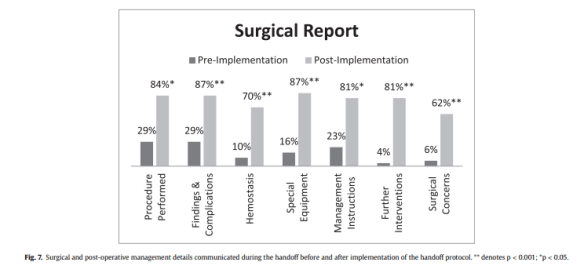
Results: Pre- and post-implementation performance was measured on all handoff elements listed above. These were elements identified as crucial to the safe and successful patient transfer.

Notably, surgeons were the only group that believed communication was effective in the existing process. Anesthesia and ICU Nursing were dissatisfied. All three groups agreed that a more structured protocol was necessary for safe patient care (p.29).

The figure below show the changes in degree of detail in surgical reports (p.35). The article provides additional charts and data on other pre- and post- findings.

handoff report

Additional reading: Karamchandani K, et al. A multidisciplinary handoff process to standardize the transfer of care between the intensive care unit and the operating room. Quality Management in Health Care. 2018 Oct/Dec;27(4):215-222. doi:10.1097/QMH.0000000000000187.

The Prospective Peri-operative Enoxaparin Cohort Trial (PROSPECT)

Reference: Dunn AS, Spyropoulos AC, Turpie AG. Bridging therapy in patients on long-term oral anticoagulants who require surgery: the Prospective Peri-operative Enoxaparin Cohort Trial (PROSPECT). Journal of Thrombosis and Haemostasis. 2007 Nov;5(11):2211-2218.

Summary: Due to limited data on the incidence of peri-operative thromboemobolic and bleeding during bridge therapy, there is no agreement on optimal peri-operative management of patients on oral anticoagulants (OACs). Dunn et al sought to “examine the incidence of major bleeding of a peri-operative strategy using once-daily therapeutic-dose enoxaparin administered primarily at home, and the effect, if any, of the extensiveness of the procedure on the risk of bleeding during bridge therapy” (p.2211-2212).

The study involved 24 sites in North America between January 2002 and August 2003. The figure below shows the study’s peri-operative management protocol (p.2212): periop mgmt2


Safety outcomes:

  • Incidence of major bleeding while on enoxaparin or in the 24 hours following cessation of enoxaparin treatment
    • Occurred in 3.5% (95% CI: 1.6-6.5)
    • Invasive procedures: 1.4%
    • Minor surgery: 0%
    • Major surgery:  27.5%
  • Rate of minor bleeding while on enoxaparin, or within 24 hours of discontinuation
    • Occurred in 108 patients (41.5%, 95% CI:35.7-47.6)
    • Invasive procedures: 44.6%
    • Minor surgery: 47.2%
    • Major surgery: 20.0%

Efficacy outcomes:

  • Incidence of arterial thromboembolic events for patients with afib
    • 4 events out of 176 patients (2.3%, 95% CI: 0.6-5.7)
    • 2 TIAs, 0 strokes, 2 patients had peripheral arterial thromboembolic events
  • Incidence of venous thromboembolic events for patients with a history of DVT.
    • 1 event out of 96 patients (1.0%, 95% CI: 0.03-5.7)
    • None fatal

Bleeding risk is high when bridging therapy is done peri-operatively in major surgery. In this study, there were 8 instances of major bleeding among 40 total patients in major surgery. Out of 220 invasive procedures or minor surgery, there was only 1 major bleeding event.