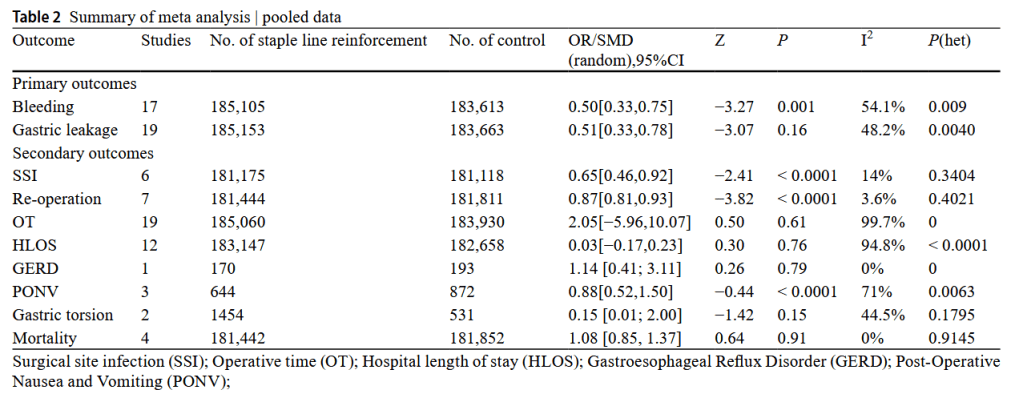
Does the use of staple line reinforcement during sleeve gastrectomy and Roux-en-Y gastric bypass affect Clinical Outcomes?

“The efficacy of bariatric surgery in facilitating sustained weight loss and managing obesity-related comorbidities has been consistently reported in the medical/scientific literature. Sleeve gastrectomy (SG) and Roux-en-Y gastric bypass (RYGB) are widely accepted bariatric procedures. However, complications, such as gastric leakage, bleeding, stricture, and surgical infection, can lead to significant morbidity and mortality, posing a formidable challenge to bariatric surgeons.
In order to reduce the incidence of complications associated with bariatric surgery, some surgeons have advocated the use of gastric incision staple line reinforcement with the
aim of improving structural integrity and reducing edge tension. However, others have suggested that the reinforcement of the incision edge may compromise suture stability, thereby raising concerns about the overall effectiveness of staple line reinforcement in preventing postoperative complications.”

Continue reading

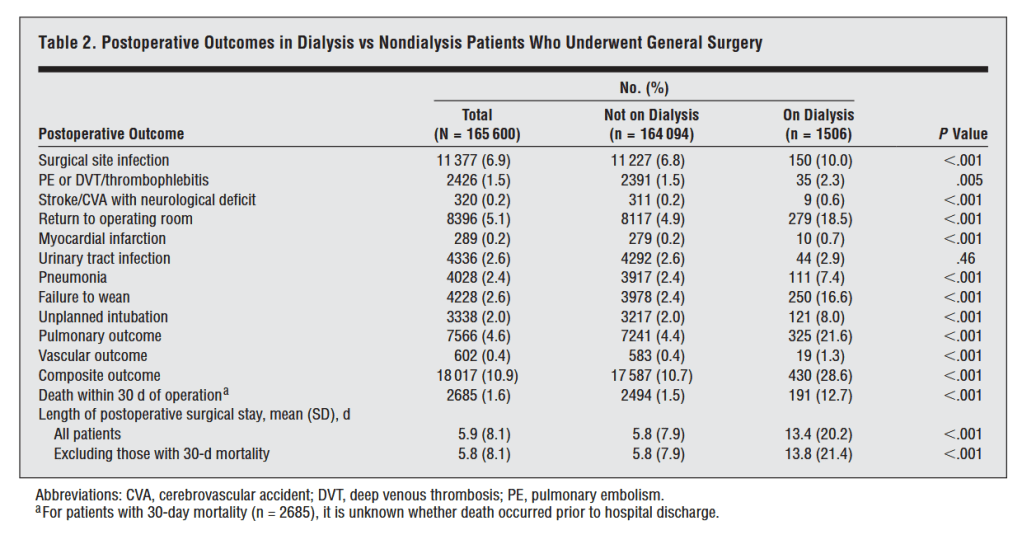
Risk of Major Nonemergent Inpatient General Surgical Procedures in Patients on Long-term Dialysis

“More than half a million individuals in the United States undergo dialysis, a number that has been forecasted to increase by 7% annually. End-stage renal disease requiring dialysis is associated with poor health care outcomes, including a 10-fold increase in risk of hospitalization and an expected lifespan between one-fourth and one-sixth of that of the general population. Despite the well-described outcomes of the effect of end-stage renal disease on community-dwelling individuals, little is known about the contribution of long-term dialysis to the risks of postoperative complications and death.”

Continue reading

The American Society of Colon and Rectal Surgeons Clinical Practice Guidelines for Ostomy Surgery

“Statistics regarding ostomy-related metrics remain elusive in the United States because of underreporting and coding limitations. The estimated number of ostomates in the United States is 750,000 to 1 million, with approximately 150,000 new ostomies created each year. Stoma creation has a relatively high rate of associated morbidity, ranging from 20% to 80%; peristomal skin complications and parastomal hernia (PSH) are the most common associated morbidities. A population-based study using the Michigan Surgical Quality Collaborative, which included 4250 patients, identified a 37% unadjusted surgical complication rate for elective cases involving an ostomy and 55% unadjusted surgical complication rate for emergency cases involving an ostomy. In this study, risk-adjusted stoma-related morbidity rates varied significantly among hospitals, indicating a potential to improve outcomes in outlying institutions.”

Continue reading

Survival, Healthcare Utilization, and End-of-life Care among Older Adults with Malignancy-associated Bowel Obstruction

“Among patients with cancer, the estimated prevalence of malignancy-associated bowel
obstruction (MBO) is 3-15%, including up to 51% in ovarian cancer and up to 28% in
cancers of the gastrointestinal tract. MBO is among the most common palliative
indications for surgical consultation5 and typically signifies a poor prognosis, with mean
survival of 3-8 months in surgical cases and 4-5 weeks in those with inoperable MBO.
Managing the considerable symptom burden associated with MBO frequently
requires hospitalization and contributes to high-intensity healthcare utilization.1, In light
of national efforts to address the poor quality and high cost of care near the end of life, it is
critical to understand the relationship between treatment for complications of terminal
cancer, such as MBO, and end-of-life (EOL) care.”

Continue reading

Definitive surgical treatment of enterocutaneous fistula

“Enterocutaneous Fistula (ECF) is defined as an abnormal connection between the gastrointestinal tract and the skin, and it requires labor-intensive medical management and surgical expertise. Complex wound management, severe malnutrition, frequent infectious complications, chronic pain, and depression require significant investment of health care resources and make the short-term and longterm care of these patients difficult. The
subsequent operative management often requires lengthy procedures in hostile abdomens with abundant adhesions and surrounding inflammation. In addition to the significant risk of mortality, morbidity can be equally as devastating.”

Continue reading

Differential diagnosis in inflammatory bowel disease colitis

“Distinction between Crohn’s disease of the colon-rectum and ulcerative colitis or inflammatory bowel disease (IBD) type unclassified can be of pivotal importance for a tailored clinical management, as each entity often involves specific therapeutic strategies and prognosis. Nonetheless, no gold standard is available and the uncertainty of diagnosis may frequently lead to misclassification or repeated examinations. Hence, we have performed a literature search to address the problem of differential diagnosis in IBD colitis, revised current and emerging diagnostic tools and refined disease classification strategies. Nowadays, the differential diagnosis is an untangled issue, and the proper diagnosis
cannot be reached in up to 10% of patients presenting with IBD colitis.”

Continue reading

Japanese Gastric Cancer Treatment Guidelines 2021

“The sixth edition of the Japanese Gastric Cancer Treatment Guidelines was completed in July 2021, incorporating new evidence that emerged after publication of the previous edition. It consists of a text-based “Treatments” part and a “Clinical Questions” part including recommendations and explanations for clinical questions. The treatments parts include a comprehensive description regarding surgery, endoscopic resection and chemotherapy for gastric cancer. The clinical question part is based on the literature search and evaluation by an independent systematic review team.”

Continue reading