Pro vs Con: thrombolysis for submassive PE

One discussion this week included thrombolysis for submassive PE.

References: Howard LS. Thrombolytic therapy for submassive pulmonary embolus? PRO viewpoint. Thorax. 2014 Feb;69(2):103-105.

Simpson AJ. Thrombolysis for acute submassive pulmonary embolism: CON viewpoint. Thorax. 2014 Feb;69(2):105-107.

Summary:  The normotensive patient with confirmed pulmonary embolism (PE) and right ventricular (RV) dilatation presents a significant dilemma to clinicians. On one hand, a string of publications have demonstrated that RV dysfunction is associated with adverse outcomes in patients with PE; on the other, thrombolysis carries a significant risk of bleeding. The real problem of course (and part of the reason for having this important debate) is that we have no reliable and accurate tools to pinpoint the important minority of patients with submassive PE who genuinely might benefit from thrombolysis or perhaps from surgical embolectomy

PRO: In proposing the argument that submassive PE should be treated with thrombolysis, we must first accept that direct mortality due to the PE itself, not confounding conditions, remains unacceptably high with anticoagulation alone. A more aggressive strategy is required. As long as the benefits of thrombolysis outweigh the risks, then thrombolysis offers the best currently available approach. When this is coupled with the further benefits of likely reduction in CTEPH, the case becomes even stronger.

Outcomes in patients with true submassive PE remain unacceptably high and thrombolysis has been shown to improve surrogate outcomes for mortality as well as long-term complications. The risks from thrombolysis are low, and when reduced doses are used, evidence so far suggests no decrease in benefit, but a further reduction in bleeding.

CON: The emerging picture is that, at the point of presentation, patients with submassive PE are highly likely to survive if treated with heparin alone and that the associated RV dilatation is likely to resolve spontaneously in the significant majority. The nagging doubt, of course, surrounds the small proportion of patients who will have persistent RV dysfunction, particularly as this group seems vulnerable to recurrent venous thromboembolism (VTE).

However attractive it may be theoretically, we have no strong evidence to inform whether early thrombolysis can reduce VTE recurrence—we know that longer-term anticoagulation does. Similarly, we have no evidence that early thrombolysis reduces the risk of CTEPH, yet modern treatments significantly improve outcomes for this important
complication. So, instead of early thrombolysis, why not repeat echocardiography at 3 months, prolong anticoagulation in those with persistent RV impairment and assess carefully for evidence of CTEPH in the ensuing period?

Please see the full text of these editorials (linked above in references) for the full argument and citations. 

Have you heard of the PESI score?

One discussion this week included the application of the Pulmonary Embolism Severity Index (PESI) score.

Reference: Aujesky D. Pulmonary Embolism Severity Index (PESI) [online calculator]. Retrieved from https://www.mdcalc.com/pulmonary-embolism-severity-index-pesi

Summary: WHEN TO USE: In the setting of a patient diagnosed with PE, the PESI can be utilized to determine mortality and long term morbidity.

PESI2

PEARLS/PITFALLS: PESI is a risk stratification tool that has been externally validated to determine the mortality and outcome of patients with newly diagnosed pulmonary embolism (PE).

In the setting of a patient with renal failure or severe comorbidities, clinical judgement should be used over the PESI, as these patients were excluded in the validation study.

  • The PESI score determines risk of mortality and severity of complications.
  • The score does not require laboratory variables.
  • It is meant to aid in decision making, not replace it. Clinical judgement should always take precedence.
  • The PESI score determines clinical severity and can influence treatment setting for management of PE.
    • Class I and II patients may possibly be safely treated as outpatients in the right clinical setting.

Go to MD Calc for the calculator below:

PESI


Additional Reading: Aujesky D, et al. Derivation and validation of a prognostic model for pulmonary embolism. American Journal of Respiratory and Critical Care Medicine. 2005 Oct 15;172(8):1041-1046.

D1 vs D2 resection for gastric cancer

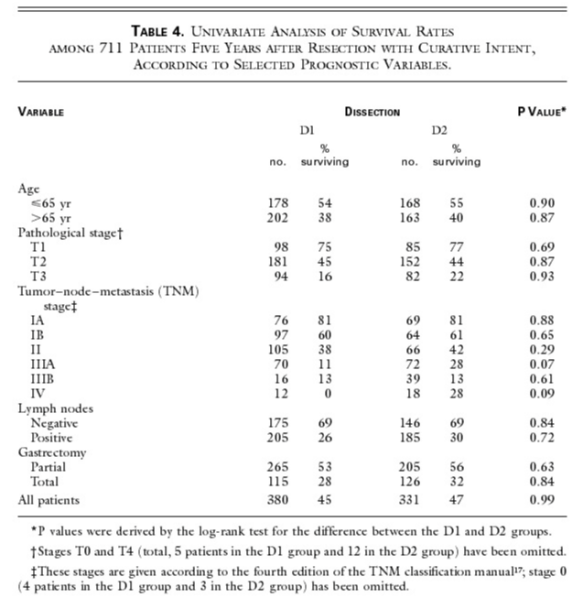
One discussion this week included a trial out of Denmark comparing D1 and D2 lymph-node dissection for gastric cancer.

Reference: Bonenkamp JJ, et al. Extended lymph-node dissection for gastric cancer. NEJM. 1999 Mar 25;340(12):908-914.

Summary: Curative resection is the treatment of choice for gastric cancer, but it is unclear whether this operation should include an extended (D2) lymph-node dissection or a limited (D1) dissection. The authors conducted a randomized trial in 80 Dutch hospitals in which they compared D1 with D2 lymph-node dissection for gastric cancer in terms of morbidity, postoperative mortality, long-term survival, and cumulative risk of relapse after surgery.

Between August 1989 and July 1993, 996 patients were enrolled. Of these, 711 underwent randomly assigned treatment (D1 = 380, D2 = 331) and 285 received palliative treatment.

General findings:

  • Complications: 43% in D2, 25% in D1
  • Postoperative deaths: 10% in D2, 4% in D1
  • Length of stay: 16 median days in D2, 14 days in D1
  • 5-year survival rates: 47% in D2, 45% in D1


d1 v d2

One of the arguments for D2 dissection is its ability to reduce rates of local recurrence, thereby increasing the quality of life. The distressing finding of local recurrence, usually in a terminal phase of the disease, often leads to second operations to restore gastrointestinal continuity. In this trial, there was a tendency toward a reduced cumulative risk of relapse after D2 dissection, but the rate of relapse remained high and the difference from D1 dissection was not significant. A subgroup analysis indicated a significant or marginally significant difference for patients with disease in UICC stages II and IIIA, but this difference was attributable largely to stage migration.

The MAGIC Trial: Does perioperative ECF improve outcomes for gastric cancer patients?

One discussion this week included the Medical Research Council Adjuvant Gastric Infusional Chemotherapy (MAGIC) Trial. [Current Controlled Trials number: ISRCTN93793971.]

Reference: Cunningham D, et al. Perioperative chemotherapy versus surgery alone for resectable gastroesophageal cancer. NEJM. 2006 Jul 6;355(1):11-20.

Summary: A regimen of epirubicin, cisplatin, and infused fluorouracil (ECF) improves survival among patients with incurable locally advanced or metastatic gastric adenocarcinoma. The MAGIC Trial assessed whether the addition of a perioperative regimen of ECF to surgery improves outcomes among patients with potentially curable gastric cancer.

METHODS: We randomly assigned patients with resectable adenocarcinoma of the stomach, esophagogastric junction, or lower esophagus to either perioperative  chemotherapy and surgery (250 patients) or surgery alone (253 patients). Chemotherapy consisted of three preoperative and three postoperative cycles of intravenous epirubicin (50 mg per square meter of body-surface area) and cisplatin (60 mg per square meter) on day 1, and a continuous intravenous infusion of fluorouracil (200 mg per square meter per day) for 21 days. The primary end point was overall survival.

CONCLUSIONS: In patients with operable gastric or lower esophageal adenocarcinomas, a perioperative regimen of ECF decreased tumor size and stage and significantly improved progression-free and overall survival.

MAGIC

(p.16)

Additional Reading: Cunningham D, et al. Perio-operative chemoterhapy with or without bevacizumab in operable oesophagogastric adenocarcinoma (UK Medical Research Council ST03): primary analysis results of a multicentre, open-label, randomised phase 2-3 trial. Lancet Oncology. 2017 Mar;18(3):357-370.  doi: 10.1016/S1470-2045(17)30043-8.

[ClinicalTrials.gov, number NCT00450203.]

Emory authors: Perioperative hyperglycemia management

One discussion this week included management of perioperative hyperglycemia.

Reference: Duggan EW, Carlson K, Umpierrez GE. Perioperative hyperglycemia management: an update. Anesthesiology. 2017 Mar;126(3):547-560. doi: 10.1097/ALN.0000000000001515.

Summary:  A substantial body of literature demonstrates a clear association between perioperative hyperglycemia and adverse clinical outcomes. The risk for post-operative complications and increased mortality relates to both long-term glycemic control and to the severity of hyperglycemia on admission and during the hospital stay. This study reports on the prevalence, diagnosis and pathophysiology of perioperative hyperglycemia and provides a practical outline for the management of surgical patients with diabetes and hyperglycemia.

The sections addressed include:

  • Metabolic consequences of surgical stress and anesthesia
  • Prevalence of hyperglycemia and diabetes in surgical patients
  • Preoperative period
  • Diabetes, fasting and feeding
  • Intraoperative period
  • Postoperative period
  • Glycemic targets
  • Pre-operative glycemic management
  • Intraoperative glycemic management
  • Post-operative glycemic management for non-ICU patients
  • Transitioning from IV to SC insulin
  • Insulin pump therapy
  • Hypoglycemia
  • Glucose monitoring in the perioperative period

CONCLUSION: Hyperglycemia is common in surgical patients. Current data demonstrates an association between elevated BG and a risk of perioperative complications in diabetic and non-diabetic patients. Insulin administration intra- and post-operatively has been shown to improve clinical outcomes. Individual patient characteristics and surgical case factors are considered when choosing subcutaneous insulin or an insulin infusion. Both are appropriate options on the day of surgery. Blood glucose values of 180 mg/dL (10 mmol/L) or higher are treated with insulin. Target range for the perioperative period is 140-180 mg/dL (7.7-10 mmol/L). Post-operatively, surgical floor patients with poor or uncertain oral intake are treated with once daily basal insulin. Prandial insulin is added when patients tolerate oral intake. Increasing evidence suggests a role for incretin therapy during the peri-operative period in patients with type 2 diabetes.

Multiple teams care for a surgical patient during the hospital course (anesthesiology, surgery, critical care medicine, internal/hospital medicine and endocrinology). Therefore, multidisciplinary groups within an institution should work together to create appropriate protocols for hyperglycemia screening, monitoring and treatment to minimize errors and to better care for patients.

Are diabetic patients at greater risk for anastomotic leaks and mortality when undergoing colectomies?

One discussion this week included postoperative anastomotic leaks.

Reference: Ziegler MA, et al. Risk factors for anastomotic leak and mortality in diabetic patients undergoing colectomy: analysis from a statewide surgical quality collaborative. Archives of Surgery. 2012 Jul;147(7):600-605. doi: 10.1001/archsurg.2012.77.

Summary: In a database review of patients in Michigan who underwent colectomy, the study aimed to determine risk factors in diabetic patients that are associated with increased postcolectomy mortality and anastomotic leak.

Primary risk factors were diabetes mellitus, hyperglycemia, steroid use, and emergency surgery. Of the 5123 patients, 889 were diabetic, 4234 were nondiabetic.

Diabetes alone was not found to be a risk factor for anastomotic leak in this study.

  • 56% of diabetic patients had preoperative glucose levels of 140 mg/dL or higher
  • Preoperative steroid use led to increased rates of anastomotic leak in diabetic patients
  • Diabetic patients who had a leak had more than a 4-fold higher mortality (26.3% vs 4.5%, P<.001) compared with nondiabetic patients (6.0% vs 2.5%, P<.05).
  • Mortality was associated with hyperglycemia for nondiabetic patients only

The authors conclude that improved screening may identify high-risk patients who would benefit from perioperative intervention.

Clinical guideline for management of sigmoid volvulus

One discussion this week included revolvulus after colonic decompression.


Reference: Vogel JD, et al. Clinical practice guidelines for colon volvulus and acute colonic pseudo-obstruction. Diseases of the Colon and Rectum. 2016 Jul;59(7):589-600. doi: 10.1097/DCR.0000000000000602

Summary: Volvulus occurs in the sigmoid colon or cecum in >95% of cases, with the remainder involving either the transverse colon or the splenic flexure of the colon. Sigmoid volvulus affects patients who are older, with more comorbid medical and neuropsychological conditions, compared with those with cecal volvulus.

Continue reading