Barbed sutures: a manufacturer’s indications for use, and a study of use in anastamotic closures

One discussion this week involved the appropriate use of V-LOC sutures.


References: Davis J. Global Value Dossier for V-LOC Wound Closure Device: Technology and Surgical Applications (version 2.0). 2018 Apr 20. Germany: Coreva-Scientific

Tsukata T, et al. Use of barbed sutures in laparoscopic gastrointestinal single-layer sutures. JSLS. 2016 Jul-Sep;20(3): pii: e2016.00023. doi: 10.4293/JSLS.2016.00023.

Summary: When contemplating the best use for a technology, it helps to ask the creator, or in this case, the manufacturer. In section 2.4 (p.12) of their Global Value Dossier for V-LOC Wound Closure Device, Medtronic describes the indications for use as follows:

“Always refer to the package insert for indications and instructions for use of V-LocTM wound closure devices appropriate for your jurisdiction. Absorbable (V-LocTM 90 and 180), and nonabsorbable (V-LocTM PBT), devices are indicated for use in soft tissue approximation wherever the use of standard, non-barbed absorbable or non-absorbable sutures is appropriate, respectively. The product is contraindicated for patients with allergies to its components and should not be secured by tying surgical knots, or used with interrupted suturing patterns, or for ligating vessels or luminal structures. The technology has not been established for use in fascial closures (abdominal wall, thoracic, extremity fascial closures), gastrointestinal anastomoses, cardiovascular anastomoses, neurological, ophthalmic, orthopedic or microsurgery applications.”

(Davis, 2018).

In a 2016 study out of Japan, Tsukada, Kaji, Kinoshita, and Shimizu analyzed the results of 40 laparoscopic anastomoses that involved V-LOC sutures.

METHODS: Between August 2012 and March 2014, 15-cm-long barbed sutures (V-Loc 180; Covidien, Mansfield, MA, USA) were used for laparoscopic intestinal anastomoses, including intestinal hole closure for esophagojejunal and gastrojejunal anastomoses after mechanical anastomoses and gastric wall closure after partial resection.

RESULTS: 38 patients underwent 40 laparoscopic anastomoses

( 26 esophagojejunostomies; 7 gastrojejunostomies; 7 simple closure of gastric defect)

  • No cases required conversion to open surgery.
  • Two cases exhibited positive air leak test results during surgery (1 case of esophagojejunostomy and 1 case of simple closure of gastric defect)
  • Two cases of intestinal obstruction were noted; of those, one patient with postoperative intestinal paresis (grade II) was managed conservatively, and the other underwent repeat laparoscopic surgery (grade IIIb) for internal herniation unrelated to V-Loc use.
  • No postoperative complications at the anastomosis site and no surgery-related deaths were noted.

CONCLUSION: Single-layer entire-thickness running suturing with the V-Loc 180 barbed suture after stapled side-to-side intestinal anastomosis was found to be safe and feasible in the reported cases.

HAP vs VAP treatment: a flowchart

One discussion this week involved treatment for hospital-acquired pneumonia (HAP) and ventilator-associated pneumonia (VAP).

Reference: Kenny JES. IDSA Guidelines 2016: HAP, VAP & It’s the End of HCAP as We Know It (And I Feel Fine) [website]. 2016 Jul 30. Retrieved from https://pulmccm.org/infectious-disease-sepsis-review/idsa-guidelines-2016-hap-vap-end-hcap-know-feel-fine/

Summary: “While the current [IDSA 2016] guidelines discuss a number of issues germane to HAP and VAP including: microbiological evaluation, ventilator-associated tracheobronchitis, the use of biomarkers and clinical prediction scores, inhaled antibiotics, etc. this post will focus on standard, empiric therapy as this is a common clinical quandary [see figure 1]” (Kenny 2016).

hap vap

“The current guidelines recommend 7 days of antimicrobial therapy for both HAP and VAP.  The authors conducted their own meta-analysis and found no difference in mortality or recurrence between long and short-courses of therapy.  This is incongruent with an often referenced trial in 2003 which noted a higher pneumonia recurrence rate if non-fermenting gram negative bacilli [e.g. pseudomonas] were isolated and patients were treated with 8 days versus 15 days of anti-microbials” (Kenny 2016).

Foley or no Foley? Criteria for perioperative Foley placement

One discussion this week included the use of Foley catheters.


Reference: Meddings J, et al. Michigan Appropriate Periopeartive (MAP) criteria for urinary catheter use in common general and orthopaedic surgeries: results obtained using the RAND/UCLA Appropriateness Method. BMJ Quality & Safety. 2019 Jan;28(1):56-66. doi:10.1136/bmjqs-2018-008025

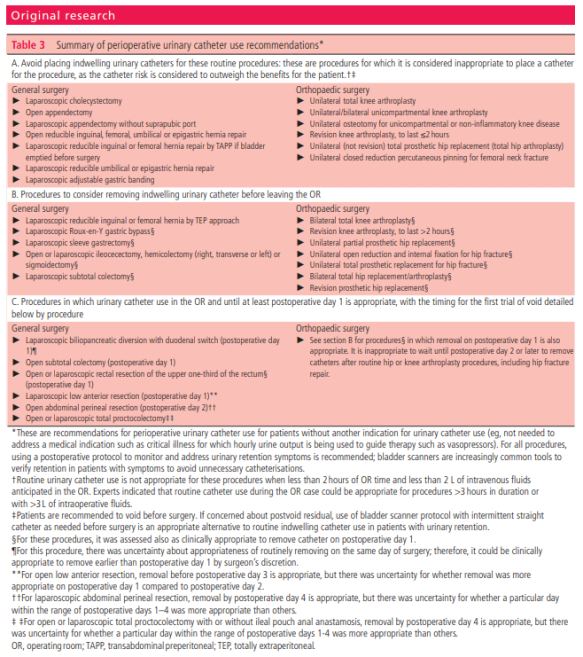
Summary: Indwelling urinary catheters are commonly used for patients undergoing general and orthopaedic surgery. Despite infectious and non-infectious harms of urinary catheters, there is limited guidance available to surgery teams regarding appropriate perioperative catheter use.

Meddings et al (2019) used the RAND Corporation/University of California Los Angeles (RAND/UCLA) Appropriateness Method 21 to formally rate the appropriateness of urinary catheter placement and timing for removal across routine general and
orthopaedic surgical procedures in adults, as rated by clinicians in different clinical settings across the US and informed by the available literature involving perioperative urinary catheter use.

foley

(Meddings et al, 2019, p.61)

Open vs closed hemorrhoidectomy: a systematic review and meta-analysis of RCTs

One discussion this week included open versus closed hemorrhoidectomy.

Reference: Bhatti M, Sajid MS, Baig MK. Milligan-Morgan (open) versus Ferguson haemorrhoidectomy (closed): A systematic review and meta-analysis of published randomized, controlled trails. World Journal of Surgery. 2016 Jun;40(6):1509-1519. doi:10.1007/s00268-016-3419-z.

Summary: In Europe, the Milligan-Morgan procedure or open haemorrhoidectomy (OH) is more frequently practised, whereas in the United States of America the closed haemorrhoidectomy (CH) procedure, as described by Ferguson and Heaton, is the most popular. CH is purported to be a less painful procedure and associated with faster wound healing due to primary wound closure. However, the conflicting outcomes following both procedures have been debated in the published literature and several controversies around post-operative pain still need clarification.

Relevant prospective randomized, controlled trials (irrespective of type, language, gender, blinding, sample size or publication status) on CH versus OH for the management of HD until May 2014 were included in this review.

Ultimately, 11 RCTs encompassing 1326 patients were included in the systematic review and meta-analysis. Significant heterogeneity was found among included trials.

CONCLUSIONS: Variables of pain on defecation, length of hospital stay, post-operative complications, HD recurrence and risk of surgical site infection were similar in both groups.

Based upon the findings of this review, CH was associated with a reduced post-operative pain, faster wound healing, lesser risk of post-operative bleeding but prolonged duration of operation.

Findings of this review are contradictory to a 2007 meta-analysis of six randomized, controlled trials.


To view full data analyses (3 tables and 11 figures!) click on the link in the reference at the top of this post.


Is TNT a viable treatment strategy for rectal cancer?

One discussion this week included total neoadjuvant therapy (TNT) for rectal cancer.

Reference: Cercek A, et al. Adoption of total neoadjuvant therapy for locally advanced rectal cancer. JAMA Oncology. 2018 Jun 14;4(6):e180071. doi:10.1001/jamaoncol.2018.0071.

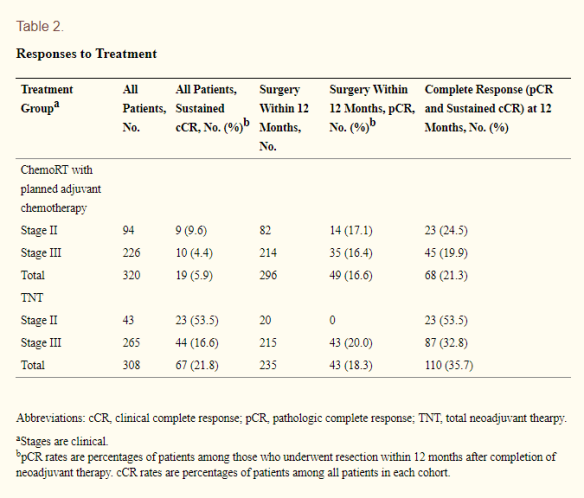
Summary: Treatment of locally advanced rectal (LARC) cancer involves chemoradiation, surgery, and chemotherapy. The concept of total neoadjuvant therapy (TNT), in which chemoradiation and chemotherapy are administered prior to surgery, has been developed to optimize delivery of effective systemic therapy aimed at micrometastases.

OBJECTIVE: To compare the traditional approach of preoperative chemoradiation (chemoRT) followed by postoperative adjuvantchemotherapy with the more recent TNT approach for LARC.

METHODS: A retrospective cohort analysis using Memorial Sloan Kettering Cancer Center (MSK) records from 2009 to 2015 was carried out. A total of 811 patients who presented with LARC (T3/4 or node-positive) were identified; 320 received chemoRT with planned adjuvant chemotherapy and 308 received TNT (induction fluorouracil- and oxaliplatin-based chemotherapy followed by chemoRT). Of the 628 patients, 373 (59%) were men, 255 (41%) were women, and the mean age was 56.7 years.

RESULTS: Patients in the TNT cohort received greater percentages of the planned oxaliplatin and fluorouracil prescribed dose than those in the chemoRT with plannned adjuvant chemotherapy cohort. The complete response (CR) rate, including both pathologic CR (pCR) in those who underwent surgery and sustained clinical CR (cCR) for at least 12 months posttreatment in those who did not undergo surgery, was 36% in the TNT cohort compared with 21% in the chemoRT with planned adjuvant chemotherapy cohort. TNT(Cerek et al, 2018)

CONCLUSIONS: Total neoadjuvant therapy was associated with improved delivery of systemic therapy and increased response to treatment, and it provides a promising platform for nonoperative watch-and-wait protocols. Long-term follow-up is necessary to determine if early systemic chemotherapy improves overall outcome

The authors conclude their findings provide additional support for the National Comprehensive Cancer Network (NCCN) guidelines that categorize TNT as a viable treatment strategy for rectal cancer.

Adjuvant chemotherapy for rectal cancer: The PROCTOR-SCRIPT trial

A discussion this week included adjuvant chemotherapy for rectal cancer after neoadjuvant and surgery.

Reference: Breugom AJ, et al. Adjuvant chemotherapy for rectal cancer patients treated with preoperative (chemo)radiotherapy and total mesorectal excision: a Dutch Colorectal Cancer Group (DCCG) randomized phase III trial. Annals of Oncology. 2015 Apr;26(4):696-701. doi:10.1093/annonc/mdu560.

Summary: Locoregional recurrence rates and survival have significantly
improved with the introduction of total mesorectal excision (TME) for patients with rectal cancer. The addition of preoperative radiotherapy to TME surgery resulted in a more than 50% decrease in locoregional recurrences. However, the combination of preoperative (chemo)radiotherapy and TME surgery did not improve overall or disease-free survival.  Up to 30% of all patients treated with curative intent for localized rectal cancer will develop distant metastases, and distant metastases are still the main cause
of death after rectal cancer.

A multicentre, randomized phase III trial, PROCTOR-SCRIPT, was conducted to investigate the value of adjuvant chemotherapy with fluoropyrimidine monotherapy after preoperative (chemo)radiotherapy and TME surgery. The primary outcome was overall survival. Secondary outcomes were disease-free survival, overall recurrence rate, and locoregional and distant recurrence rate separately.

METHODS: Patients from 52 hospitals were recruited. Those with histologically proven stage II or III rectal adenocarcinoma were randomly assigned to observation (n=221) or adjuvant chemotherapy (n=216) after preoperative (chemo)radiotherapy and TME. Radiotherapy consisted of 5 × 5 Gy. Chemoradiotherapy consisted of 25 × 1.8-2 Gy combined with 5-FU-based chemotherapyAdjuvant chemotherapy consisted of 5-FU/LV (PROCTOR) or eight courses capecitabine (SCRIPT). Randomization was based on permuted blocks of six, stratified according to centre, residual tumour, time between last irradiation and surgery, and preoperative treatment. The primary end point was overall survival.

RESULTS: Between 1 March 2000 and 1 January 2013, 470 patients were included, of whom 33 were incorrectly randomized. Therefore, 437 patients (309 Dutch and 128 Swedish patients) were eligible for analyses. The trial was finally closed due to poor patient accrual without reaching the intended inclusion.

  • Survival: A total of 95 patients died. Five-year overall survival was 79.2% in the observation group and 80.4% in the chemotherapy group.
  • Disease-free survival: No statistically significant difference in disease-free survival was
    observed. Five-year disease-free survival was 55.4% for the observation group and 62.7% for the chemotherapy group.
  • Recurrences: In total, there were 157 recurrences. At 5 years, the cumulative incidence for overall recurrences was 40.3% in the observation group and 36.2% in the chemotherapy group.
  • Locoregional recurrences: The 5-year cumulative incidence for locoregional recurrences was 7.8% in the observation group versus 7.8% in the chemotherapy group. This amounted to 38.5% and 34.7%, respectively, for distant recurrences.

CONCLUSION: The PROCTOR-SCRIPT trial could not demonstrate a significant benefit of adjuvant chemotherapy with fluoropyrimidine monotherapy regarding overall survival, disease-free survival, and recurrence rates after preoperative (chemo)radiotherapy and TME surgery in ypTNM stage II and III rectal cancer patients. However, this trial did not complete planned accrual.

Epidurals, DVTs, and chemical prophylaxis in the setting of oncologic surgery

One discussion this week involved preoperative epidurals and chemical prophylaxis.

Reference: Manguso N, et al. The impact of epidural analgesia on the rate of thromboembolism without chemical thromboprophylaxis in major oncologic surgery. The American Surgeon. 2018 Jun 1;84(6):851-855.

Summary: General surgery patients are at a particularly high risk of developing deep vein thrombosis (DVT) without prophylaxis and some data suggest their risk increases 2-fold if an underlying malignancy is present. A meta-analysis by Leonardi et al (2007) found that without chemical prophylaxis, the rate of DVT is as high as 35%, which drops to 12% if a patient receives chemical prophylaxis.

Although the use of chemical prophylaxis to reduce the risk of thromboembolic events has been validated in numerous studies, these drugs increase the risk of bleeding. Risk of bleeding in the setting of epidural analgesia may put the patient at risk for the potentially catastrophic complication of epidural hematoma which may lead to long-term paralysis.

Manguso et al (2018) evaluated the rate of thromboembolic events in cancer patients undergoing major oncologic abdominal and/or pelvic surgery who had a preoperative epidural catheter (EC) placed for postoperative pain control.

The aim of this study was to evaluate the need for chemical thromboprophylaxis in patients undergoing major abdominal or pelvic oncologic surgery with preoperative EC placement for postoperative pain control. Of the 285 patients for whom data were collected over this five-year period, the rates of above knee and below-knee DVTs were 3.2 and 5.2%, respectively. These patients were all asymptomatic and had no serious adverse events occur secondary to the identified thromboses.

A secondary finding was that 2.5% of patients had above-knee DVT before undergoing surgery; thus, it is important to consider the patient’s risk factors for DVT and screen preoperatively if there is concern.

Our data suggest that patients undergoing major open operations with epidural analgesia have low rates of DVT and may obviate the need for chemical prophylaxis. However, larger studies are required to determine the overall effects of epidural analgesia on the development of DVTs postoperatively.