Negative appendectomy rate over 18 years of technological advances

One discussion this week included the rate of negative appendectomy.

Reference: Raja AS, et al. Negative appendectomy rate in the era of CT: an 18-year perspective. Radiology. 2010 Aug;256(2):460-465. doi: 10.1148/radiol.10091570.

Summary: In a retrospective study of records from 1990-2007, researchers from Harvard sought to estimate the correlation between the negative appendectomy rate (NAR) and the rate of preoperative computed tomography (CT) in patients suspected of having acute appendicitis who presented to the emergency department.

The findings showed NAR decreased significantly from 23.0% to 1.7% (P < .0001), the annual number of appendectomies decreased significantly from 217 per year to 119 per year (P = .0003), and the proportion of patients undergoing appendectomy who underwent preoperative CT increased significantly from 1% to 97.5% (P < .0001).

Data from this study also suggest that the use of preoperative CT has been associated with a decrease in the female-to-male NAR ratio from 1.9:1 in 1990 to 0.9:1 in 2007, implying that the use of CT may have been helpful in decreasing the number
of negative appendectomies in women.

NAR

(Raja et al, 2010, p.464)

The STITCH trial: a summary

One discussion this week mentioned the STITCH trial.

Reference: Deerenberg EB, et al. Small bites versus large bites for closure of abdominal midline incisions (STITCH): a double-blind, multicentre, randomised control trial. Lancet. 2015 Sep 26;386(10000):1254-1260. doi: 10.1016/S0140-6736(15)60459-7.

Summary: Incisional hernia is a frequent complication of abdominal operations with an incidence of 10–23%, which can increase to 38% in specific risk groups. It is associated with pain and discomfort, resulting in a decreased quality of life. Incarceration and strangulation of abdominal contents can take place, for which emergency surgery is indicated, with associated morbidity and mortality. The authors (2015) estimate about 348,000 operations for incisional hernia are done every year in the US with $3.2 billion in annual associated costs.

Continue reading

Clinical Nutrition in surgery guidelines

Early oral feeding is the preferred mode of nutrition for surgical patients. Avoidance of any nutritional therapy bears the risk of underfeeding during the postoperative course after major surgery. Considering that malnutrition and underfeeding are risk factors for postoperative complications, early enteral feeding is especially relevant for any surgical patient at nutritional risk, especially for those undergoing upper gastrointestinal surgery.

Continue reading

What is the risk of rupture for type II endoleaks?

One discussion last week included the risk of rupture with type II endoleaks.

Reference: Brown A, et al. Type II endoleaks: challenges and solutions. Vascular Health Risk Management. 2016;12:53-63.

Summary:  Although type II endoleak appears to be associated with sac expansion (volume changes), the significance of this expansion on risk of aneurysm rupture remains unclear.

Wyss et al found a significant association between sac expansion and rupture.Twenty-seven ruptures occurred in an EVAR population of 848 patients, with an average follow-up of 4.8 years. Sixty-three percent of these ruptures occurred more than 30 days post-repair and were associated with prior complications detected on follow-up imaging. Five of these 17 ruptures demonstrated evidence of type II endoleak with associated sac expansion (four were isolated type II endoleaks and one was associated with a concomitant type Ib endoleak).

Conversely, other authors have shown no correlation. Van Marrewijk et al demonstrated that sac expansion was significantly associated with type II endoleaks; however, there was no correlation with rupture or increase in aneurysm-associated mortality. A recent systematic review reported a low incidence of rupture in patients with isolated type II endoleaks (under 1%) of which 57% were associated with sac expansion.

Sac expansion may therefore be a poor marker of risk in this population of patients; however, we do not currently have a more sensitive way of monitoring risk of rupture. As such, some authors suggest that consideration should be given to prevention of/or treatment for type II endoleak.

Pro vs Con: thrombolysis for submassive PE

One discussion this week included thrombolysis for submassive PE.

References: Howard LS. Thrombolytic therapy for submassive pulmonary embolus? PRO viewpoint. Thorax. 2014 Feb;69(2):103-105.

Simpson AJ. Thrombolysis for acute submassive pulmonary embolism: CON viewpoint. Thorax. 2014 Feb;69(2):105-107.

Summary:  The normotensive patient with confirmed pulmonary embolism (PE) and right ventricular (RV) dilatation presents a significant dilemma to clinicians. On one hand, a string of publications have demonstrated that RV dysfunction is associated with adverse outcomes in patients with PE; on the other, thrombolysis carries a significant risk of bleeding. The real problem of course (and part of the reason for having this important debate) is that we have no reliable and accurate tools to pinpoint the important minority of patients with submassive PE who genuinely might benefit from thrombolysis or perhaps from surgical embolectomy

PRO: In proposing the argument that submassive PE should be treated with thrombolysis, we must first accept that direct mortality due to the PE itself, not confounding conditions, remains unacceptably high with anticoagulation alone. A more aggressive strategy is required. As long as the benefits of thrombolysis outweigh the risks, then thrombolysis offers the best currently available approach. When this is coupled with the further benefits of likely reduction in CTEPH, the case becomes even stronger.

Outcomes in patients with true submassive PE remain unacceptably high and thrombolysis has been shown to improve surrogate outcomes for mortality as well as long-term complications. The risks from thrombolysis are low, and when reduced doses are used, evidence so far suggests no decrease in benefit, but a further reduction in bleeding.

CON: The emerging picture is that, at the point of presentation, patients with submassive PE are highly likely to survive if treated with heparin alone and that the associated RV dilatation is likely to resolve spontaneously in the significant majority. The nagging doubt, of course, surrounds the small proportion of patients who will have persistent RV dysfunction, particularly as this group seems vulnerable to recurrent venous thromboembolism (VTE).

However attractive it may be theoretically, we have no strong evidence to inform whether early thrombolysis can reduce VTE recurrence—we know that longer-term anticoagulation does. Similarly, we have no evidence that early thrombolysis reduces the risk of CTEPH, yet modern treatments significantly improve outcomes for this important
complication. So, instead of early thrombolysis, why not repeat echocardiography at 3 months, prolong anticoagulation in those with persistent RV impairment and assess carefully for evidence of CTEPH in the ensuing period?

Please see the full text of these editorials (linked above in references) for the full argument and citations. 

Have you heard of the PESI score?

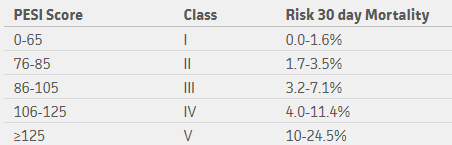
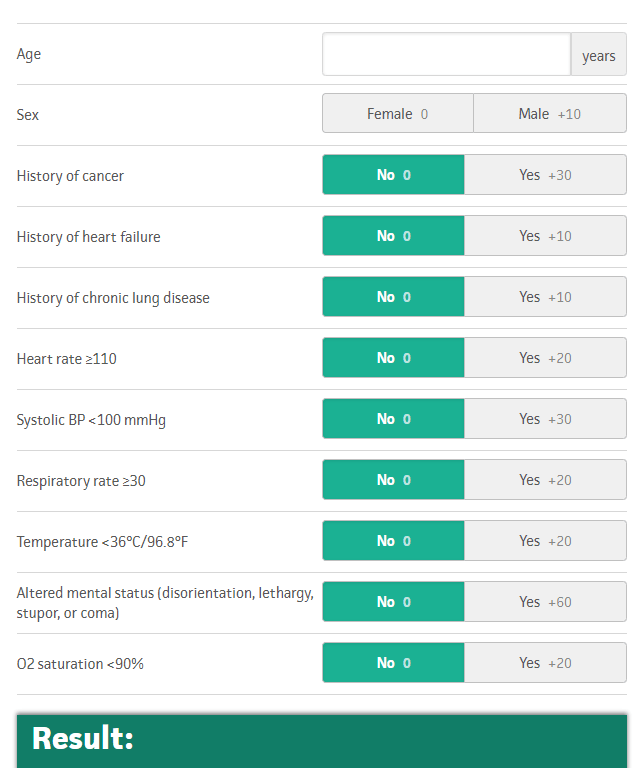
One discussion this week included the application of the Pulmonary Embolism Severity Index (PESI) score.

Reference: Aujesky D. Pulmonary Embolism Severity Index (PESI) [online calculator]. Retrieved from https://www.mdcalc.com/pulmonary-embolism-severity-index-pesi

Summary: WHEN TO USE: In the setting of a patient diagnosed with PE, the PESI can be utilized to determine mortality and long term morbidity.

PESI2

PEARLS/PITFALLS: PESI is a risk stratification tool that has been externally validated to determine the mortality and outcome of patients with newly diagnosed pulmonary embolism (PE).

In the setting of a patient with renal failure or severe comorbidities, clinical judgement should be used over the PESI, as these patients were excluded in the validation study.

  • The PESI score determines risk of mortality and severity of complications.
  • The score does not require laboratory variables.
  • It is meant to aid in decision making, not replace it. Clinical judgement should always take precedence.
  • The PESI score determines clinical severity and can influence treatment setting for management of PE.
    • Class I and II patients may possibly be safely treated as outpatients in the right clinical setting.

Go to MD Calc for the calculator below:

PESI


Additional Reading: Aujesky D, et al. Derivation and validation of a prognostic model for pulmonary embolism. American Journal of Respiratory and Critical Care Medicine. 2005 Oct 15;172(8):1041-1046.