
Emory authors: Perioperative hyperglycemia management

One discussion this week included management of perioperative hyperglycemia.

Reference: Duggan EW, Carlson K, Umpierrez GE. Perioperative hyperglycemia management: an update. Anesthesiology. 2017 Mar;126(3):547-560. doi: 10.1097/ALN.0000000000001515.

Summary:  A substantial body of literature demonstrates a clear association between perioperative hyperglycemia and adverse clinical outcomes. The risk for post-operative complications and increased mortality relates to both long-term glycemic control and to the severity of hyperglycemia on admission and during the hospital stay. This study reports on the prevalence, diagnosis and pathophysiology of perioperative hyperglycemia and provides a practical outline for the management of surgical patients with diabetes and hyperglycemia.

The sections addressed include:

  • Metabolic consequences of surgical stress and anesthesia
  • Prevalence of hyperglycemia and diabetes in surgical patients
  • Preoperative period
  • Diabetes, fasting and feeding
  • Intraoperative period
  • Postoperative period
  • Glycemic targets
  • Pre-operative glycemic management
  • Intraoperative glycemic management
  • Post-operative glycemic management for non-ICU patients
  • Transitioning from IV to SC insulin
  • Insulin pump therapy
  • Hypoglycemia
  • Glucose monitoring in the perioperative period

CONCLUSION: Hyperglycemia is common in surgical patients. Current data demonstrates an association between elevated BG and a risk of perioperative complications in diabetic and non-diabetic patients. Insulin administration intra- and post-operatively has been shown to improve clinical outcomes. Individual patient characteristics and surgical case factors are considered when choosing subcutaneous insulin or an insulin infusion. Both are appropriate options on the day of surgery. Blood glucose values of 180 mg/dL (10 mmol/L) or higher are treated with insulin. Target range for the perioperative period is 140-180 mg/dL (7.7-10 mmol/L). Post-operatively, surgical floor patients with poor or uncertain oral intake are treated with once daily basal insulin. Prandial insulin is added when patients tolerate oral intake. Increasing evidence suggests a role for incretin therapy during the peri-operative period in patients with type 2 diabetes.

Multiple teams care for a surgical patient during the hospital course (anesthesiology, surgery, critical care medicine, internal/hospital medicine and endocrinology). Therefore, multidisciplinary groups within an institution should work together to create appropriate protocols for hyperglycemia screening, monitoring and treatment to minimize errors and to better care for patients.

Are diabetic patients at greater risk for anastomotic leaks and mortality when undergoing colectomies?

One discussion this week included postoperative anastomotic leaks.

Reference: Ziegler MA, et al. Risk factors for anastomotic leak and mortality in diabetic patients undergoing colectomy: analysis from a statewide surgical quality collaborative. Archives of Surgery. 2012 Jul;147(7):600-605. doi: 10.1001/archsurg.2012.77.

Summary: In a database review of patients in Michigan who underwent colectomy, the study aimed to determine risk factors in diabetic patients that are associated with increased postcolectomy mortality and anastomotic leak.

Primary risk factors were diabetes mellitus, hyperglycemia, steroid use, and emergency surgery. Of the 5123 patients, 889 were diabetic, 4234 were nondiabetic.

Diabetes alone was not found to be a risk factor for anastomotic leak in this study.

  • 56% of diabetic patients had preoperative glucose levels of 140 mg/dL or higher
  • Preoperative steroid use led to increased rates of anastomotic leak in diabetic patients
  • Diabetic patients who had a leak had more than a 4-fold higher mortality (26.3% vs 4.5%, P<.001) compared with nondiabetic patients (6.0% vs 2.5%, P<.05).
  • Mortality was associated with hyperglycemia for nondiabetic patients only

The authors conclude that improved screening may identify high-risk patients who would benefit from perioperative intervention.

Foreign body removal without hospitalization: a new use for a stent removal device

One discussion this week involved the removal of foreign bodies.

Reference: Smith PM, et al. Isiris: a novel method of removing foreign bodies from the lower urinary tract to avoid unnecessary hospitalization and anesthesia. Journal of Endourology Case Reports. 2016 Aug 1;2(1):144-147. doi: 10.1089/cren.2016.0086.

Summary: Polyembolokoilamania refers to the practice of inserting foreign bodies (FBs) into natural orifices. A FB within the urethra is a relatively rare phenomenon with 646 cases recorded last year in the United Kingdom. Management of these patients presents technical challenges and complexities because of underlying psychiatric disorders that are often associated. This case illustrates a novel way of removing FBs from the genitourinary tract, requiring less resources, preventing hospital admission, and attempts to break the cycle of behavior, leading to recurrent attendance with polyembolokoilamania.

A 38-year-old Caucasian male prisoner, with psychiatric history presented to the emergency department (ED) with a history of inserting FBs into his urethra on 12 different occasions over a 6-week period. Of these 12 attendances, 3 resulted in admission and 2 required emergency intervention in theater under general anesthesia. After the third attendance in 5 days, it was decided to use Isiris™, a single-use flexible cystoscopy device with a built-in ureteral stent grasper, to remove the FBs and check the integrity of the urethra. The procedure was performed within the ED, without the need for admission to a ward bed or general anesthesia. Furthermore, only two members of staff were required to remove all of the urethral FBs.

Isiris, although marketed as a stent removal device, enabled us to remove all the patient’s FBs in one procedure. Isiris is an easy to use device, similar to a flexible cystoscope, that a specialist nurse or resident would be familiar using. It allows efficient and safe removal of lower urinary tract FBs, even out of hours. It requires minimal staffing support and can be done in the ED. It has the potential to reduce associated sequela of urethral polyembolokoilamania, saving resources while preserving the availability of the emergency theater.

Outcomes of and predictors for bowel ischemia after AAA repair: a study of 7312 patients

One discussion this week included AAA repair. The article cited here was provided by the chief resident.

Reference: Ultee KH, et al. Incidence of and risk factors for bowel ischemia after abdominal aortic aneurysm repair. Journal of Vascular Surgery. 2016 Nov;64(5):1384-1391. doi: 10.1016/j.jvs.2016.05.045.

Summary: Bowel ischemia is a rare but devastating complication after abdominal aortic aneurysm (AAA) repair. Its rarity has prohibited extensive risk-factor analysis, particularly since the widespread adoption of endovascular AAA repair (EVAR); therefore, this study assessed the incidence of postoperative bowel ischemia after AAA repair in the endovascular era and identified risk factors for its occurrence

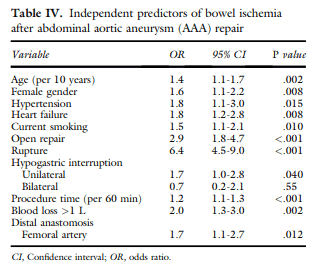
METHODS: A total of 7312 patients undergoing intact or ruptured AAA repair in the Vascular Study Group of New England (VSGNE) January 2003 – November 2014 were included. Patients with and without postoperative bowel ischemia were compared and stratified by indication (intact and ruptured) and treatment approach (open repair and EVAR). Criteria for diagnosis were endoscopic or clinical evidence of ischemia, including bloody stools, in patients who died before diagnostic procedures were performed. Independent predictors of postoperative bowel ischemia were established using multivariable logistic regression analysis.

RESULTS: Postoperative outcomes (p.1389):

AAA repair

RESULTS: Predictors of bowel ischemia after AAA repair (p.1390):

AAA predictors

CONCLUSIONS: The authors state that “these date should be considered during operative planning in an effort to adequately assess patient risk for bowel ischemia and undertake efforts to reduce it” (p.1391).

Can vein diameter predict arteriovenous fistula maturation?

One discussion this week included the relationship between vein size and fistula failure.

Reference: Bashar K, et al. The role of venous diameter in predicting arteriovenous fistula maturation: when not to expect an AVF to mature according to pre-operative vein diameter measurements? A best evidence topic. International Journal of Surgery. 2015 Mar;15:95-99. doi: 10.1016/j.ijsu.2015.01.035.

Summary: This best evidence topic was investigated according to a described protocol, and asked the question: what is the minimal vein diameter that can successfully predict maturation of an arteriovenous fistula (AVF) in patients undergoing dialysis?

The search retrieved 804 papers, of which 5 represented the best evidence to answer the clinical question. All studies assessed the association between successful AVF maturation and the size of vein used.

Highlighted findings:

  1. The strongest evidence came from a non-randomised controlled follow-up study in which 76% of fistulas created using >2 mm cephalic vein successfully matured compared to 16% when the vein measured ≤2 mm.
  2. Another prospective, multicentre study showed 65% successful maturation using veins >4 mm compared to 45% with veins < 3 mm. Vein diameter was found to be an independent predictor of maturation in multivariate regression analysis in two retrospective observational studies.
  3. A retrospective observational study found that using venous measurements of ≥2.5 mm following tourniquet application resulted in more fistulas been created that would have otherwise been denied based on venous ultrasound mapping.
  4. Routine use of tourniquet makes it possible to form AVFs in patients who otherwise would have been rejected. One study showed good results from using a transposed BBAVF when a BCAVF was deemed inappropriate following US.

In conclusion, a vein diameter of <2.5 mm should be considered inadequate for formation of an AVF, particularly if those measurements remain unchanged following the use of tourniquet.

What are the rates of major and minor bleeding complications after pharmacologic DVT prophylaxis?

One discussion this week included the rate of bleeding complications after pharmacologic DVT prophylaxis.

Reference: Leonardi MJ, McGory ML, Ko CY. The rate of bleeding complications after pharmacologic deep venous thrombosis prophylaxis: a systematic review of 33 randomized controlled trials. Archives of Surgery. 2006 Aug;141(8):790-797.

Summary: In a systematic review of 33 RCTs with 33,813 patients, Leonardi et al (2006) concluded that there is a small, but measurable, rate of minor bleeding complications associated with pharmacologic DVT prophylaxis: injection site bruising (6.9%), wound hematoma (5.7%), drain site bleeding (2.0%), and hematuria (1.6%).

The rate of major complications, such as GI tract (0.2%) or RP (<0.1%) bleeding, was extremely low in this review. Complications requiring a change in care, such as subsequent operation (0.7%) or discontinuation of prophylaxis (2.0%), were also infrequent. The subsequent operation rate for bleeding problems for pharmacologic prophylaxis vs placebo was identical, at 0.7%.

dvt

(p.795)

Additional Reading: Leonardi MJ, McGory ML, Ko CY. A systematic review of deep venous thrombosis prophylaxis in cancer patients: implications for improving quality. Annals of Surgical Oncology. 2007 Feb;14(2):929-936.

Meta-analysis, systematic review of carbonic anhydrase inhibitors in respiratory failure and metabolic alkalosis

One discussion this week involved carbonic anhydrase inhibitors (CAIs) in the setting of respiratory failure and metabolic alkalosisa.

Reference: Tanios BY, et al. Carbonic anhydrase inhibitors in patients with respiratory failure and metabolic alkalosis: a systematic review and meta-analysis of randomized controlled trials. Critical Care. 2018 Oct 29;22(1):275.  doi: 10.1186/s13054-018-2207-6

Summary: Metabolic alkalosis is common in patients with respiratory failure and may delay weaning in mechanically ventilated patientsCarbonic anhydrase inhibitors (such as acetazolamide, methazolamide, and dichlorphenamide) block renal bicarbonate reabsorption, and thus reverse metabolic alkalosis. However, uncertainty remains about
their effects in the setting of respiratory failure with concurrent metabolic alkalosis on duration of hospitalization, mechanical ventilation (MV), or noninvasive positive pressure ventilation (NIPPV), and mortality.

The objective of this systematic review is to assess the benefits and harms of carbonic anhydrase inhibitor therapy in patients with respiratory failure and metabolic alkalosis.

Randomized clinical trials were included if they assessed at least one of the following outcomes: mortality, duration of hospital stay, duration of mechanical ventilation, adverse events, and blood gas parameters. Six eligible studies were identified with a total of 564 patients.

There were no definitive results for the effects of CAI therapy on clinically important outcomes such as mortality and duration of hospital stay in patients with respiratory failure and metabolic alkalosis. The results suggest that CAI therapy may decrease the duration of mechanical ventilation. There was a trend towards increased incidence of adverse events in the CAI group; however, most of these adverse events were mild.

On the other hand, the results suggest that CAI therapy has favorable effects on arterial blood gas parameters (PaCO2, PaO2, bicarbonate and pH), with decreased PaCO2, increased PaO2, and, as expected, decreased bicarbonate and pH levels.

Conclusion

In patients with respiratory failure and metabolic alkalosiscarbonic anhydrase inhibitor therapy may have favorable effects on blood gas parameters. The authors note that this analysis did not provide conclusive results for clinically important outcomes.

In mechanically ventilated patientscarbonic anhydrase inhibitor therapy may decrease the duration of mechanical ventilation. A major limitation was that only two trials assessed this clinically important outcome.