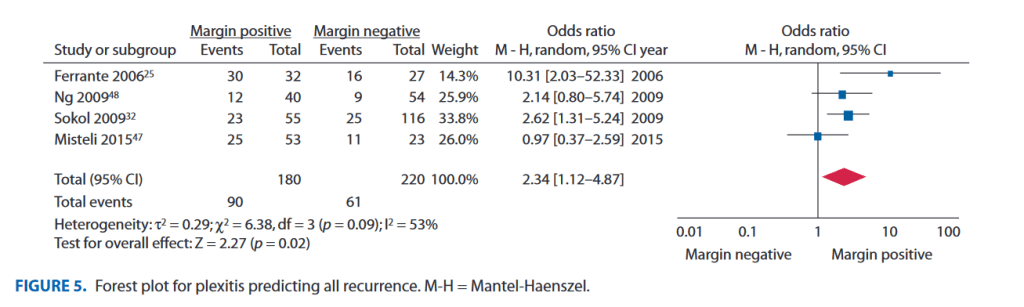
Histological Margin Positivity in the Prediction of Recurrence After Crohn’s Resection

The presence of involved histological margins at the time of index resection in Crohn’s disease is associated with recurrence, and plexitis shows promise as a marker of more aggressive disease. Further studies with homogeneity of histopathological and recurrence reporting are required.“”The presence of involved histological margins at the time of index resection in Crohn’s disease is associated with recurrence, and plexitis shows promise as a marker of more aggressive disease. Further studies with homogeneity of histopathological and recurrence reporting are required.

Continue reading

Mesenteric Venous Thrombosis

“Mesenteric venous thrombosis is caused by impairment of venous return of the bowel due to local blood coagulation. Primary mesenteric venous thrombosis is considered spontaneous and idiopathic, whereas secondary mesenteric venous thrombosis is due to an underlying condition. Mesenteric venous thrombosis can lead to venous engorgement and mesenteric ischemia and accounts for 5 to 15 percent of mesenteric ischemic events.”

Continue reading

Handsewn vs. stapled anastomoses in colon and rectal surgery

“Trials comparing handsewn with stapled anastomoses in colon and rectal surgery have not found statistical differences. Despite this, authors have differed in their conclusions as to which technique is superior. To help determine whether differences in patient outcomes are present, a meta-analysis of all trials was performed.”

Continue reading

ketorolac use and the risk of anastomotic leak after colorectal surgery.

“This meta-analysis included seven studies with 400,822 patients. Our results demonstrated that ketorolac administration after surgery increases the risk of anastomotic leak [OR = 1.41, 95% CI: 0.81–2.49, Z = 1.21, P = 0.23].”

(Chen)

“Anastomotic leak is a serious complication that occurs after colorectal surgery, which can lead to increased morbidity and mortality. Non-selective NSAIDs (such as ketorolac) may affect the healing of the intestine by inhibiting the action of cyclooxygenase. NSAIDs have been shown to weaken granulocyte function, which is an essential part of the acute phase of wound healing. NSAIDs may also inhibit epithelial cell migration and mucosal recovery, which are important in the pathophysiology of intestinal ulcer healing. These findings suggest a potential biological mechanism that may explain the association identified in this study.”

Chen W, et al Administration After Colorectal Surgery Increases Anastomotic Leak Rate: A Meta-Analysis and Systematic Review. Front Surg. 2022 Feb 9;9:652806. Free Full Text

Management of Anorectal Abscess

A generally accepted explanation for the etiology of anorectal abscess and fistula-in-ano is that the abscess results from obstruction of an anal gland and the fistula is due to chronic infection and epithelialization of the abscess drainage tract. Anorectal abscesses are defined by the anatomic space in which they develop and are more common in the perianal and ischiorectal spaces and less common in the intersphincteric, supralevator,and submucosal locations.

Continue reading

Diverting Ostomy: For Whom, When, What, Where, and Why

“Fecal diversion is an important tool in the surgical armamentarium. There is much controversy regarding which clinical scenarios warrant diversion. Some of the most common applications for the use of a diverting stoma include construction of diverting ileostomy or colostomy, ostomy for low colorectal/coloanal anastomosis, inflammatory bowel disease, diverticular disease, and obstructing colorectal cancer with the conclusion that diverting loop ileostomy is preferred to loop colostomy” (Plasencia)

Continue reading

PREOPERATIVE URETERAL STENT PLACEMENT IN THE IDENTIFICATION OF INTRAOPERATIVE IDENTIFICATION OF IATROGENIC URETERAL INJURY?

“The use of prophylactic ureteral stents remains controversial and could help in the intraoperative identification of ureteral injury.”

Methods:
Patients undergoing elective abdominal colorectal surgery and preoperative ureteral stent placement at three enterprise-wide tertiary referral hospitals between 2015 and 2021 were retrospectively identified through their billing records. The main study endpoint was ureteral injury identified within 30 days postoperatively. The decision to place ureteral stents was at the discretion of the treating surgeon. A number of demographic, disease-related, and treatment-related variables were examined for possible association with ureteral stent placement. We compared the incidence of ureteral injury and timing of the identification according to use of ureteral stents. Bivariate associations were examined using Kruskal-Wallis tests for continuous variables and Chi-square tests for categorical variables.


Continue reading