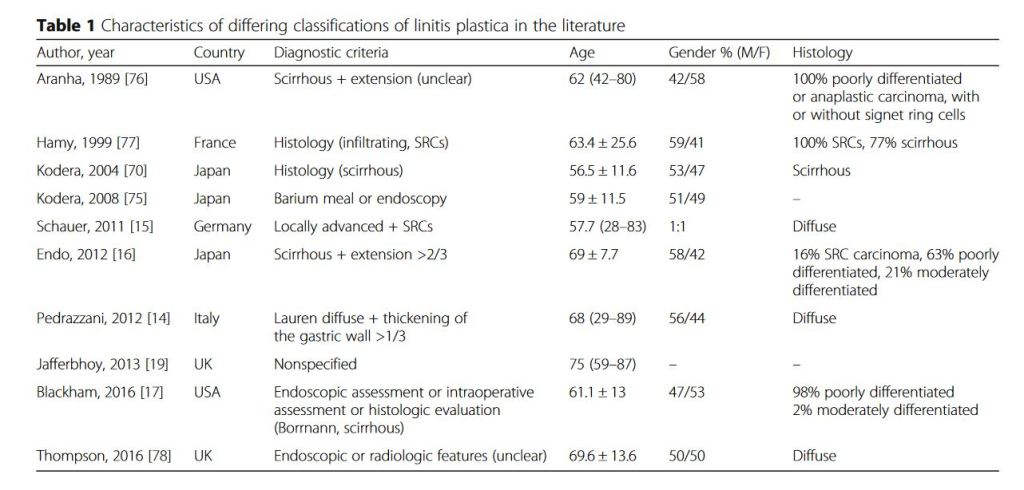
“Linitis plastica (LP) is a distinct phenotype of gastric cancer. Macroscopically, it is characterized as a thickened stomach, with prominent diffusion of the tumor into the submucosal and muscular layers; microscopically, it is often associated with signet ring cell features and diffuse and scirrhous (referring to the histologic characteristic of abundant stromal cells) histologic types.”
“Linitis plastica due to gastric adenocarcinoma is a condition with a long history, but still lacks a standardized definition and is commonly confused with Borrmann type IV, Lauren diffuse, and signet-cell type gastric cancer. The absence of a clear definition is a problem when investigating its biological characteristics and role as a possible independent factor for prognosis. Nevertheless, the biological behavior for linitis plastica, which is unique, may be valuable in risk stratification and have implications for treatment. A definition of linitis plastica based on molecular or genomic criteria could represent a useful starting point for investigating new targeted therapies.”
“Gastric acid production is necessary for the body to digest food and break down nutritional components into absorbable amino acids, carbohydrates, and fats. Most of the acid is produced when gastric pH stimulates the release of gastrointestinal using the release and activation of various digestive enzymes. The stomach is a relatively acidic environment with a pH of less than 4.0, which can drop to 2.0 with parietal cells. Parietal cells live in the fundus and the body of the stomach and secrete hydrogen ions. This activity explains when this condition should be considered on a differential diagnosis, articulates how to properly evaluate for this condition, and highlights the role of the interprofessional team in caring for patients with this condition.”
Early use of PPIs and H2 blockers in patients can be beneficial to prevent stress gastritis.
PPIs work to inhibit hydrogen ion secretion by blocking the H/K ATPase of parietal cells.
Parietal cells are stimulated by acetylcholine, gastrin, and histamine to secrete hydrogen ions.
Acetylcholine and gastrin via phospholipase and PKC to stimulate hydrogen ion secretion.
Histamine works through cAMP and PKA to stimulate hydrogen ion secretion.
The most common presenting symptom is bleeding (bloody nasogastric tube, melena).
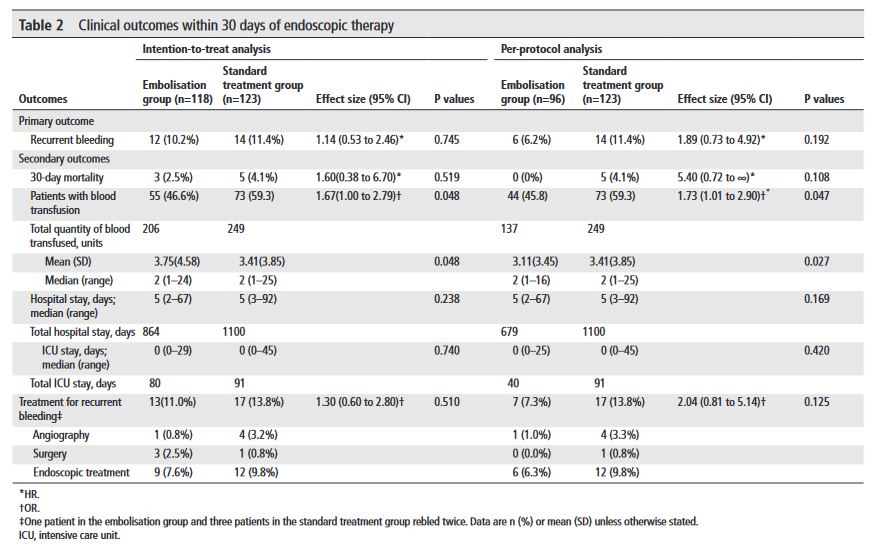
“Acute upper gastrointestinal bleeding (AUGIB) is one of the most common emergencies in gastroenterology. Despite major improvements in its management, AUGIB continues to be associated with significant morbidity and mortality. Bleeding peptic ulcers are one of the principal causes of AUGIB. Endoscopic therapy to bleeding ulcers reduces further bleeding and improves patients’ outcomes”
“Anastomotic leakage is a common yet one of the most feared complications following colorectal surgery. Dehiscence of the anastomosis can result in fatal complications such as peritonitis, abscess formation, and sepsis, thereby increasing morbidity and mortality, cost and length of hospital stay. Multiple factors contribute to the development of anastomotic dehiscence. Several studies have been published identifying various risk factors that may play a role in causing AL.” (Sripathi)
“Anastomotic leak in colorectal surgery is a multifactorial complication associated with an increased morbidity and mortality rate. It has remained the most feared complication over the past several years, despite numerous studies and technological advances like robotic surgery, staplers, and other anastomotic techniques. The clinical significance of reviewing and summarizing the risk factors of AL is to identify high-risk patients. Awareness and understanding of these factors will provide an opportunity to offer more comprehensive preoperative patient counseling.” (Sripathi)
“The number of intersections of staple lines is associated with anastomotic leakage, and the inversion technique is a useful method for avoiding anastomotic leakage. Using an appropriate technique by skilled operator, double stapling technique for laparoscopic anterior resection is safe and feasible.”
“
Laparoscopic intracorporeal colorectal anastomosis with double stapling technique is difficult because of the unsuitable cutting angle associated with using a linear stapler in the narrow pelvic cavity. Consequently, we sometimes have used multiple stapler firings during division of the rectum. Because of the long and tilted linear staple line placed on the rectal stump, a circular anastomotic plane can create multiple intersections of staple lines and dog-ears. Anastomotic leakage is a major problem in patients with colorectal cancer who have undergo laparoscopic surgery. Despite technical improvements in laparoscopic surgery, recent studies have reported that the anastomotic leakage rate remains at 6.3% to 13.7%.” (Lee)
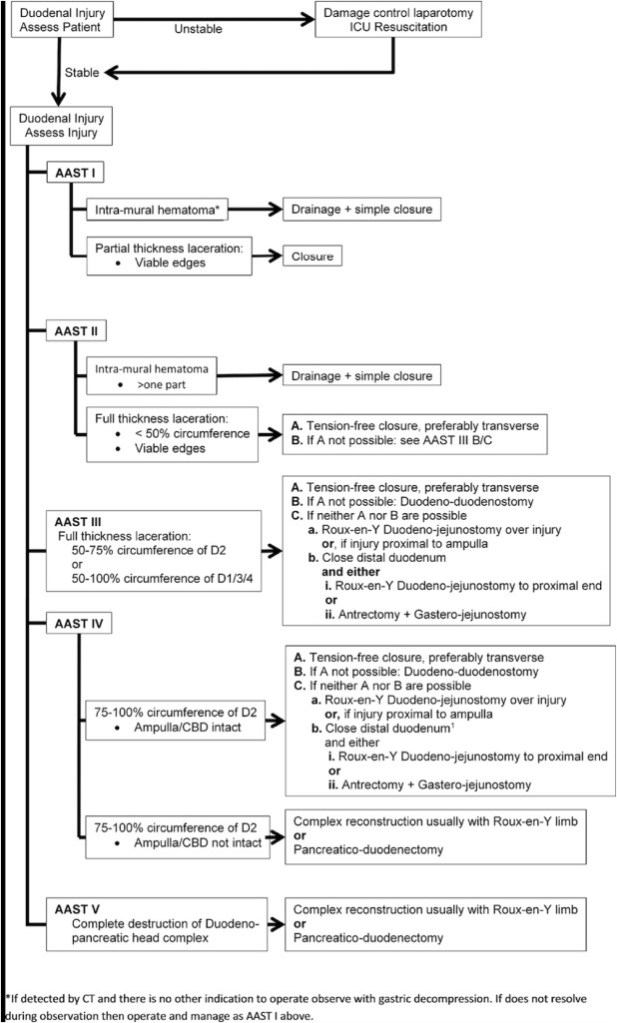
“Duodenal trauma is a rare occurrence existing in 1–4.7% of all abdominal trauma. Its posterior and partially retroperitoneal location shields it from most traumatic mechanisms. Colloquially referred to as the ‘surgical soul’, its proximity to complex regional anatomy makes duodenal trauma particularly at risk for biliary, pancreatic and major vascular injury with 68–86.5% of patients sustaining an associated injury.”