Use of DOTATATE in the surgical management of small bowel neuroendocrine tumors

A discussion this week included the use of DOTATATE in the surgical management of small bowel neuroendocrine tumors.


Reference: Howe JR et al. The surgical management of small bowel neuroendocrine tumors: consensus guidelines of the North American Neuroendocrine Tumor Society (NANTES). Pancreas. 2017 Jul;46(6):715-731. doi:10.1097/MPA.0000000000000846

Summary: The three most commonly used 68Ga-labeled somatostatin receptor PET imaging agents are 68Ga-DOTATATE, 68Ga-DOTATOC and 68Ga-DOTANOC. Despite the slight variation of the somatostatin receptor affinity of these agents, all of them have shown excellent sensitivity in detection of NETs. At this time, there is no evidence of significant diagnostic superiority of one agent over the others.

Continue reading

Endovascular repair vs open repair for ruptured abdominal aortic aneurysm

One discussion this week included open vs endovascular repair for ruptured AAA.

Reference: IMPROVE trial investigators. Comparative clinical effectiveness and cost effectiveness of endovascular strategy v open repair for ruptured abdominal aortic aneurysm: three year results of the IMPROVE randomised trial. BMJ. 2017 Nov 14;359:j4859. doi: 10.1136/bmj.j4859

Trial registration: Current controlled trials ISRCTN48334791; ClinicalTrials NCT00746122.

Summary: Involving 30 vascular centers – 29 in UK, one in Canada – and 613 patients between 2009 and 2016, the IMPROVE trial is the first RCT comparing keyhole endovascular aneurysm repair to the traditional open surgery with comprehensive mid-term outcomes. The primary outcome was mortality; secondary outcomes included reinterentions, quality of life, resource use, consts, quality adjusted life year (QALYs), and cost effectiveness.

The data analyses showed endovascular repair “offers no significant reduction in operative mortality at 30 or 90 days, but there is an interim midterm survival advantage (3 months to 3 years), that when taken together with the early gains in QoL, leads to a mid-term gain in QALYs after 3 years.

  • Mortality: 179 deaths in endovascular group, 183 in open repair, with similar results for mortality related to aneurysm
    • Of the 502 patients treated for confirmed rupture, mortality at 3 years: 109/259 (42%) in endovascular, 131/243 (54%) in open repair
  • Reinterventions related to aneurysm: occured at similar rate in both groups, especially those for life threatening conditions.
  • Cost differences at 30 days: “not erorded by an increased burden of reinterventions in later follow-up and therefore the endovascular strategy is cost effective” (p.7).

The authors conclude that at three years, the endovascular repair “offers an increase in QALYs, without an excess of reinterventions, and is cost effective” (p.9). The IMPROVE trial mid-term follow-up supports the benefits of endvascular vs open repair to treat ruptured AAA.

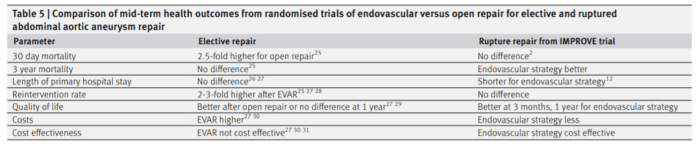
Table 5 (p.8) compares the mid-term outcomes from multiple RCTs of endovascular vs open repair for AAA, including the IMPROVE trial.

improve table 5

Additional reading: Bjorck M. Endovascular or open repair for ruptured abdominal aortic aneurysm? BMJ. 2017;359:j5170. doi:10.1136/bmj.j5170.

Laparoscopic sleeve gastrectomy vs laparoscopic Roux-en-Y gastric bypass on weight loss: Two RCTs

A discussion in December included gastric bypass versus sleeve gastrectomy.

References: Peterli R, et al. Effect of laparoscopic sleeve gastrectomy vs laparoscopic Roux-en-Y gastric bypass on weight loss patients with morbid obesity: the SM-BOSS randomized clinical trial. JAMA. 2018 Jan 16;319(3):255-265. doi:10.1001/jama.2017.20897

Salminen P, et al. Effect of laparoscopic sleeve gastrectomy vs laparoscopic Roux-en-Y gastric bypass on weight loss at 5 years among patients with morbid obesity: the SLEEVEPASS randomized clinical trial. JAMA. 2018 Jan 16;319(3):241-254. doi:10.1001/jama.2017.20313

Summary: Published in the same issue of JAMA, these two trials – one in Switzerland, one in Finland – provide thorough insight into comparing the sleeve and gastric bypass for weight loss in morbidly obese patients. To be consice, the study designs, results, and conclusions are quoted below.

SM-BOSS trial – clinicaltrials.gov Identifier: NCT00356213

DESIGN, SETTING, AND PARTICIPANTS: The Swiss Multicenter Bypass or Sleeve Study (SM-BOSS), a 2-group randomized trial, was conducted from January 2007 until November 2011 (last follow-up in March 2017). Of 3971 morbidly obese patients evaluated for bariatric surgery at 4 Swiss bariatric centers, 217 patients were enrolled and randomly assigned to sleeve gastrectomy or Roux-en-Y gastric bypass with a 5-year follow-up period.

RESULTS: Among the 217 patients (mean age, 45.5 years; 72% women; mean BMI, 43.9) 205 (94.5%) completed the trial. Excess BMI loss was not significantly different at 5 years: for sleeve gastrectomy, 61.1%, vs Roux-en-Y gastric bypass, 68.3% (absolute difference, −7.18%; 95% CI, −14.30% to −0.06%; P = .22 after adjustment for multiple comparisons). Gastric reflux remission was observed more frequently after Roux-en-Y gastric bypass (60.4%) than after sleeve gastrectomy (25.0%). Gastric reflux worsened (more symptoms or increase in therapy) more often after sleeve gastrectomy (31.8%) than after Roux-en-Y gastric bypass (6.3%). The number of patients with reoperations or interventions was 16/101 (15.8%) after sleeve gastrectomy and 23/104 (22.1%) after Roux-en-Y gastric bypass.

CONCLUSIONS AND RELEVANCE: Among patients with morbid obesity, there was no significant difference in excess BMI loss between laparoscopic sleeve gastrectomy and laparoscopic Roux-en-Y gastric bypass at 5 years of follow-up after surgery.

SLEEVEPASS trial – clinicaltrials.gov Identifier: NCT00793143

DESIGN, SETTING, AND PARTICIPANTS: The Sleeve vs Bypass (SLEEVEPASS) multicenter, multisurgeon, open-label, randomized clinical equivalence trial was conducted from March 2008 until June 2010 in Finland. The trial enrolled 240 morbidly obese patients aged 18 to 60 years, who were randomly assigned to sleeve gastrectomy or gastric bypass with a 5-year follow-up period (last follow-up, October 14, 2015).

RESULTS: Among 240 patients randomized (mean age, 48 [SD, 9] years; mean baseline body mass index, 45.9, [SD, 6.0]; 69.6% women), 80.4% completed the 5-year follow-up. At baseline, 42.1% had type 2 diabetes, 34.6% dyslipidemia, and 70.8% hypertension. The estimated mean percentage excess weight loss at 5 years was 49% (95% CI, 45%-52%) after sleeve gastrectomy and 57% (95% CI, 53%-61%) after gastric bypass (difference, 8.2 percentage units [95% CI, 3.2%-13.2%], higher in the gastric bypass group) and did not meet criteria for equivalence. Complete or partial remission of type 2 diabetes was seen in 37% (n = 15/41) after sleeve gastrectomy and in 45% (n = 18/40) after gastric bypass (P > .99). Medication for dyslipidemia was discontinued in 47% (n = 14/30) after sleeve gastrectomy and 60% (n = 24/40) after gastric bypass (P = .15) and for hypertension in 29% (n = 20/68) and 51% (n = 37/73) (P = .02), respectively. There was no statistically significant difference in QOL between groups (P = .85) and no treatment-related mortality. At 5 years the overall morbidity rate was 19% (n = 23) for sleeve gastrectomy and 26% (n = 31) for gastric bypass (P = .19).

CONCLUSIONS AND RELEVANCE: Among patients with morbid obesity, use of laparoscopic sleeve gastrectomy compared with use of laparoscopic Roux-en-Y gastric bypass did not meet criteria for equivalence in terms of percentage excess weight loss at 5 years. Although gastric bypass compared with sleeve gastrectomy was associated with greater percentage excess weight loss at 5 years, the difference was not statistically significant, based on the prespecified equivalence margins.

Early versus delayed cholecystectomy

A discussion in December compared early versus delayed cholecystectomy.


References: Ackerman J, et al. Beware of the interval cholecystectomy. The Journal of Trauma and Acute Care Surgery. 2017 Jul;83(10):55-60. Full-text for Emory users.

Gurusamy KS, Davidson C, Gludd C, Davidson BR. Early versus delayed laparoscopic cholecystectomy for people with acute cholecystitis (Review). Cochrane Database of Systematic Reviews. 2013 Jun 30;(6):CD005440. Full-text for Emory users.

Summary: Cochrane’s review on early vs delayed cholecystectomy included 6 trials and 488 individuals. Of those, 244 received laparoscopic cholecystectomy early (within 7 days of presentation), while the remaining 244 received it at least 6 weeks after index admission with acute cholecystitis. The primary conclusion is that “based on information from a varied number of participants as well as trials at high risk of bias, early laparoscopic cholecystectomy during acute cholecystitis appears safe and shortens the total hospital stay [by 4 days]” (p.2).

There was no significant difference in operating time. Only one of the trials measured time to return to work, nothing that patients in the early group returned to work an average of 11 days earlier than the delayed group. Four trials did not report any gallstone-related complications; one trial reported five, including two people with cholangitis. In five trials, one-sixth of people in the delayed group had either non-resolution or recurrence of symptoms before their planned operation and had to have emergency laparoscopic cholecystectomy (p.6).

Using the terms immediate and interval, Ackerman et al (2017) conducted a retrospective cohort analysis to quantify the morbidity and mortality associated with a delayed, or interval cholecystectomy (IC). Of all patients admitted to 7 hospitals within the same healthcare system, 337 had percutaneous cholecystostomy (PC), 177 (52.5%) of those also had an interval cholecystectomy (IC). The table below illustrates the outcomes:

ic outcomes

(Ackerman et al, 2017, p.57)

Sclerosing encapsulating peritonitis

One discussion this week involved small bowel obstruction and sclerosing encapsulating peritonitis (SEP).


Reference: Liberale G, Sugarbaker PH. Sclerosing encapsulating peritonitis as a potential complication of cytoreductive surgery and HIPEC: clinical features and results of treatment in 4 patients. Surgical Oncology. 2018 Dec;27(4):657-662.

Summary: Liberale and Sugarbaker (2018) define SEP as “a rare entity characterized by encapsulation of the small bowel and/or the colon by fibrous tissue forming a shell” (p.657). It is iatrogenic, idiopathic, or secondardy, and its pathophysiology is uncertain. The most common symptoms are abdominal pain, discomfort, and partial or complete obstruction.

In this article, the authors present 4 cases of SEP, all of which required additional surgery to alleviate recurrent episodes of small bowel obstruction.

In discussion, they provide some advice (p.661):

  • An adverse event to avoid is small bowel fistula following surgery.
  • The prevention of fistulization which results in enteric contamination of the peritoneal space is of utmost importance in reoperative surgery.
  • Careful marking of seromuscular tears and their repair prior to closing the abdomen is important.
  • A major problem that may occur in follow-up is the difficulty of distinguishing recurrence of peritoneal metastases from benign causes of bowel obstruction.

There are two types of SEP (p.661):

  • Type I: a fibrous membrane sheathing the bowel loops together without a clearly separated dissection plane. Surgery is challenging and the surgeon needs to open the plane between bowel loops while avoiding causing serosal tears.
  • Type II: a fibrous membrane forming an enterocele or ‘pseudocyst-like’ structure. These are easier to manage as, once the pouch is open, the small bowel can be dissected and separated easily from the surrounding sheath.

To drain or not to drain…the GRECCAR 5 randomized trial

One discussion this week focused on pelvic drains.

Reference: Denost Q, et al. To drain or not to drain infraperitoneal anastomosis after rectal excision for Cancer: The GRECCAR 5 randomized trial. Annals of Surgery. 2017 Mar;265(3):474-480. doi:10.1097/SLA.0000000000001991.

Summary: The GRECCAR 5 randomized trial sought to explore the benefit of a drain for postoperative pelvic sepsis, overall morbidity and mortality, rate of re-operation, length of stay, and rate of stoma closure at 6 months (p.474). It involved 469 patients (236 with drains, 233 without) between 2011 and 2014.

Ultimately, the trial did not find any benefit of the pelvic drain after low anterior resection for rectal cancer. Thus, the authors “recommend not using pelvic drain after rectal excision for cancer, except in case of operative bleeding or beyond TME surgery” (p.480).

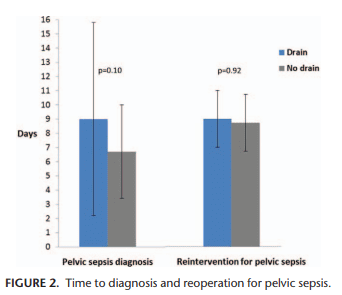
The drain did not contribute to an efficient diagnosis of sepsis, for the time to diagnosis of pelvic sepsis was an average of 7.8 days, yet the drain was removed at 5.5 days postop (see figure below; p.1478).

pelvic sepsis

There was no significant difference between the two groups for any of the noted measurements. Pelvic sepsis occurred in 16.1% of those with the drain and 18.0% of those without drain. Re-operation for pelvic sepsis was done in 10.2% of those with drain and 12.0% of those without drain.

Additional reading: Placer C. To drain or not to drain infraperitoneal anastomosis after rectal excision for cancer: an unclosed debate [Letter to the Editor]. Annals of Surgery. 2018. doi:10.1097/SLA.0000000000003005. [Epub ahead of print]

The Prospective Peri-operative Enoxaparin Cohort Trial (PROSPECT)

Reference: Dunn AS, Spyropoulos AC, Turpie AG. Bridging therapy in patients on long-term oral anticoagulants who require surgery: the Prospective Peri-operative Enoxaparin Cohort Trial (PROSPECT). Journal of Thrombosis and Haemostasis. 2007 Nov;5(11):2211-2218.

Summary: Due to limited data on the incidence of peri-operative thromboemobolic and bleeding during bridge therapy, there is no agreement on optimal peri-operative management of patients on oral anticoagulants (OACs). Dunn et al sought to “examine the incidence of major bleeding of a peri-operative strategy using once-daily therapeutic-dose enoxaparin administered primarily at home, and the effect, if any, of the extensiveness of the procedure on the risk of bleeding during bridge therapy” (p.2211-2212).

The study involved 24 sites in North America between January 2002 and August 2003. The figure below shows the study’s peri-operative management protocol (p.2212): periop mgmt2


Safety outcomes:

  • Incidence of major bleeding while on enoxaparin or in the 24 hours following cessation of enoxaparin treatment
    • Occurred in 3.5% (95% CI: 1.6-6.5)
    • Invasive procedures: 1.4%
    • Minor surgery: 0%
    • Major surgery:  27.5%
  • Rate of minor bleeding while on enoxaparin, or within 24 hours of discontinuation
    • Occurred in 108 patients (41.5%, 95% CI:35.7-47.6)
    • Invasive procedures: 44.6%
    • Minor surgery: 47.2%
    • Major surgery: 20.0%

Efficacy outcomes:

  • Incidence of arterial thromboembolic events for patients with afib
    • 4 events out of 176 patients (2.3%, 95% CI: 0.6-5.7)
    • 2 TIAs, 0 strokes, 2 patients had peripheral arterial thromboembolic events
  • Incidence of venous thromboembolic events for patients with a history of DVT.
    • 1 event out of 96 patients (1.0%, 95% CI: 0.03-5.7)
    • None fatal

Bleeding risk is high when bridging therapy is done peri-operatively in major surgery. In this study, there were 8 instances of major bleeding among 40 total patients in major surgery. Out of 220 invasive procedures or minor surgery, there was only 1 major bleeding event.