Negative pressure wound therapy versus standard care for incisionallaparotomy subcutaneous wounds

“Surgical site infections after gastrointestinal perforation with peritonitis have significant
morbidity, increased hospital stays, and cost of treatment. The appropriate management of these wounds is still debatable.”

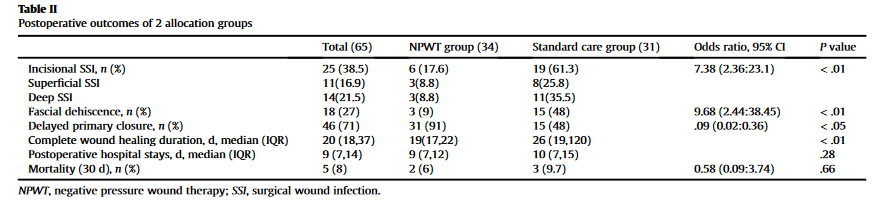
“In this single-center randomized controlled trial, we found that the use of NPWT on the surgical incision in patients with GIP significantly reduced the rate of SSI and wound dehiscence. The overall incidence of SSI in the present study was 38.5%. The use of
NPWT also significantly increased the rate of delayed primary wound closure and improved wound healing time.”
Continue reading

Comparative study between Graham’s omentopexy and modified-Graham’s omentopexy

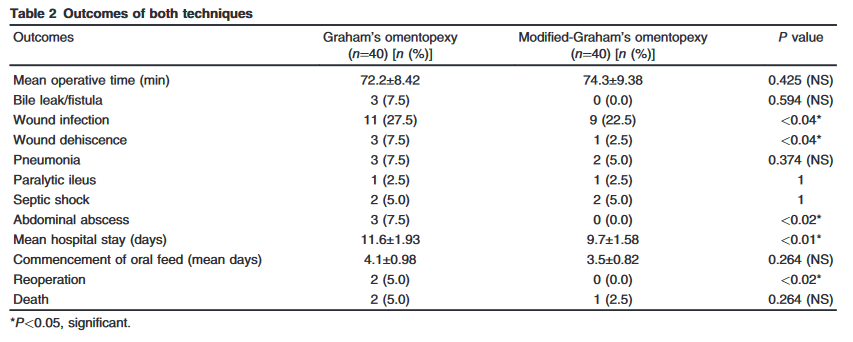
“Peptic ulcer perforation is a frequent cause of hospitalization, which affects 2–10% of patients with peptic ulcer. Omentopexy is commonly used in emergency management of duodenal ulcer perforation. Omentopexy was first described by Cellen Jones in 1929 and was later modified by Graham in 1937. The surgical approaches for omental patching rely on two principles, that is, direct and indirect omentopexy.”

Continue reading

Effects of honey compared to silver sulfadiazine for the treatment of burns

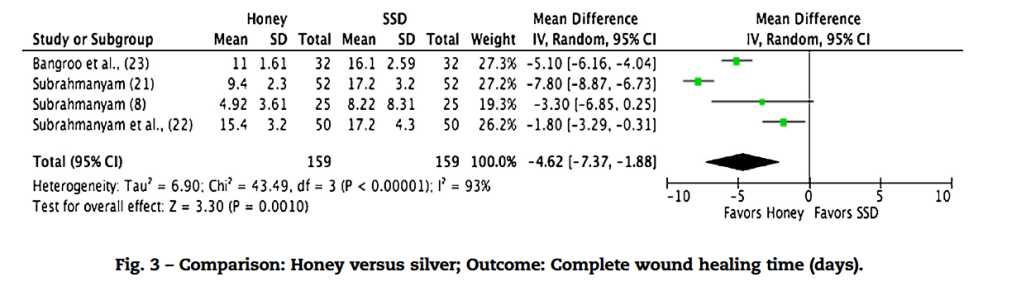
“Topical dressings containing honey as well as silver sulfadiazine (SSD) have re-emerged as a treatment option for burn wound management. Honey is postulated to facilitate wound healing by its chemical debridement and anti-inflammatory action, and its ability to create a viscous barrier on the wound surface thus preventing the invasion of micro-organisms. Meanwhile, SSD may be considered as the gold standard for topical burn treatment. In contrast to honey, silver-containing dressings are capable of absorbing the burn exudates and releasing silver which has been recognized as an effective antimicrobial agent against a broad range of bacteria, yeast, and viruses. However, recent findings have shown that topical silver delays rather than promotes wound healing and is associated with potentially severe adverse effects.”

Continue reading

The STITCH trial: a summary

One discussion this week mentioned the STITCH trial.

Reference: Deerenberg EB, et al. Small bites versus large bites for closure of abdominal midline incisions (STITCH): a double-blind, multicentre, randomised control trial. Lancet. 2015 Sep 26;386(10000):1254-1260. doi: 10.1016/S0140-6736(15)60459-7.

Summary: Incisional hernia is a frequent complication of abdominal operations with an incidence of 10–23%, which can increase to 38% in specific risk groups. It is associated with pain and discomfort, resulting in a decreased quality of life. Incarceration and strangulation of abdominal contents can take place, for which emergency surgery is indicated, with associated morbidity and mortality. The authors (2015) estimate about 348,000 operations for incisional hernia are done every year in the US with $3.2 billion in annual associated costs.

Continue reading

Myasthenia gravis and vascular endothelial growth factor (VEGF)

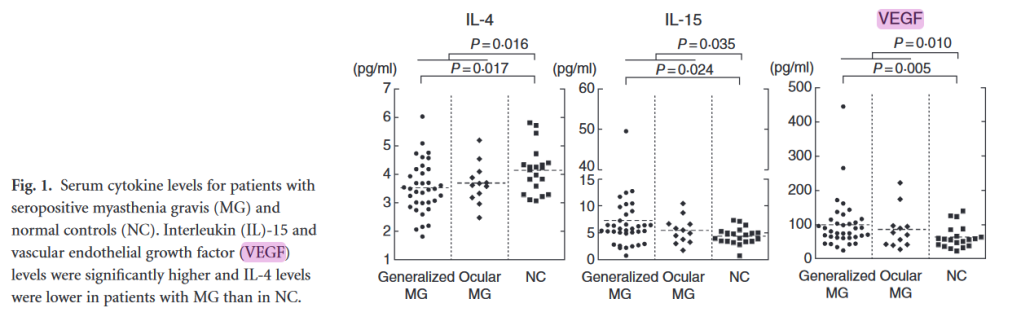
“Myasthenia gravis (MG), an antibody-mediated autoimmune disease of the neuromuscular junction, is characterized by muscle weakness and fatigability and is caused by autoantibodies against muscle nicotinic acetylcholine receptor (AChR). The anti-AChR antibody is produced by T cell-dependent and B cell-mediated pathogenic mechanisms, activates the complement system and leads to inflammation of the postsynaptic muscle membrane.” (Uzawa)

Uzawa

Continue reading

Frailty and Emergency Surgery

“Emergency surgery carries higher risk of mortality and morbidity. Appropriate risk assessment, attentive decision-making and carefully selected interventions are the cornerstones of a patient centered management.” (Leiner)

“Frailty, a “syndrome of loss of reserves,” is more than decade old concept. Initially it was used mainly in geriatrics but lately its use has been extended into other specialties including surgery. A meta-analysis demonstrated that frail surgical patients had a higher risk of readmission and increased risk of mortality.” (Leiner)

ACS NSQIP Surgical Risk Calculator

Continue reading