
Risk of Major Nonemergent Inpatient General Surgical Procedures in Patients on Long-term Dialysis

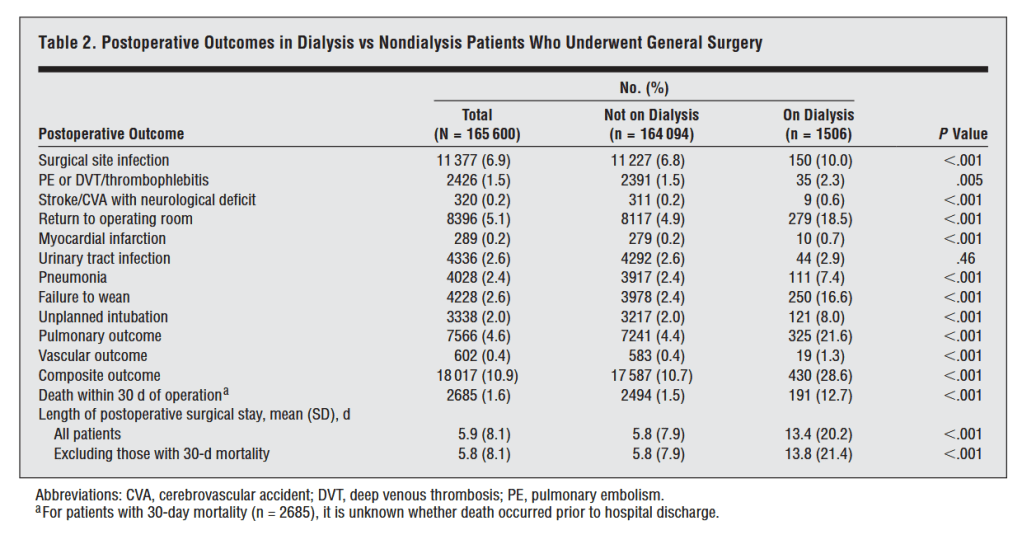
“More than half a million individuals in the United States undergo dialysis, a number that has been forecasted to increase by 7% annually. End-stage renal disease requiring dialysis is associated with poor health care outcomes, including a 10-fold increase in risk of hospitalization and an expected lifespan between one-fourth and one-sixth of that of the general population. Despite the well-described outcomes of the effect of end-stage renal disease on community-dwelling individuals, little is known about the contribution of long-term dialysis to the risks of postoperative complications and death.”
Continue reading

Mortality risk reduction associated with PTH reduction for Secondary Hyperparathyroidism

One discussion this week included parathyroid hormone (PTH) levels.


Reference: Komaba H, et al. Parathyroidectomy and survival among Japanese hemodialysis patients with secondary hyperparathyroidism. Kidney International. 2015 Aug;88(2):350-359. doi: 10.1038/ki.2015.72

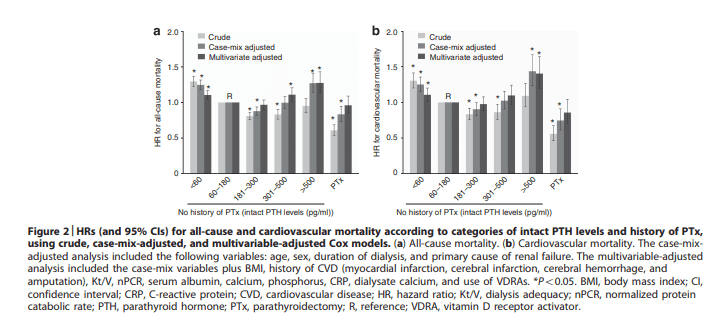
Summary: In a nationwide study of 114,064 hemodialysis patients, Komaba et al asked if PTx for severe SHPT improves survival of dialysis patients.  They compared patient outcomes by PTH levels, and by those with a history of parathyroidectomy (PTx) (6,6280) and those without PTx (107,436).

fig2

(p.353)

Excess PTH is shown to increase cardiac fibrosis; elevations in serum calcium, phophorus, and PTH levels are associated with death and cardiovascular events primarily due to vascular calcification (p.350).

fig4

(p.355)

For cardiovascular death, there was a significant increase in the multivariate-adjusted HR for patients with intact PTH levels < 60 pg/ml (HR, 1.11; 95% CI, 1.02–1.20) and those with intact PTH levels >500 pg/ml (HR, 1.41; 95% CI, 1.20–1.64). In contrast, such an increased risk of mortality was not observed in patients with a history of PTx, despite the fact that these patients had severe SHPT preoperatively.