
Management of the difficult duodenal stump

Burch JM, Cox CL, Feliciano DV, Richardson RJ, Martin RR. Management of the difficult duodenal stump. Am J Surg. 1991 Dec;162(6):522-6.

Full-text for Emory users.

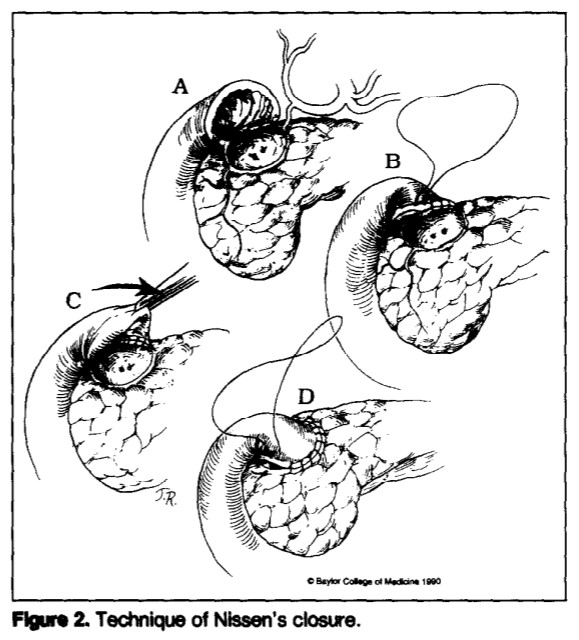
Abstract: Leakage from the duodenal stump has been the most feared complication of the Billroth II reconstruction following gastric resection. The purpose of our study was to evaluate four methods of duodenal stump closure in 200 patients. One hundred and forty-seven (74%) patients had duodenal ulcers; 28 (14%) had gastric ulcers; and 25 (13%) had a variety of other inflammatory conditions. The most common indication for operation was acute hemorrhage (51%), followed by perforation (24%), intractability (15%), and obstruction (10%). Conventional duodenal closures were performed in 160 (80%) patients, Nissen’s closure in 25 (13%), Bancroft’s closure in 6 (3%), and tube duodenostomy in 9 (5%). Duodenal leaks occurred in four (2.5%) patients with conventional closures and in three (33%) patients with tube duodenostomies. No leaks occurred in patients with Nissen’s or Bancroft’s closures. The hospital mortality rate for the series was 9.5%; however, no patient who developed a duodenal leak died. We conclude that Nissen’s and Bancroft’s closures were safe and effective, but that tube duodenostomy did not reliably prevent uncontrolled leakage.
Continue reading

Prophylactic arterial embolization in patients with bleeding peptic ulcers

“Upper gastrointestinal bleeding is a common emergency in people. With a hospitalization rate of 67 per 100,000 in the USA and an in-hospital mortality of 1.9 per 100 cases, it is a severe condition. The most common cause of upper gastrointestinal bleeding is a peptic ulcer in the stomach or duodenum. The aetiology of peptic ulcers is complex, but known risk factors for complications of peptic ulcers are Helicobacter pylori infection, and the use of non-steroidal anti-inflammatory drugs (NSAIDs). The definition of a peptic ulcer is a loss of tissue from the mucosa. The bleeding is often from the arteries in the submucosa or tunica muscularis, but there can be erosions of larger arteries, such as the gastroduodenal, right gastric, or left gastric arteries.”

Continue reading

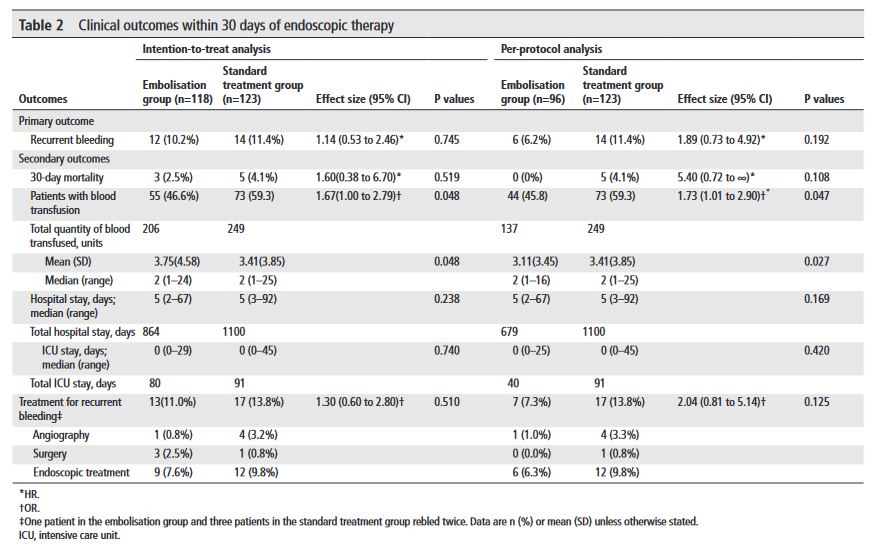
Can angiographic embolisation after endoscopic haemostasis to high-risk ulcers could reduce recurrent bleeding.?

“Acute upper gastrointestinal bleeding (AUGIB) is one of the most common emergencies in gastroenterology. Despite major improvements in its management, AUGIB continues to be associated with significant morbidity and mortality. Bleeding peptic ulcers are one of the principal causes of AUGIB. Endoscopic therapy to bleeding ulcers reduces further bleeding and improves patients’ outcomes”

Continue reading