Foreign body removal without hospitalization: a new use for a stent removal device

One discussion this week involved the removal of foreign bodies.

Reference: Smith PM, et al. Isiris: a novel method of removing foreign bodies from the lower urinary tract to avoid unnecessary hospitalization and anesthesia. Journal of Endourology Case Reports. 2016 Aug 1;2(1):144-147. doi: 10.1089/cren.2016.0086.

Summary: Polyembolokoilamania refers to the practice of inserting foreign bodies (FBs) into natural orifices. A FB within the urethra is a relatively rare phenomenon with 646 cases recorded last year in the United Kingdom. Management of these patients presents technical challenges and complexities because of underlying psychiatric disorders that are often associated. This case illustrates a novel way of removing FBs from the genitourinary tract, requiring less resources, preventing hospital admission, and attempts to break the cycle of behavior, leading to recurrent attendance with polyembolokoilamania.

A 38-year-old Caucasian male prisoner, with psychiatric history presented to the emergency department (ED) with a history of inserting FBs into his urethra on 12 different occasions over a 6-week period. Of these 12 attendances, 3 resulted in admission and 2 required emergency intervention in theater under general anesthesia. After the third attendance in 5 days, it was decided to use Isiris™, a single-use flexible cystoscopy device with a built-in ureteral stent grasper, to remove the FBs and check the integrity of the urethra. The procedure was performed within the ED, without the need for admission to a ward bed or general anesthesia. Furthermore, only two members of staff were required to remove all of the urethral FBs.

Isiris, although marketed as a stent removal device, enabled us to remove all the patient’s FBs in one procedure. Isiris is an easy to use device, similar to a flexible cystoscope, that a specialist nurse or resident would be familiar using. It allows efficient and safe removal of lower urinary tract FBs, even out of hours. It requires minimal staffing support and can be done in the ED. It has the potential to reduce associated sequela of urethral polyembolokoilamania, saving resources while preserving the availability of the emergency theater.

Outcomes of and predictors for bowel ischemia after AAA repair: a study of 7312 patients

One discussion this week included AAA repair. The article cited here was provided by the chief resident.

Reference: Ultee KH, et al. Incidence of and risk factors for bowel ischemia after abdominal aortic aneurysm repair. Journal of Vascular Surgery. 2016 Nov;64(5):1384-1391. doi: 10.1016/j.jvs.2016.05.045.

Summary: Bowel ischemia is a rare but devastating complication after abdominal aortic aneurysm (AAA) repair. Its rarity has prohibited extensive risk-factor analysis, particularly since the widespread adoption of endovascular AAA repair (EVAR); therefore, this study assessed the incidence of postoperative bowel ischemia after AAA repair in the endovascular era and identified risk factors for its occurrence

METHODS: A total of 7312 patients undergoing intact or ruptured AAA repair in the Vascular Study Group of New England (VSGNE) January 2003 – November 2014 were included. Patients with and without postoperative bowel ischemia were compared and stratified by indication (intact and ruptured) and treatment approach (open repair and EVAR). Criteria for diagnosis were endoscopic or clinical evidence of ischemia, including bloody stools, in patients who died before diagnostic procedures were performed. Independent predictors of postoperative bowel ischemia were established using multivariable logistic regression analysis.

RESULTS: Postoperative outcomes (p.1389):

AAA repair

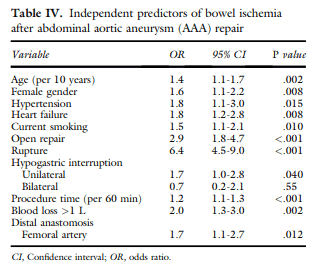
RESULTS: Predictors of bowel ischemia after AAA repair (p.1390):

AAA predictors

CONCLUSIONS: The authors state that “these date should be considered during operative planning in an effort to adequately assess patient risk for bowel ischemia and undertake efforts to reduce it” (p.1391).

Can vein diameter predict arteriovenous fistula maturation?

One discussion this week included the relationship between vein size and fistula failure.

Reference: Bashar K, et al. The role of venous diameter in predicting arteriovenous fistula maturation: when not to expect an AVF to mature according to pre-operative vein diameter measurements? A best evidence topic. International Journal of Surgery. 2015 Mar;15:95-99. doi: 10.1016/j.ijsu.2015.01.035.

Summary: This best evidence topic was investigated according to a described protocol, and asked the question: what is the minimal vein diameter that can successfully predict maturation of an arteriovenous fistula (AVF) in patients undergoing dialysis?

The search retrieved 804 papers, of which 5 represented the best evidence to answer the clinical question. All studies assessed the association between successful AVF maturation and the size of vein used.

Highlighted findings:

  1. The strongest evidence came from a non-randomised controlled follow-up study in which 76% of fistulas created using >2 mm cephalic vein successfully matured compared to 16% when the vein measured ≤2 mm.
  2. Another prospective, multicentre study showed 65% successful maturation using veins >4 mm compared to 45% with veins < 3 mm. Vein diameter was found to be an independent predictor of maturation in multivariate regression analysis in two retrospective observational studies.
  3. A retrospective observational study found that using venous measurements of ≥2.5 mm following tourniquet application resulted in more fistulas been created that would have otherwise been denied based on venous ultrasound mapping.
  4. Routine use of tourniquet makes it possible to form AVFs in patients who otherwise would have been rejected. One study showed good results from using a transposed BBAVF when a BCAVF was deemed inappropriate following US.

In conclusion, a vein diameter of <2.5 mm should be considered inadequate for formation of an AVF, particularly if those measurements remain unchanged following the use of tourniquet.

The timing and accuracy of SLNB for nodal management after NAC

One discussion this week included nodal management after neoadjuvant chemotherapy (NAC).


Reference: Pilewskie M and Morrow M. Axillary nodal management following neoadjuvant chemotherapy. JAMA Oncology. 2017 Apr 1;3(4):549-555.

Summary: The increasing use of NAC has raised questions about the optimal approach to the axilla, including accuracy and timing of sentinel lymph node biopsy (SLNB) in patients who are clinically node negative (cN0) at presentation, use of NAC to avoid axillary lymph node dissection (ALND) in patients presenting with node-positive disease, and the relative importance of pre-and post-NAC stage in predicting the risk of locoregional recurrence (LRR).

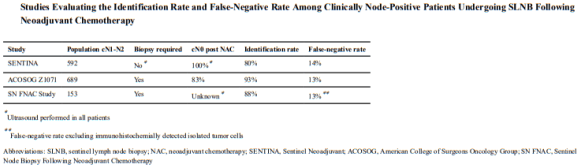
The decrease in nodal metastases in cN0 patients undergoing post-NAC axillary staging and the increasing rates of pCR in the breast in patients treated with current chemotherapy regimens led to the study of SLNB among patients presenting with cN+ disease. Table 3 (below) summarizes data from three prospective, multi-institutional trials assessing the accuracy of SLNB after NAC among node-positive patients.

SLNB

The authors conclude: NAC reduces the need for ALND, and SLNB is an accurate
method of determining nodal status post NAC. The demonstration that SLNB accurately stages the axilla after NAC regardless of the presenting nodal stage (cN0, cN1) provides an important rationale for the use of NAC for axillary downstaging in patients who are candidates for breast-conserving surgery at presentation or who desire mastectomy. SLN identification rates and FNRs in those who are cN0 are similar to those seen with initial SLN surgery, and nodal recurrence after a negative SLNB is uncommon.


Additional Reading: Boughey JC, et al. Sentinel lymph node surgery after neoadjuvant chemotherapy in patients with node-positive breast cancer: the ACOSOG Z1071 (Alliance) clinical trial. JAMA. 2013 Oct 9;310(14):1455-1461. doi:10.1001/jama.2013.278932.

What are the rates of major and minor bleeding complications after pharmacologic DVT prophylaxis?

One discussion this week included the rate of bleeding complications after pharmacologic DVT prophylaxis.

Reference: Leonardi MJ, McGory ML, Ko CY. The rate of bleeding complications after pharmacologic deep venous thrombosis prophylaxis: a systematic review of 33 randomized controlled trials. Archives of Surgery. 2006 Aug;141(8):790-797.

Summary: In a systematic review of 33 RCTs with 33,813 patients, Leonardi et al (2006) concluded that there is a small, but measurable, rate of minor bleeding complications associated with pharmacologic DVT prophylaxis: injection site bruising (6.9%), wound hematoma (5.7%), drain site bleeding (2.0%), and hematuria (1.6%).

The rate of major complications, such as GI tract (0.2%) or RP (<0.1%) bleeding, was extremely low in this review. Complications requiring a change in care, such as subsequent operation (0.7%) or discontinuation of prophylaxis (2.0%), were also infrequent. The subsequent operation rate for bleeding problems for pharmacologic prophylaxis vs placebo was identical, at 0.7%.

dvt

(p.795)

Additional Reading: Leonardi MJ, McGory ML, Ko CY. A systematic review of deep venous thrombosis prophylaxis in cancer patients: implications for improving quality. Annals of Surgical Oncology. 2007 Feb;14(2):929-936.

Restrictive vs liberal red-cell transfusion strategy: the Transfusions Requirements in Critical Care (TRICC) trial

One discussion this week included the TRICC trial.

Reference: Herbert PC, et al…the Transfusion Requirements in Critical Care Investigators for the Canadian Critical Care Trials Group. A multicenter, randomized, controlled clinical trial of transfusion requirements in critical care. NEJM. 1999 Feb 11;340(6):409-417.

Summary:  The aim of the study was to determine whether a restrictive strategy of red-cell transfusion and a liberal strategy produced equivalent results in critically ill patients, we compared the rates of death from all causes at 30 days and the severity of organ dysfunction.

Methods: Between 1994 and 1997, the trial enrolled 838 critically ill patients with euvolemia after initial treatment who had hemoglobin concentrations of less than 9.0 g per deciliter within 72 hours after admission to the intensive care unit and randomly assigned 418 patients to a restrictive strategy of transfusion, in which red cells were transfused if the hemoglobin concentration dropped below 7.0 g per deciliter and hemoglobin concentrations were maintained at 7.0 to 9.0 g per deciliter, and 420 patients to a liberal strategy, in which transfusions were given when the hemoglobin concentration fell below 10.0 g per deciliter and hemoglobin concentrations were maintained at 10.0 to 12.0 g per deciliter.

Results: The use of a threshold for red-cell transfusion as low as 7.0 g of hemoglobin per deciliter, combined with maintenance of hemoglobin concentrations in the range of 7.0 to 9.0 g per deciliter, was at least as effective as and possibly superior to a liberal transfusion strategy (threshold, 10.0 g per deciliter; maintenance range, 10.0 to 12.0) in critically ill patients with normovolemia. There was a trend toward decreased 30-day mortality among patients who were treated according to the restrictive transfusion strategy. The significant differences in mortality rates during hospitalization, rates of cardiac complications, and rates of organ dysfunction all favored the restrictive strategy.

TRICC trial

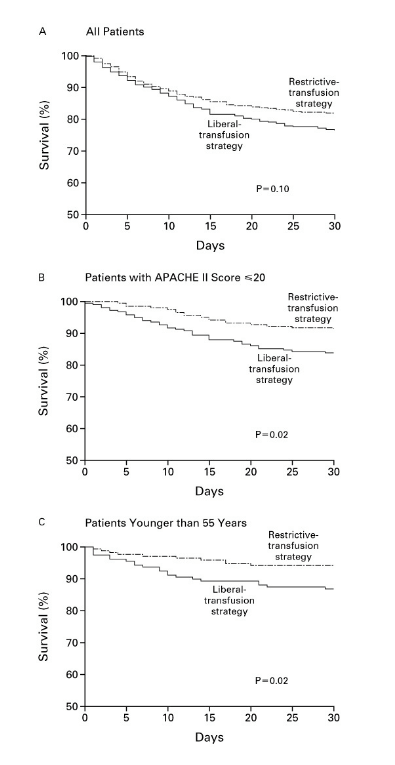
Overall, 30-day mortality was similar in the two groups (18.7 percent vs. 23.3 percent, P= 0.11). However, the rates were significantly lower with the restrictive transfusion strategy among patients who were less acutely ill — those with an Acute Physiology and Chronic Health Evaluation II score of < or =20 (8.7 percent in the restrictive-strategy group and 16.1 percent in the liberal-strategy group; P=0.03) — and among patients who were less than 55 years of age (5.7 percent and 13.0 percent, respectively; P=0.02), but not among patients with clinically significant cardiac disease (20.5 percent and 22.9 percent, respectively; P=0.69). The mortality rate during hospitalization was significantly lower in the restrictive-strategy group (22.3 percent vs. 28.1 percent, P=0.05).

Conclusion:  On the basis of the trial’s results, the authors recommend that critically ill patients receive red-cell transfusions when their hemoglobin concentrations fall below 7.0 g per deciliter and that hemoglobin concentrations should be maintained between 7.0 and 9.0 g per deciliter. The diversity of the patients enrolled in this trial and the consistency of the results suggest that these conclusions may be generalized to most critically ill patients, with the possible exception of patients with active coronary ischemic syndromes.


Enterocutaneous fistulas: causes, management, and Emory authors

One discussion this week involved enterocutaneous fistulas.

Reference: Haak CI, Galloway JR, Srinivasan J. Enterocutaneous fistulas: a look at causes and management. Current Surgery Reports. 2014 Oct;2:71.

Summary: Despite advances in medical technology and surgical care, the management of enterocutaneous fistulas (ECF) remains one of the most challenging problems faced by physicians. Success depends on an expert multidisciplinary team, access to long-term enteral and parenteral nutrition support, advanced wound care, optimal medical management and meticulous, methodical, surgical decision-making and technique.

Continue reading