
The role of evoked potentials in thoracoabdominal aortic repair

One discussion this week involved the role of evoked potentials in thoracoabdominal aortic (TAA) repair.

Reference: Achouh PE, et al. Role of somatosensory evoked potentials in predicting outcome during thoracoabdominal aortic repair. The Annals of Thoracic Surgery. 2007 Sep; 84(3):782-787.

Summary:  Between January 2000 and April 2005, a study out of Houston, TX, used SSEP monitoring in 444 patients (270 thoracoabdominal aorta and 174 descending thoracic aorta).  Changes were classified as (1) no change, (2) transient changes that returned to baseline by the end of the procedure, or (3) persistent changes that did not return to baseline by the end of the procedure.

Primary findings included:

  • Somatosensory evoked potential changes occurred in 87 (19.6%) patients; 22 (25%) of these did not return to baseline.
  • Immediate neurologic deficit occurred in 8 of 444 patients (1.8%); five deficits (5 of 87; 5.8%) occurred in patients with SSEP changes, compared with three deficits (3 of 357; 0.8%) in patients without changes.
  • Somatosensory evoked potential was a poor screening tool for neurologic deficit, with a sensitivity of 62.5% and specificity 81.2%. Negative predictive value was 99.2%, indicating a very low event probability in the absence of SSEP changes. Delayed neurologic deficit occurred in 3.2% and was not related to SSEP changes.
  • Somatosensory evoked potential changes were also associated with increased 30-day mortality and low glomerular filtration rate.

Achouh et al (2007) conclude that “intraoperative SSEP monitoring was reliable in ruling out spinal injury in DTA and TAA repair, but had a low sensitivity. Somatosensory evoked potential did not predict delayed ND. Spinal SSEP change was an independent predictor for mortality in DTA and TAA repair and correlated with low preoperative glomerular filtration rate” (p.787).
Monitoring gastric residuals in ICU patients: Does it prevent ventilator-associated pneumonia?

One discussion this week involved monitoring gastric residuals in ICU patients.

Reference: Reignier J, et al. Effect of not monitoring residual gastric volume on risk of ventilator-assisted pneumonia in adults receiving mechanical ventilation and early enteral feeding: a randomized control trial. JAMA. 2013 Jan 16;309(3):249-56. doi: 10.1001/jama.2012.196377.

TRIAL REGISTRATION: clinicaltrials.gov Identifier: NCT01137487.

Summary: Monitoring of residual gastric volume is recommended to prevent ventilator-associated pneumonia (VAP) in patients receiving early enteral nutrition. However, studies have challenged the reliability and effectiveness of this measure.

DESIGN, SETTING, AND PATIENTS: Randomized, noninferiority, open-label, multicenter trial conducted from May 2010 through March 2011 in adults requiring invasive mechanical ventilation for more than 2 days and given enteral nutrition within 36 hours after intubation at 9 French intensive care units (ICUs); 452 patients were randomized and 449 included in the intention-to-treat analysis (3 withdrew initial consent).

INTERVENTION: Absence of residual gastric volume monitoring. Intolerance to enteral nutrition was based only on regurgitation and vomiting in the intervention group and based on residual gastric volume greater than 250 mL at any of the 6 hourly measurements and regurgitation or vomiting in the control group.

RESULTS: In the intention-to-treat population, VAP occurred in 38 of 227 patients (16.7%) in the intervention group and in 35 of 222 patients (15.8%) in the control group (difference, 0.9%; 90% CI, -4.8% to 6.7%). There were no significant between-group differences in other ICU-acquired infections, mechanical ventilation duration, ICU stay length, or mortality rates. The proportion of patients receiving 100% of their calorie goal was higher in the intervention group (odds ratio, 1.77; 90% CI, 1.25-2.51; P = .008). Similar results were obtained in the per-protocol population.

CONCLUSION AND RELEVANCE: Among adults requiring mechanical ventilation and receiving early enteral nutrition, the absence of gastric volume monitoring was not inferior to routine residual gastric volume monitoring in terms of development of VAP.

The authors further conclude that “eliminating residual gastric volume monitoring from standard care may have beneficial effects. First, in the present study, absence of residual gastric volume monitoring was associated with improved enteral nutrition delivery. High residual gastric volume values often lead to enteral nutrition discontinuation, which in turn causes underfeeding with increases in morbidity and mortality rates. We found no difference in mortality rates. However, our enteral nutrition protocol was more aggressive than previously reported protocols: enteral nutrition was started at the rate required to meet the calorie target and was stopped gradually in the event of intolerance. Moreover, enteral nutrition solution lost by vomiting, being discarded, or both was not measured, thus resulting in potential overestimation of delivered calories. These factors may have attenuated any mortality difference related to differences in delivered enteral nutrition volume” (p.255).

Endovascular repair vs open repair for ruptured abdominal aortic aneurysm

One discussion this week included open vs endovascular repair for ruptured AAA.

Reference: IMPROVE trial investigators. Comparative clinical effectiveness and cost effectiveness of endovascular strategy v open repair for ruptured abdominal aortic aneurysm: three year results of the IMPROVE randomised trial. BMJ. 2017 Nov 14;359:j4859. doi: 10.1136/bmj.j4859

Trial registration: Current controlled trials ISRCTN48334791; ClinicalTrials NCT00746122.

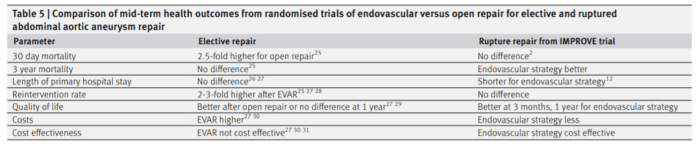
Summary: Involving 30 vascular centers – 29 in UK, one in Canada – and 613 patients between 2009 and 2016, the IMPROVE trial is the first RCT comparing keyhole endovascular aneurysm repair to the traditional open surgery with comprehensive mid-term outcomes. The primary outcome was mortality; secondary outcomes included reinterentions, quality of life, resource use, consts, quality adjusted life year (QALYs), and cost effectiveness.

The data analyses showed endovascular repair “offers no significant reduction in operative mortality at 30 or 90 days, but there is an interim midterm survival advantage (3 months to 3 years), that when taken together with the early gains in QoL, leads to a mid-term gain in QALYs after 3 years.

  • Mortality: 179 deaths in endovascular group, 183 in open repair, with similar results for mortality related to aneurysm
    • Of the 502 patients treated for confirmed rupture, mortality at 3 years: 109/259 (42%) in endovascular, 131/243 (54%) in open repair
  • Reinterventions related to aneurysm: occured at similar rate in both groups, especially those for life threatening conditions.
  • Cost differences at 30 days: “not erorded by an increased burden of reinterventions in later follow-up and therefore the endovascular strategy is cost effective” (p.7).

The authors conclude that at three years, the endovascular repair “offers an increase in QALYs, without an excess of reinterventions, and is cost effective” (p.9). The IMPROVE trial mid-term follow-up supports the benefits of endvascular vs open repair to treat ruptured AAA.

Table 5 (p.8) compares the mid-term outcomes from multiple RCTs of endovascular vs open repair for AAA, including the IMPROVE trial.

improve table 5

Additional reading: Bjorck M. Endovascular or open repair for ruptured abdominal aortic aneurysm? BMJ. 2017;359:j5170. doi:10.1136/bmj.j5170.

The use of REBOA for trauma

One discussion this week included the use of REBOA for trauma cases.

Reference: Brenner, M, et al. Use of resuscitative endovascular balloon occlusion of the aorta for proximal aortic control in patients with severe hemorrhage and arrest. JAMA Surgery. 2018 Feb;153(2):130-135. doi:10.1001/jamasurg.2017.3549.

Summary: Reporting on the largest single-institution study on REBOA in the US, Brenner et al (2018) state that the risks of clinician exposure and morbidity of opening the thorax to cross-clamp the aorta make REBOA a more attractive option than emergency department thoracotomy with aortic cross-clamp (EDTCC). This study observed outcomes of patients with  severe traumatic hemorrhage, traumatic arrest (AR), and nontraumatic hemorrhage (NTH) between 2013 and 2017.

For 79 patients with severe traumatic hemorrhage and AR, in-hospital mortality was 71%. Technical success, as defined by AO at the intended level (zone 1 or 3), occurred in 44 of the 53 patients (83%) who had radiographic, fluoroscopic, manual, or CT confirmation of the balloon. The remaining identified malpositioned catheters were repositioned immediately to a slightly more proximal location (proximal zone 2 to distal zone 1) without clinical sequelae. Seven patients underwent REBOA at zone 1, which was then purposefully repositioned to zone 3 after intra-abdominal hemorrhage was ruled out by imaging (n = 3) or surgical exploration (n = 4) (p.131-132).

In the patients with severe traumatic hemorrhage, the 30-day survival was 59% (p.132). Indications for REBOA were transient responders or nonresponders who remained severely hypotensive despite resuscitation efforts. A total of 18 patients (62%) received REBOA in zone 1, while 11 patients with severe hemorrhage from the pelvis or below (38%) received REBOA in zone 3. Twelve patients received REBOA in the OR; the indications included AR or impending AR, refractory hypotension, presence of expanding pelvic hematoma with abdominal hemostasis, and performance of REBOA prior to exploration of a large central hematoma including, in 1 patient, severe adhesions from a previous laparotomy.

Of the patients with AR, 50 received REBOA while in arrest. Spontaneous circulation occurred in 29 (58%), 20 of those survived to the OR. The 30-day survival was 10% (p.133). Access to the CFA was percutaneous in 13 patients and via surgical cutdown
in 37 patients, including 8 patients who had access attempted percutaneously but completed via cutdown. Patients received cardiopulmonary resuscitation throughout the REBOA procedure (p.133).

Benefits of REBOA are:

  • the ability to provide continuous closed chest compressions during the procedure
  • its ability to temporize hemorrhage and thus buy time to gather results of diagnostic imaging, especially when other injuries may alter treatment algorithms
  • the consequences of extended occlusion, particularly in patient care settings without resources for definitive hemorrhage control

Brenner et al (2018) note that REBOA can also be used for more targeted AO in the distal aorta for pelvic, junctional, or extremity hemorrhage (p.135).

What is the morbidity and mortality of TEVAR for ruptured thoracic aortic aneurysms?

One discussion this week included the morbidity and mortality of TEVAR in the setting of ruptured thoracic aortic aneurysms.

Reference: Geisbusch, P, et al. Endovascular repair of ruptured thoracic aortic aneurysms is associated with high perioperative mortality and morbidity. Journal of Vascular Surgery. 2010 Feb;51(2):299-304. doi:10.1016/j.jvs.2009.08.049.

Summary: In a retrospective study, Geisbusch et al (2010) analyzed the outcomes of emergency endovascular treatment of thoracic aortic pathologies (TEVAR). Out of 236 patients, 23 received thoracic aortic repair due to a ruptured thoracic aortic aneurysm (rTAA). The overall hospital mortality was 48% (see table below, p.302). Overall technical success was 87%. Three patients showed relevant primary endoleaks, and thus were not considered technical successes.

table3

The causes of death in the 11 patients were: cardiac complications (7), multiorgan failure (3), and pulmonary embolism (1) (p.301).

The authors admit: “Mortality rates after TEVAR for acute descending aortic rupture vary between 0% and 17% in the few available series, which seems relatively low compared with our in-hospital mortality rate of 48%” (p.303).

The patient population in this study had a median age of 75 years, and was highly comorbid (83% with coronary heart disease, 43% with renal insufficiency, and 30% with COPD), resulting in high cardio-pulmonary and renal complications with consecutive perioperative death. Three-year survival is estimated at 30%.

In conclusion, “the endovascular treatment of ruptured thoracic aortic aneurysms is associated with a high perioperative mortality and morbidity as well as poor midterm survival. Renal insufficiency proved as an independent risk factor for perioperative death” (p.303).

The Carotid Revascularization Endarterectomy vs Stenting Trial (CREST)

One discussion this week involved the Carotid Revascularization Endarterectomy vs. Stenting Trial (CREST).


Reference: Brott TG, et al. Stenting versus endarterectomy for treatment of carotid-artery stenosis. New England Journal of Medicine. 2010 Jul 1;363(1):11-23. doi:10.1056/NEJMoa0912321.

Summary:  CREST is an RCT with blinded end-point adjudication whose aim was “to compare the outcomes of carotid-artery stenting with those of carotid endarterectomy among patients with symptomatic or asymptomatic extracranial carotid stenosis” (p.12).

Between December 2000 through July 2008, 2522 patients were enrolled in 108 centers in the US and 9 in Canada. Of those, 1271 patients were randomly assigned to undergo carotid-artery stenting.

Primary findings include (p.18):

  • Carotid revascularization performed by highly qualified surgeons and interventionists is effective and safe.
  • Stroke was more likely after carotid-artery stenting.
  • Myocardial infarction was more likely after carotid endarterectomy, but the effect on the quality of life was less than the effect of stroke.
  • Younger patients had slightly fewer events after carotid-artery stenting than after carotid endarterectomy.
  • Older patients had few events after carotid endarterectomy.
  • Low absolute risk of recurrent stroke suggests that both carotid-artery stenting and carotid endarterectomy are clinically durable and reflect advances in medical therapy.

The Asymptomatic Carotid Atherosclerosis Study (ACAS)

One discussion this week included the Asymptomatic Carotid  Atherosclerosis Study (ACAS).

Reference: Endarterectomy for asymptomatic carotid artery stenosis. Executive Committee for the Asymptomatic Carotid Atherosclerosis Study. JAMA. 1995 May 10;273(18):1421-1428.

Summary: ACAS was a prospective, randomized trial conducted at 39 sites in the US and Canada between December 1987 and December 1993. Its purpose was to “determine whether the addition of carotid endarterectomy to aggressive medical management can reduce the incidence of cerebral infarction in patients with asymptomatic carotid artery stenosis” (p.1421).

The primary finding was that the risk of ipsilateral stroke and any periopoerative stroke or death over 5 years was 5.1% for surgical patients and 11.0% for medically treated patients (p.1425). Furthermore, those who are good candidates for elective surgery and have carotid artery stenosis of 60% or greater reduction in diameter will have a significantly reduced 5-year risk of ipsilateral stroke “if carotid endarterecomy performed with less than 3% perioperative morbidity and mortality is added to aggressive management of modifiable risk factors” (p.1421).

Additionally, ACAS concluded that CEA reduces the relative stroke risk 66% for men and 17% for women. This difference is perhaps due to higher rates of perioperative complications in women.When arteriographic and perioperative complications are excluded, the risk reduction was 79% for men and 56% for women (p.1427).