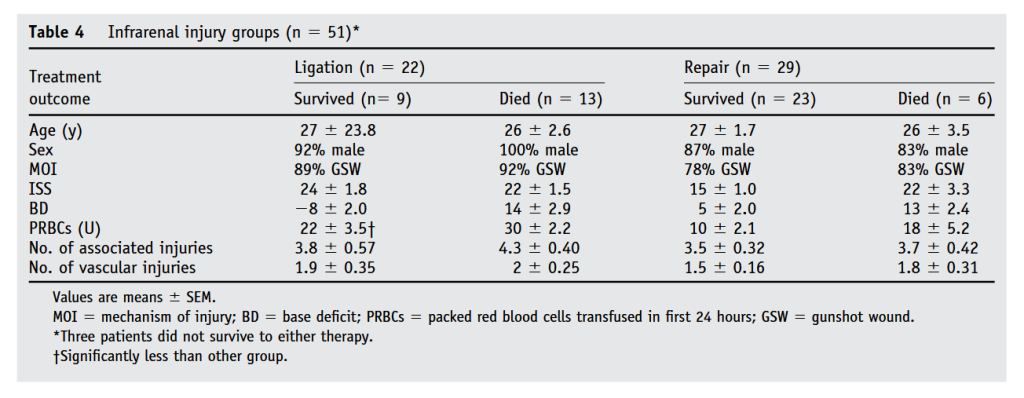
Outcome of ligation of the inferior vena cava in the modern era

“Injury to the inferior vena cava (IVC) is a relatively rare event occurring more commonly after penetrating trauma (.5%–5%) than after blunt trauma (.6%–1%). The incidence of IVC injuries, however, has been increasing in civilian trauma centers, with these injuries accounting for up to 40% of abdominal vascular injuries in recent series.
Because of the increasing frequency and persistently high mortality associated with these injuries, perioperative management of the IVC remains a focus of interest. Indeed, while ligation of the significantly injured IVC is an acceptable practice in the era of damage control surgery, little long-term follow-up data are available in survivors of this technique.”
Continue reading

Postoperative CD4 counts predict anastomotic leaks in patients withpenetrating abdominal trauma

“Survival following penetrating abdominal trauma has improved significantly, nonetheless despite enhanced resuscitation and surgical intervention strategies the immune mediated systemic inflammatory response syndrome (SIRS) continues to result in organ dysfunction and potential death. Posttraumatic lymphopenia or altered cell-mediated immunity as a result of decreased lymphocyte subsets may affect SIRS severity; however in penetrating trauma it is uncertain which factors may result in decreased CD4 counts and whether or not these changes affect postoperative outcomes, in particular anastomotic complications.”

Continue reading

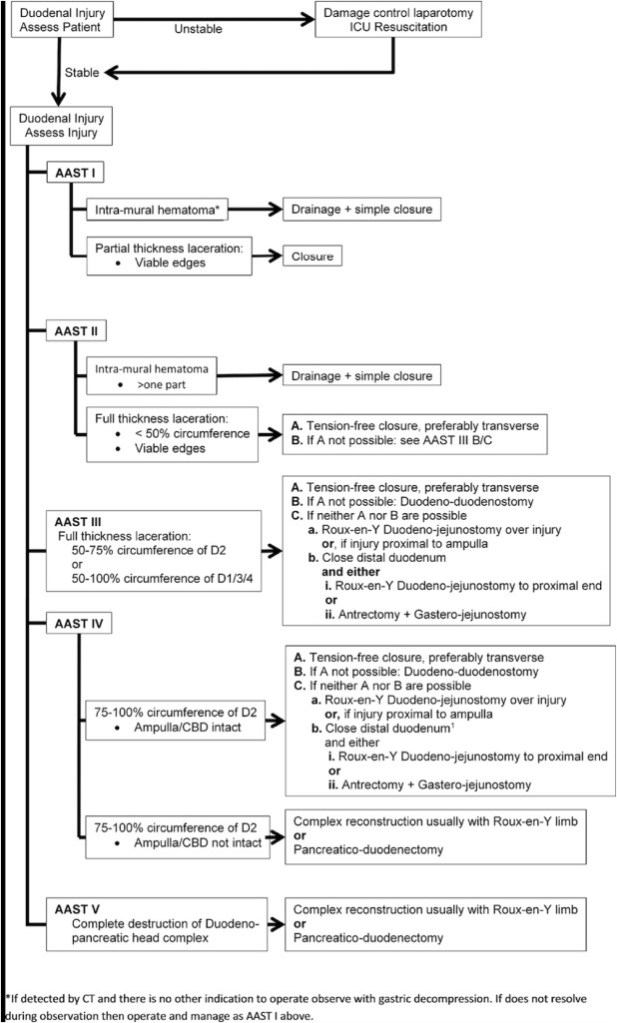
Management of the complex duodenal injury

“Duodenal trauma is a rare occurrence existing in 1–4.7% of all abdominal trauma. Its posterior and partially retroperitoneal location shields it from most traumatic mechanisms. Colloquially referred to as the ‘surgical soul’, its proximity to complex regional anatomy makes duodenal trauma particularly at risk for biliary, pancreatic and major vascular injury with 68–86.5% of patients sustaining an associated injury.”

Continue reading

Article of interest: Anatomic guidelines for the prevention of abdominal wall hematoma induced by trocar placement

Balzer KM, et al. Anatomic guidelines for the prevention of abdominal wall hematoma induced by trocar placement. Surg Radiol Anat. 1999;21(2):87-9. Full-text for Emory users.

Abstract: A knowledge of the parietal structures of the abdominal wall is necessary to minimize risks of operative procedures like laparoscopy. For means to prevent intraoperative bleeding and the occurrence of abdominal wall hematoma, we studied the course of the inferior epigastric arteries and the ascending branch of the deep circumflex iliac artery in 21 human cadavers. The abdominal wall structures were dissected and the distances of the arteries in relation to anatomic structures such as the umbilicus, pubic symphysis, superior ischial spine and lower edge of the rib-cage were measured. Comparison of the morphometric results obtained with the location of 36 trocar incision sites recommended in the common literature yields the information that about half of these incision sites incur the risk of injuring the arteries.

Continue reading