Complications of Jejunostomy Feeding Tubes

“To help mitigate the perioperative risks of poor nutrition status, nutritional interventions via either parenteral or enteral techniques are available. For these reasons, especially in the
setting of foregut reconstruction and planned return to oncology therapy, our bias has been the use of postoperative jejunal feeding tube access in our surgical oncology population in
high-risk and nutritionally depleted patients. Jejunostomy feeding tubes are not without complication, however, with high reported rates of tube dysfunction. Jejunostomy tubes
can be easily dislodged, have imperfect seals at wound exit sites leading to leakage, and can be somewhat cumbersome for patients and caregivers to maintain. Some authors have
begun to advocate for the selective placement of jejunostomy tubes following gastric and esophageal resections.”

Continue reading

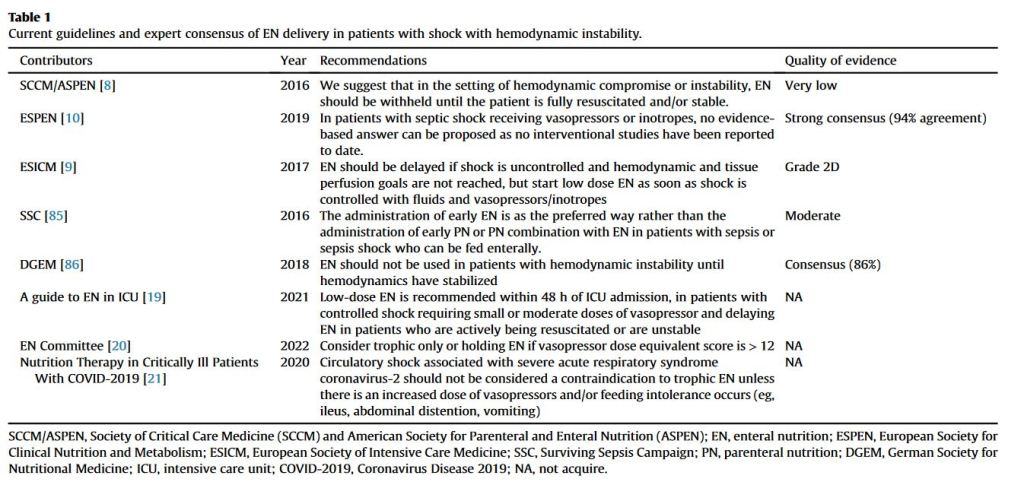
Starting early enteral nutrition safely in patients with shock on vasopressors

“Shock is a common critical illness characterized by microcirculatory disorders and insufficient tissue perfusion. Patients with shock and hemodynamic instability generally require vasopressors to maintain the target mean arterial pressure. Enteral nutrition (EN) is an important therapeutic intervention in critically ill patients and has unique benefits for intestinal recovery. However, the initiation of early EN in patients with shock receiving vasopressors remains controversial.”
“It remains a therapeutic challenge in critical care nutrition therapy to determine the initiation time of EN in patients with shock receiving vasopressors and the safe threshold region for initiating EN with vasopressors. Therefore, the current review aimed to summarize the evidence on the optimal and safe timing of early EN initiation in patients with shock receiving vasopressors to improve clinical practice.”

Continue reading

Article of interest: Comparison of open gastrostomy tube to percutaneous endoscopic gastrostomy tube in lung transplant patients.

Taghavi S, et al. Comparison of open gastrostomy tube to percutaneous endoscopic gastrostomy tube in lung transplant patients. Ann Med Surg (Lond). 2015 Dec 23;5 :76-80.

Introduction: Lung transplant patients require a high degree of immunosuppression, which can impair wound healing when surgical procedures are required. We hypothesized that because of impaired healing, lung transplant patients requiring gastrostomy tubes would have better outcomes with open gastrostomy tube (OGT) as compared to percutaneous endoscopic gastrostomy tube (PEG).

Continue reading

The safety of enteral and parenteral nutrition in ICU patients receiving vasopressors

Patel JJ, et al. Phase 3 Pilot Randomized Controlled Trial Comparing Early Trophic Enteral Nutrition With “No Enteral Nutrition” in Mechanically Ventilated Patients With Septic Shock. JPEN J Parenter Enteral Nutr. 2020 Jul;44(5):866-873.

Full-text for Emory users.

Results: One hundred thirty-one patients were eligible for enrollment, and 49 were available for consent. Thirty-one (86%) consented and were randomized and 100% of patients in the early EN arm and 94% in the “no EN” arm completed their protocols. While on vasopressors, early EN group received median 384 kcal, and the “no EN” group received median 0 kcal. Contamination rate was 0 in the early trophic EN arm and 6% in the “no EN” arm. The early EN group had median 25 intensive care unit-free days, as compared with 12 in the “no EN” arm (P = .014). The early EN arm had median 27 ventilator-free days, compared with 14 in “no EN” arm (P = .009).

Conclusion: Our protocol comparing early trophic EN with “no EN” in septic shock was feasible. Early trophic EN may be beneficial, but a larger multicenter trial is warranted to confirm the observed clinical benefits seen in this trial.

Continue reading

A randomised trial of post-discharge enteral feeding following surgical resection of an upper gastrointestinal malignancy

Froghi F, et al. A randomised trial of post-discharge enteral feeding following surgical resection of an upper gastrointestinal malignancy. Clin Nutr. 2017 Dec;36(6):1516-1519.

Full-text for Emory users.

RESULTS: 44 patients (M:F, 29:15) were randomised, 23 received jejunal supplements. There were no differences between the groups. Percentage of calculated energy requirement received was greater in the supplemented group at weeks 3 and 6 (p < 0.0001). Oral energy intake was not different between the groups at any time period. After hospital discharge, there were no differences in MFI-20, EQ5D and QLQ-OES18 scores at any time point. From hospital discharge fatigue improved and plateaued at 6 weeks (p < 0.05 for both groups), independence at 12 weeks (p < 0.05 for both groups). No improvement was seen in quality of life until 24 weeks in the active group alone (p < 0.02) and not at all in the control group.

CONCLUSIONS: Addition of jejunal feeding is effective in providing patients with an adequate energy intake. Increased energy intake however, produced no obvious improvement in measures of fatigue, quality of life or health economics.

Nutritional support of the enterocutaneous fistula patient

Kumpf VJ, et al. ASPEN-FELANPE Clinical Guidelines: Nutrition Support of Adult Patients With Enterocutaneous Fistula.JPEN J Parenter Enteral Nutr. 2017 Jan;41(1):104-112. doi: 10.1177/0148607116680792.

Free full-text. 

Questions addressed in these guidelines: 

In adult patients with enterocutaneous fistula: (1) What factors best describe nutrition status? (2) What is the preferred route of nutrition therapy (oral diet, enteral nutrition, or parenteral nutrition)? (3) What protein and energy intake provide best clinical outcomes? (4) Is fistuloclysis associated with better outcomes than standard care? (5) Are immune-enhancing formulas associated with better outcomes than standard formulas?(6) Does the use of somatostatin or somatostatin analogue provide better outcomes than standard medical therapy? (7) When is home parenteral nutrition support indicated?

Continue reading