
Retracting the thyroid matters: Who develops asymptomatic transient thyrotoxicosis after parathyroidectomy

“Thyrotoxicosis has been reported as a postoperative complication of parathyroidectomy
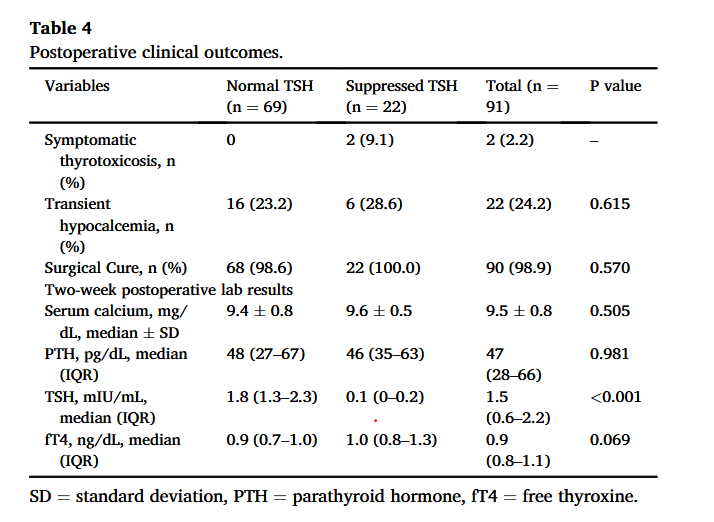
(PTx), attributed to palpation thyroiditis. Palpation thyroiditis was first described by Carney et al., in 1975 as a pathologic response to the traumatic injury of thyroid follicles, characterized by multifocal granulomatous folliculitis. The existing cohort studies in post-PTx thyrotoxicosis are limited. A prospective study of patients who underwent PTx for primary and secondary HPT reported that the incidence rate of thyrotoxicosis after PTx was 31.2 % and 77 %, respectively. The clinical significance of post-PTx thyrotoxicosis remains controversial. While
various manifestations of thyrotoxicosis, including tremors, palpitations, new-onset atrial fibrillation, and angina pectoris mimicking myocardial infarction, were described by case reports, Stang et al. in a cohort study reported that only 15 % of patients developed symptoms of thyrotoxicosis 1–2 weeks after the operation. They further concluded
that the degree of neck dissection appeared explanatory but did not specify which maneuvers were contributory.”
Continue reading

Symptomatic hyperthyroidism following parathyroidectomy

A discussion in January included postoperative hyperthyroidism following parathyroidectomy.


Reference: Patel SG, et al. Hyperthyroidism after parathyroid surgery: A prospective analysis of potential contributing factors. (unpublished)

Summary:

In a prospective study of 101 patients between 2014 and 2015, Patel et al examined surgical extent, anatomic findings, thyroid manipulation, anesthetic medication, and outcomes in order to identify potential intraoperative contributing factors for hyperthyroidism after parathyroidectomy.

Unilateral exploration was found to be significantly less often associated with postoperative hyperthyroidism than bilateral exploration. Additionally, incidence was lower with intraoperative ephedrine and four-fold higher with bilateral exploration. The authors recommend that “postoperative TSH screening for those who require bilateral exploration and/or symptoms of hyperthyroidism should be strongly considered.”

It is stated that this prospective study is the first “to evaluate the type and extent of thyroid manipulation during parathyroid exploration as a cause of hyperthyroidism.”

Due to the fact that the data/manuscript is currently unpublished, minimal information is shared here. We will post a notification when it is published. Our deepest thanks to Dr. Patel for his generosity in sharing this information.

Additional reading: Madill EM, Cooray SD, Bach LA. Palpation thyroiditis following subtotal parathyroidectomy for hyperparathyroidism. Endocrinology, Diabetes & Metabolism Case Reports. 2016 July; pii: 16-0049. doi: 10.1530/EDM-16-0049

Mai VQ et al. Palpation thyroiditis causing new-onset atrial fibrillation. Thyroid. 2008;18(5):571-573. doi:10.1089/thy.2007.0246

Stang MT, et al. Hyperthyroidism after parathyroid exploration. Surgery. 2005 Dec;138(6):1058-1064.