The PAUSE study: Safety of perioperative DOAC management in patients with atrial fibrillation

A discussion during a previous conference included the perioperative management of patients with atrial fibrillation receiving a direct oral anticoagulant (DOAC).


Reference: Douketis JD, et al. Perioperative management of patients with atrial fibrillation receiving a direct oral anticoagulant. JAMA Internal Medicine. 2019 Aug 5; doi:10/1001/jamainternmed.2019.2431

Summary: Each year, 1 in 6 patients with AF, or an estimated 6 million patients worldwide, will require perioperative anticoagulant management. When DOAC regimens became available for clinical use in AF, starting in 2010, no studies had been conducted to inform the timing of perioperative DOAC therapy interruption and resumption, whether heparin bridging should be given, and whether preoperative coagulation function testing was needed. Uncertainty about the perioperative management of DOACs may be associated with unsubstantiated practices and increased harm to patients.

Continue reading

Foley or no Foley? Criteria for perioperative Foley placement

One discussion this week included the use of Foley catheters.


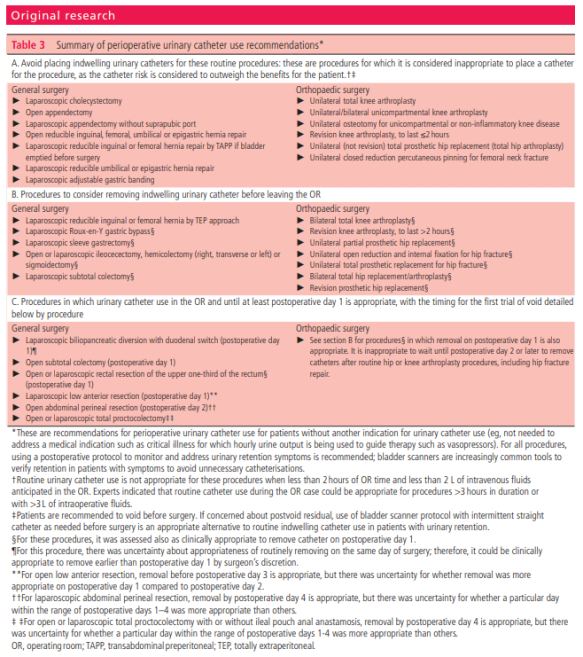
Reference: Meddings J, et al. Michigan Appropriate Periopeartive (MAP) criteria for urinary catheter use in common general and orthopaedic surgeries: results obtained using the RAND/UCLA Appropriateness Method. BMJ Quality & Safety. 2019 Jan;28(1):56-66. doi:10.1136/bmjqs-2018-008025

Summary: Indwelling urinary catheters are commonly used for patients undergoing general and orthopaedic surgery. Despite infectious and non-infectious harms of urinary catheters, there is limited guidance available to surgery teams regarding appropriate perioperative catheter use.

Meddings et al (2019) used the RAND Corporation/University of California Los Angeles (RAND/UCLA) Appropriateness Method 21 to formally rate the appropriateness of urinary catheter placement and timing for removal across routine general and
orthopaedic surgical procedures in adults, as rated by clinicians in different clinical settings across the US and informed by the available literature involving perioperative urinary catheter use.

foley

(Meddings et al, 2019, p.61)

An algorithm for preoperative cardiac risk assessment

One discussion last week involved cardiac arrest in the setting of hernia repair. The reference below was highlighted in the chief resident’s presentation.


Reference: Rafiq A, Skylar E, Bella JN. Cardiac evaluation and monitoring of patients undergoing noncardiac surgeryHealth Services Insight. 2017 Feb 20; 9: 1178632916686074. doi: 10.1177/1178632916686074.

Summary: Cardiovascular complications in the perioperative period are one of the most common events leading to increased morbidity and mortality. Although such events are very small in number, they are associated with a high mortality rate making it essential for physicians to understand the importance of perioperative cardiovascular risk assessment and evaluation. Its involves a detailed process of history taking, patient’s medical profile, medications being used, functional status of the patient, and knowledge about the surgical procedure and its inherent risks.

That being said, this review by Rafiq et al (2017) aims to provide a concise but comprehensive analysis on all such aspects of perioperative cardiovascular risk assessment for noncardiac surgeries and provide a basic methodology toward such assessment and decision making.

The ideal approach toward perioperative cardiac risk assessment requires a multidisciplinary team or a dedicated perioperative team of physicians. This leads expert physicians in this field to be involved in patient care with improved communications among primary physicians, anesthesiologist, surgeons, the patient, family members of the patient, cardiologist, and all other ancillary departments of health care involved.

Figure 1: Algorithm for perioperative cardiac risk assessment prior to noncardiac surgery (p.2)

algorithm cardiac

The authors state that it is important to stress the fact that a majority of these recommendations are based, to a large extent, on observational studies and clinical experience. There are only few RCTs that address this matter. It is prudent that more randomized trials are needed to improve on current recommendations, hence leading to further improvement in patient care and management in the perioperative period.