“Acute fascia dehiscence (FD) is a threatening complication occurring in 0.4–3.5% of cases after abdominal surgery. Prolonged hospital stay, increased mortality and increased rate of incisional hernias could be following consequences. Several risk factors are controversially discussed. Even though surgical infection is a known, indisputable risk factor, it is still not proven if a special spectrum of pathogens is responsible. In this study, we investigated if a specific spectrum of microbial pathogens is associated with FD.”
Continue readingTag Archives: Surgical Wound Dehiscence
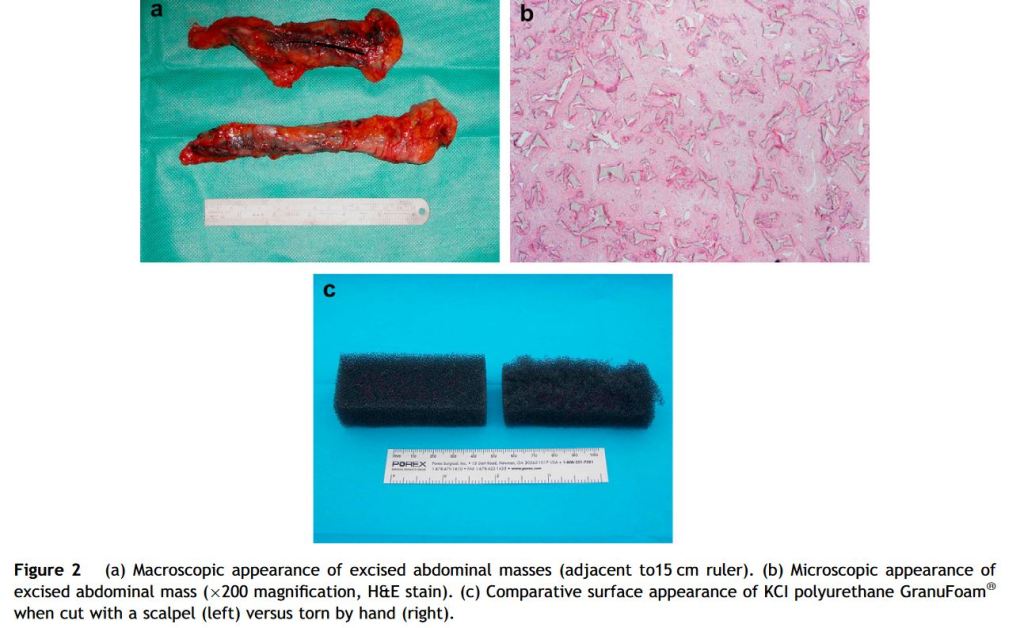
Retained wound VAC material as complication of abdominoplasty
With large cavitating wounds, there is a risk of sponge retention that may be all too easily
overlooked, particularly with the surgeons’ habit of cutting the sponge to the desired shape and the use of multiple fragments. We therefore recommend that a count is made of the number of sponges used – as is standard practise for swabs, needles and instruments.

The impact of abdominal incisional closure techniques on rates of fascial dehiscence
Tolstrup MB, Watt SK, Gögenur I. Reduced Rate of Dehiscence After Implementation of a Standardized Fascial Closure Technique in Patients Undergoing Emergency Laparotomy. Ann Surg. 2017 Apr;265(4):821-826.
Full-text for Emory users.
RESULTS: We included 494 patients from 2014 to 2015 and 1079 patients from our historical cohort for comparison. All patients had a midline laparotomy in an emergency setting. The rate of dehiscence was reduced from 6.6% to 3.8%, P = 0.03 comparing year 2009 to 2013 with 2014 to 2015. Factors associated with dehiscence were male gender [hazard ratio (HR) 2.8, 95% confidence interval (95% CI) (1.8-4.4), P < 0.001], performance status ≥3 [HR 2.1, 95% CI (1.2-3.7), P = 0.006], cirrhosis [HR 3.8, 95% CI (1.5-9.5), P = 0.004], and retention sutures [HR 2.8, 95% CI (1.6-4.9), P < 0.000]. The 30-day mortality rate was 18.4% in the standardized group vs 22.4% in 2009 to 2013, P = 0.057 and 90-day mortality 24.2% vs 30.4%, P = 0.008.
CONCLUSION: The standardized procedure of closing the midline laparotomy by using a “small steps” technique of continuous suturing with a slowly absorbable (polydioxanone) suture material reduces the rate of fascial dehiscence.