
Lobectomy vs total thyroidectomy for intermediate-size papillary thyroid cancer

One discussion last week included the extent of surgery for intermediate-size papillary thyroid cancer: lobectomy vs total thyroidectomy.


Reference: Adam MA, et al. Extent of surgery for papillary thyroid cancer is not associated with survival: an analysis of 61,775 patients. Annals of Surgery. 2014 Oct;260(4):601-605. doi:10.1097/SLA.0000000000000925.

Summary: Guidelines recommend total thyroidectomy for PTC tumors >1 cm, based on older data demonstrating an overall survival advantage for total thyroidectomy over lobectomy.

Adult patients with PTC tumors 1.0-4.0 cm undergoing thyroidectomy in the National Cancer Database between 1998-2006 were included, totaling 61,775 patients. Median follow-up was 82 months (range, 60-179 months).

Lobectomy (n=6849)

Total thyroidectomy (n=54,926)

Nodal disease

7%

27%

Extrathyroidal disease

5%

16%

Multifocual disease

29%

44%

After multivariable adjustment, overall survival was similar in patients undergoing total thyroidectomy versus lobectomy for tumors 1.0-4.0 cm and when stratified by tumor size: 1.0-2.0 cm and 2.1-4.0 cm. Older age, male sex, black race, lower income, tumor size, and presence of nodal or distant metastases were independently associated with compromised survival (P < 0.0001).

Adam et al (2014) conclude that although current guidelines suggest total thyroidectomy for PTC tumors >1 cm, they did not observe a survival advantage associated with total thyroidectomy compared with lobectomy. These findings call into question whether tumor size should be an absolute indication for total thyroidectomy.
Treatment in uremic bleeding

One discussion this week involved the treatment for uremic bleeding.


Reference: Hedges SJ, et al. Evidence-based treatment recommendations for uremic bleedingNational Clinical Practice. Nephrology. 2007 Mar;3(3):138-153.

Summary: Hedges et al (2007) provide a review of normal hemostatic and homeostatic mechanisms that operate within the body to prevent unnecessary bleeding, as well as an in-depth discussion of the dysfunctional components that contribute to complications associated with uremic bleeding syndrome. Prevention and treatment options can include one or a combination of the following: dialysis, erythropoietin, cryoprecipitate, desmopressin, and conjugated estrogens.

The article cited is worth a full text read because:

  • Treatment options are compared with regard to their mechanism of action, and onset and duration of efficacy.
  • An extensive review of the clinical trials that have evaluated each treatment is also presented (Tables 3, 4, 5).
  • An evidence-based treatment algorithm to help guide clinicians through most clinical scenarios, and address common questions related to the management of uremic bleeding.

Uremic bleeding in patients with chronic renal failure is extremely complex. One factor contributing to this complexity is the incomplete elucidation of its pathophysiology. Because the mechanisms underlying uremic bleeding are not fully understood, prevention and treatment for many different clinical scenarios are not clearly defined (p.150).

  • EPO works to increase the number of red blood cells, allowing platelets to travel in closer proximity to the endothelium.
  • Cryoprecipitate and desmopressin work to increase the proportion of normal or functional factors that might be dysfunctional in patients with uremic bleeding.
  • Estrogens are thought to work by decreasing NO levels, thereby increasing concentrations of TxA2 and ADP.

Multiple interventions that simultaneously affect different aspects of the pathophysiology of uremic bleeding might most effectively prevent bleeding in high-risk patients and limit active bleeding in those for who cessation of blood loss is more pressing.

By determining which patients are most at risk, clinicians can utilize dialysis and EPO in the early stages of uremic bleeding, and employ desmopressin, cryoprecipitate and/or estrogens prior to a surgical procedure, thereby possibly preventing bleeding secondary to uremic platelet dysfunction.

Readmission rates following parathyroidectomy for renal disease

One discussion this week included readmission rates following parathyroidectomy.


References: Ferrandino R, et al. Unplanned 30-day readmissions after parathyroidectomy in patients with chronic kidney disease: a nationwide analysis. Otolaryngology – Head and Neck Surgery. 2017 Dec;157(6):955-965. doi:10.1177/0194599817721154.

Summary: A retrospective cohort study was performed using the 2013 Nationwide Readmissions Database (NRD) of the Healthcare Cost and Utilization Project (HCUP) from the Agency for Healthcare Research and Quality (AHRQ). In a total of 2756 parathyroidectomies performed in patients with chronic kidney disease, 17.2%  had at least one unplanned readmission rate within the first 30-days, and 2.4% had more than one readmission. Overall, readmission rates for chronic kidney disease patients are nearly 5-times that of the general population (Ferrandino et al, 2017).

Hypocalcemia/hungry bone syndrome accounted for 40% of readmissions. While readmissions occurred uniformly throughout the 30 days after discharge, those for hypocalcemia/hungry bone syndrome peaked in the first 10 days and decreased over time.

Weight loss/malnutrition at time of parathyroidectomy and length of stay of 5-6 days conferred increased risk of readmission with adjusted odds ratios of 3.31 and 1.87, respectively. Relative to primary hyperparathyroidism, parathyroidectomies performed for secondary hyperparathyroidism were associated with higher risk of readmission.

The authors conclude: “While there are few patient-specific predictors of readmission, we note that the bulk of these readmissions can be attributed to hypocalcemia. To improve readmission rates after parathyroidectomy in CKD patients, we propose focusing on accurate, appropriate medication reconciliation, and optimizing communication and transitions of care to outside facilities (skilled nursing, dialysis, etc.) to facilitate the comprehensive care of this high-risk patient population” (Ferrandino et al, p.964).

Additional Reading: Sharma J, et al. Improved long-term survival of dialysis patients after near-total parathyroidectomy. Journal of the American College of Surgeons. 2012 Apr;214(4):400-407. doi:10.1016/j.jamcollsurg.2011.12.046.

Westerdahl J, et al. Risk factors for postoperative hypocalcemia after surgery for primary hyperparathyroidism. Archives of Surgery. 2000 Feb;135(2):142-147.

AHA Guidelines on post-cardiac stent operations: post-stent dual antiplatelet therapy (DAPT)

One discussion last week included the AHA guidelines on post-stent DAPT.

Reference: Levine GN, et al. ACC/AHA Guideline Update on Duration of Dual Antiplatelet Therapy in CAD Patients. American College of Cardiology. Retrieved from https://www.acc.org/latest-in-cardiology/ten-points-to-remember/2016/03/25/14/56/2016-acc-aha-guideline-focused-update-on-duration-of-dapt.

Additional Reading: Capodanno D, et al. ACC/AHA versus ESC guidelines on dual antiplatelet therapy: JACC guideline comparison. Journal of the American College of Cardiology. 2018 Dec 11;72(23 Part A):2915-2931.  doi: 10.1016/j.jacc.2018.09.057.

Summary: Published on the website in March 2016, the following are “key points to remember about the updated guideline on duration of dual antiplatelet therapy (DAPT) in patients with coronary artery disease (CAD)”.

  1. The scope of this focused update is limited to addressing recommendations on duration of DAPT (aspirin plus a P2Y12 inhibitor) in patients with coronary artery disease (CAD).
  2. Intensification of antiplatelet therapy, with the addition of a P2Y12 inhibitor to aspirin monotherapy, and prolongation of DAPT, necessitate a fundamental tradeoff between decreasing ischemic risk and increasing bleeding risk. Decisions regarding treatment with and duration of DAPT require a thoughtful assessment of the benefit/risk ratio, integration of study data, and patient preference.
  3. Recommendations in the document apply specifically to duration of P2Y12 inhibitor therapy in patients with CAD treated with DAPT. Aspirin therapy should almost always be continued indefinitely in patients with CAD.
  4. Lower daily doses of aspirin, including in patients treated with DAPT, are associated with lower bleeding complications and comparable ischemic protection compared with higher doses of aspirin. The recommended daily dose of aspirin in patients treated with DAPT is 81 mg (range 75–100 mg).
  5. In patients with stable ischemic heart disease (SIHD) treated with DAPT after drug-eluting stent (DES) implantation, P2Y12 inhibitor therapy with clopidogrel should be given for at least 6 months (Class I). In patients with SIHD treated with DAPT after bare-metal stent (BMS) implantation, P2Y12 inhibitor therapy (clopidogrel) should be given for a minimum of 1 month (Class I).
  6. In patients with SIHD treated with DAPT after BMS or DES implantation who have tolerated DAPT without a bleeding complication and who are not at high bleeding risk (e.g., prior bleeding on DAPT, coagulopathy, oral anticoagulant use), continuation of DAPT with clopidogrel for longer than 1 month in patients treated with BMS or longer than 6 months in patients treated with DES may be reasonable (Class IIb).
  7. In patients with acute coronary syndrome (ACS) (non-ST elevation [NSTE]-ACS or ST elevation myocardial infarction [STEMI]) treated with DAPT after BMS or DES implantation, P2Y12 inhibitor therapy (clopidogrel, prasugrel, or ticagrelor) should be given for at least 12 months (Class I).
  8. In patients with ACS (NSTE-ACS or STEMI) treated with coronary stent implantation who have tolerated DAPT without a bleeding complication and who are not at high bleeding risk (e.g., prior bleeding on DAPT, coagulopathy, oral anticoagulant use), continuation of DAPT (clopidogrel, prasugrel, or ticagrelor) for longer than 12 months may be reasonable (Class IIb). A new risk score (the “DAPT score”), derived from the Dual Antiplatelet Therapy study, may be useful for decisions about whether to continue (prolong or extend) DAPT in patients treated with coronary stent implantation.
  9. In patients with ACS (NSTE-ACS or STEMI) treated with DAPT after coronary stent implantation and in patients with NSTE-ACS treated with medical therapy alone (without revascularization), it is reasonable to use ticagrelor in preference to clopidogrel for maintenance P2Y12 inhibitor therapy (Class IIa). Among those who are not at high risk for bleeding complications and who do not have a history of stroke or transient ischemic attack, it is reasonable to choose prasugrel over clopidogrel for maintenance P2Y12 inhibitor therapy (Class IIa).
  10. In patients with ACS (NSTE-ACS or STEMI) being treated with DAPT who undergo coronary artery bypass grafting (CABG), P2Y12 inhibitor therapy should be resumed after CABG to complete 12 months of DAPT therapy after ACS (Class I).
  11. In patients with STEMI treated with DAPT in conjunction with fibrinolytic therapy, P2Y12inhibitor therapy (clopidogrel) should be continued for a minimum of 14 days and ideally at least 12 months (Class I).
  12. Elective noncardiac surgery should be delayed 30 days after BMS implantation and optimally 6 months after DES implantation. In patients treated with DAPT after coronary stent implantation who must undergo surgical procedures that mandate the discontinuation of P2Y12 inhibitor therapy, it is recommended that aspirin be continued if possible and the P2Y12 platelet receptor inhibitor be restarted as soon as possible after surgery (Class I).

(Levine et al, 2016)


Symptomatic hyperthyroidism following parathyroidectomy

A discussion in January included postoperative hyperthyroidism following parathyroidectomy.


Reference: Patel SG, et al. Hyperthyroidism after parathyroid surgery: A prospective analysis of potential contributing factors. (unpublished)

Summary:

In a prospective study of 101 patients between 2014 and 2015, Patel et al examined surgical extent, anatomic findings, thyroid manipulation, anesthetic medication, and outcomes in order to identify potential intraoperative contributing factors for hyperthyroidism after parathyroidectomy.

Unilateral exploration was found to be significantly less often associated with postoperative hyperthyroidism than bilateral exploration. Additionally, incidence was lower with intraoperative ephedrine and four-fold higher with bilateral exploration. The authors recommend that “postoperative TSH screening for those who require bilateral exploration and/or symptoms of hyperthyroidism should be strongly considered.”

It is stated that this prospective study is the first “to evaluate the type and extent of thyroid manipulation during parathyroid exploration as a cause of hyperthyroidism.”

Due to the fact that the data/manuscript is currently unpublished, minimal information is shared here. We will post a notification when it is published. Our deepest thanks to Dr. Patel for his generosity in sharing this information.

Additional reading: Madill EM, Cooray SD, Bach LA. Palpation thyroiditis following subtotal parathyroidectomy for hyperparathyroidism. Endocrinology, Diabetes & Metabolism Case Reports. 2016 July; pii: 16-0049. doi: 10.1530/EDM-16-0049

Mai VQ et al. Palpation thyroiditis causing new-onset atrial fibrillation. Thyroid. 2008;18(5):571-573. doi:10.1089/thy.2007.0246

Stang MT, et al. Hyperthyroidism after parathyroid exploration. Surgery. 2005 Dec;138(6):1058-1064.


Endovascular repair vs open repair for ruptured abdominal aortic aneurysm

One discussion this week included open vs endovascular repair for ruptured AAA.

Reference: IMPROVE trial investigators. Comparative clinical effectiveness and cost effectiveness of endovascular strategy v open repair for ruptured abdominal aortic aneurysm: three year results of the IMPROVE randomised trial. BMJ. 2017 Nov 14;359:j4859. doi: 10.1136/bmj.j4859

Trial registration: Current controlled trials ISRCTN48334791; ClinicalTrials NCT00746122.

Summary: Involving 30 vascular centers – 29 in UK, one in Canada – and 613 patients between 2009 and 2016, the IMPROVE trial is the first RCT comparing keyhole endovascular aneurysm repair to the traditional open surgery with comprehensive mid-term outcomes. The primary outcome was mortality; secondary outcomes included reinterentions, quality of life, resource use, consts, quality adjusted life year (QALYs), and cost effectiveness.

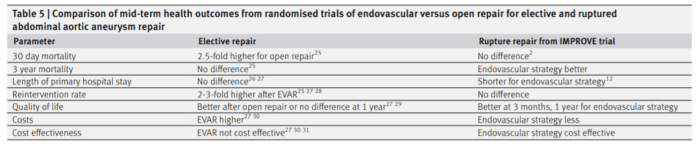
The data analyses showed endovascular repair “offers no significant reduction in operative mortality at 30 or 90 days, but there is an interim midterm survival advantage (3 months to 3 years), that when taken together with the early gains in QoL, leads to a mid-term gain in QALYs after 3 years.

  • Mortality: 179 deaths in endovascular group, 183 in open repair, with similar results for mortality related to aneurysm
    • Of the 502 patients treated for confirmed rupture, mortality at 3 years: 109/259 (42%) in endovascular, 131/243 (54%) in open repair
  • Reinterventions related to aneurysm: occured at similar rate in both groups, especially those for life threatening conditions.
  • Cost differences at 30 days: “not erorded by an increased burden of reinterventions in later follow-up and therefore the endovascular strategy is cost effective” (p.7).

The authors conclude that at three years, the endovascular repair “offers an increase in QALYs, without an excess of reinterventions, and is cost effective” (p.9). The IMPROVE trial mid-term follow-up supports the benefits of endvascular vs open repair to treat ruptured AAA.

Table 5 (p.8) compares the mid-term outcomes from multiple RCTs of endovascular vs open repair for AAA, including the IMPROVE trial.

improve table 5

Additional reading: Bjorck M. Endovascular or open repair for ruptured abdominal aortic aneurysm? BMJ. 2017;359:j5170. doi:10.1136/bmj.j5170.

Small bowel obstruction: clinical and radiographic predictors for surgical intervention

One discussion this week included the clinical and radiographic signs for operation or nonoperation in the setting of adhesive small bowel obstruction (ASBO).


Reference: Kulvatunyou N, et al. A multi-institution prospective observational study of small bowel obstruction: Clinical and computerized tomography predictors of which patients may require early surgery. The Journal of Trauma and Acute Care Surgery. 2015. 79(3);393-398. doi:10.1079/TA.0000000000000759.

Summary: The absence of flatus and the CT finding of free fluid and high-grade obstruction have been identified by Kulvatunyou et al (2015) as predictors that early operative intervention would be beneficial. This prospective observational study involved 200 patients at three academic and tertiary referral medical centers; 148 in the nonoperative group, 52 in the operative group.

Clinical signs: The only clinical sign identified as a predictor for surgical intervention, “no flatus” was listed in 58% of the operative group, 34% of the nonoperative group. Too large to include here, Table 3 in the text (p.397) lists the univariate analysis of all clinical signs.

CT findings: Individual CT signs listed include transition point, free fluid, multiple fluid locations, small bowel fecalization, mesenteric edema, closed loop, and high-grad obstruction. All had low PPVs, ranging 21-41%. Using the three predictors identified, the PPV improved but remained low at 37-56% (p.397).

The table below (p.397) illustrates the utility of the three variables in a few combinations.

predictors

In the article, the authors state that they are currently (2015) pursuing a study applying the predictors to a different ASBO patient population so as to cross-validate this predictor model. A search for such a study in the published literature was not successful.

Additional Reading: Catena F, et al. Bologna guidelines for diagnosis and management of adhesive small bowel obstruction (ASBO): 2010 evidence-based guidelines of the World Society of Emergency Surgery. World Journal of Emergency Surgery. 2011 Jan 21;6:5. doi: 10.1186/1749-7922-6-5.