Preoperative Nutrition Status and Postoperative Outcomesin Patients Undergoing Cytoreductive Surgery and Hyperthermic Intraperitoneal Chemotherapy

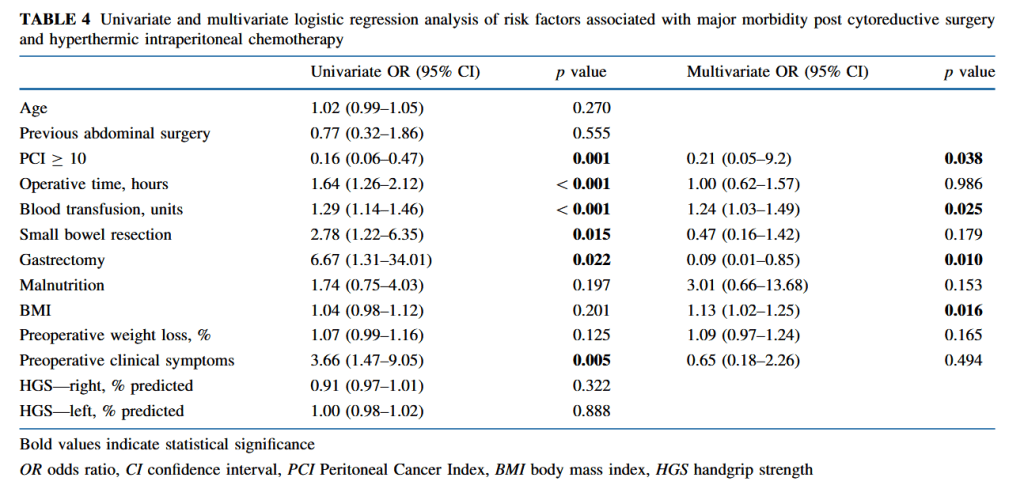
“Cytoreductive surgery (CRS) and hyperthermic intraperitoneal chemotherapy (HIPEC) is complex surgery to treat peritoneal surface malignancy (PSM). PSM arises from gastrointestinal (GI), gynecological, or primary peritoneal cancers. CRS aims to completely remove macroscopic tumor. In order to achieve complete cytoreduction, multiple abdominal organ resections are often necessary. After cytoreduction, HIPEC is delivered into the abdominal cavity for 30–90 min to treat residual microscopic disease.”
“Malnutrition is prevalent in patients undergoing surgery for abdominopelvic malignancy and is associated with increased morbidity, longer hospital length of stay (LOS), and mortality. Preoperative malnutrition is a risk factor for organ dysfunction, impaired immune function,
wound complications, impaired physical function, and increased LOS. Malnutrition prevalence is documented in up to 67% of patients with ovarian cancer and 30–50% of patients with colorectal cancer.”
Continue reading

Enhanced Recovery and Perioperative Quality Initiative on Nutrition Screening and Therapy Within a Surgical Enhanced Recovery Pathway

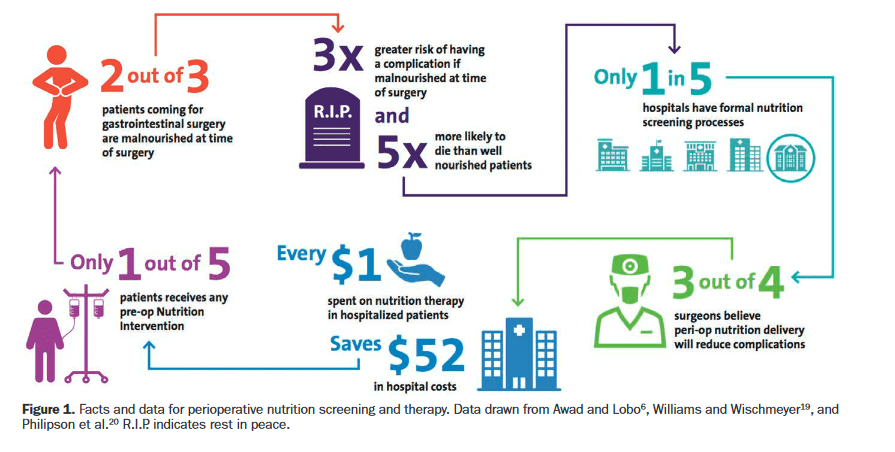
“Perioperative malnutrition has proven to be challenging to define, diagnose, and treat. Despite these challenges, it is well known that sub-optimal nutritional status is a strong independent predictor of poor postoperative outcomes.”

“Malnourished surgical patients have significantly higher postoperative mortality, morbidity, length of stay (LOS), readmission rates, and increased hospital costs.It is estimated that 24%–65% of patients undergoing surgery are at nutrition risk. Additionally, recent prospective observational data indicate that undernourished patients or patients at risk of malnutrition are twice as likely to be readmitted within 30 days after elective colorectal surgery.”

Continue reading

Clinical Nutrition in surgery guidelines

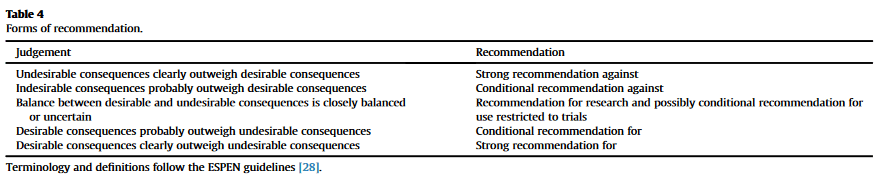
Early oral feeding is the preferred mode of nutrition for surgical patients. Avoidance of any nutritional therapy bears the risk of underfeeding during the postoperative course after major surgery. Considering that malnutrition and underfeeding are risk factors for postoperative complications, early enteral feeding is especially relevant for any surgical patient at nutritional risk, especially for those undergoing upper gastrointestinal surgery.

Continue reading

Calculation of essential metabolites in total parenteral nutrition (TPN): the basics

Madsen H, Frankel EH. The hitchhiker’s guide to parenteral nutrition management for adult patients. Practical Gastroenterology. 2006 Jul;30(7):46.

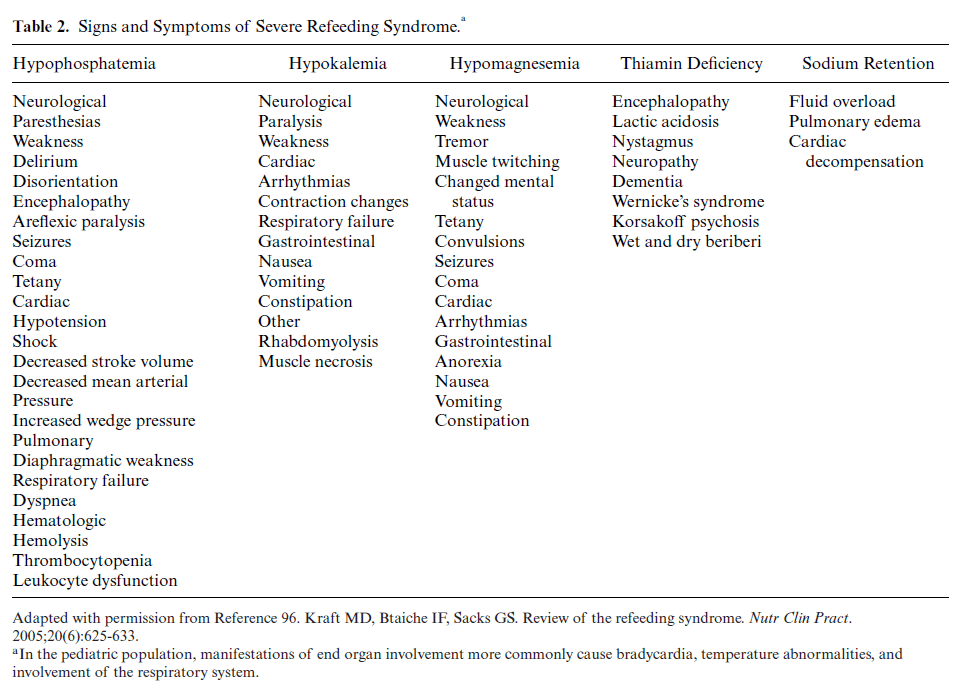
Summary: This was discussed as a possible question on boards. Below are three tables, taken directly from the article referenced.

p. 48
Continue reading

Article of interest: Comparison of open gastrostomy tube to percutaneous endoscopic gastrostomy tube in lung transplant patients.

Taghavi S, et al. Comparison of open gastrostomy tube to percutaneous endoscopic gastrostomy tube in lung transplant patients. Ann Med Surg (Lond). 2015 Dec 23;5 :76-80.

Introduction: Lung transplant patients require a high degree of immunosuppression, which can impair wound healing when surgical procedures are required. We hypothesized that because of impaired healing, lung transplant patients requiring gastrostomy tubes would have better outcomes with open gastrostomy tube (OGT) as compared to percutaneous endoscopic gastrostomy tube (PEG).

Continue reading

The safety of enteral and parenteral nutrition in ICU patients receiving vasopressors

Patel JJ, et al. Phase 3 Pilot Randomized Controlled Trial Comparing Early Trophic Enteral Nutrition With “No Enteral Nutrition” in Mechanically Ventilated Patients With Septic Shock. JPEN J Parenter Enteral Nutr. 2020 Jul;44(5):866-873.

Full-text for Emory users.

Results: One hundred thirty-one patients were eligible for enrollment, and 49 were available for consent. Thirty-one (86%) consented and were randomized and 100% of patients in the early EN arm and 94% in the “no EN” arm completed their protocols. While on vasopressors, early EN group received median 384 kcal, and the “no EN” group received median 0 kcal. Contamination rate was 0 in the early trophic EN arm and 6% in the “no EN” arm. The early EN group had median 25 intensive care unit-free days, as compared with 12 in the “no EN” arm (P = .014). The early EN arm had median 27 ventilator-free days, compared with 14 in “no EN” arm (P = .009).

Conclusion: Our protocol comparing early trophic EN with “no EN” in septic shock was feasible. Early trophic EN may be beneficial, but a larger multicenter trial is warranted to confirm the observed clinical benefits seen in this trial.

Continue reading