Is TNT a viable treatment strategy for rectal cancer?

One discussion this week included total neoadjuvant therapy (TNT) for rectal cancer.

Reference: Cercek A, et al. Adoption of total neoadjuvant therapy for locally advanced rectal cancer. JAMA Oncology. 2018 Jun 14;4(6):e180071. doi:10.1001/jamaoncol.2018.0071.

Summary: Treatment of locally advanced rectal (LARC) cancer involves chemoradiation, surgery, and chemotherapy. The concept of total neoadjuvant therapy (TNT), in which chemoradiation and chemotherapy are administered prior to surgery, has been developed to optimize delivery of effective systemic therapy aimed at micrometastases.

OBJECTIVE: To compare the traditional approach of preoperative chemoradiation (chemoRT) followed by postoperative adjuvantchemotherapy with the more recent TNT approach for LARC.

METHODS: A retrospective cohort analysis using Memorial Sloan Kettering Cancer Center (MSK) records from 2009 to 2015 was carried out. A total of 811 patients who presented with LARC (T3/4 or node-positive) were identified; 320 received chemoRT with planned adjuvant chemotherapy and 308 received TNT (induction fluorouracil- and oxaliplatin-based chemotherapy followed by chemoRT). Of the 628 patients, 373 (59%) were men, 255 (41%) were women, and the mean age was 56.7 years.

RESULTS: Patients in the TNT cohort received greater percentages of the planned oxaliplatin and fluorouracil prescribed dose than those in the chemoRT with plannned adjuvant chemotherapy cohort. The complete response (CR) rate, including both pathologic CR (pCR) in those who underwent surgery and sustained clinical CR (cCR) for at least 12 months posttreatment in those who did not undergo surgery, was 36% in the TNT cohort compared with 21% in the chemoRT with planned adjuvant chemotherapy cohort. TNT(Cerek et al, 2018)
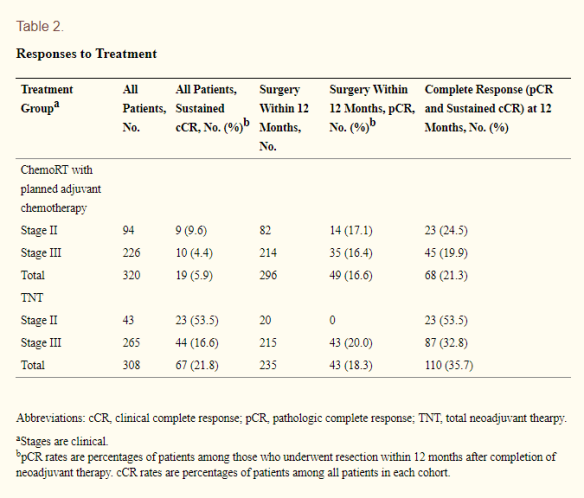
CONCLUSIONS: Total neoadjuvant therapy was associated with improved delivery of systemic therapy and increased response to treatment, and it provides a promising platform for nonoperative watch-and-wait protocols. Long-term follow-up is necessary to determine if early systemic chemotherapy improves overall outcome

The authors conclude their findings provide additional support for the National Comprehensive Cancer Network (NCCN) guidelines that categorize TNT as a viable treatment strategy for rectal cancer.

Adjuvant chemotherapy for rectal cancer: The PROCTOR-SCRIPT trial

A discussion this week included adjuvant chemotherapy for rectal cancer after neoadjuvant and surgery.

Reference: Breugom AJ, et al. Adjuvant chemotherapy for rectal cancer patients treated with preoperative (chemo)radiotherapy and total mesorectal excision: a Dutch Colorectal Cancer Group (DCCG) randomized phase III trial. Annals of Oncology. 2015 Apr;26(4):696-701. doi:10.1093/annonc/mdu560.

Summary: Locoregional recurrence rates and survival have significantly
improved with the introduction of total mesorectal excision (TME) for patients with rectal cancer. The addition of preoperative radiotherapy to TME surgery resulted in a more than 50% decrease in locoregional recurrences. However, the combination of preoperative (chemo)radiotherapy and TME surgery did not improve overall or disease-free survival.  Up to 30% of all patients treated with curative intent for localized rectal cancer will develop distant metastases, and distant metastases are still the main cause
of death after rectal cancer.

A multicentre, randomized phase III trial, PROCTOR-SCRIPT, was conducted to investigate the value of adjuvant chemotherapy with fluoropyrimidine monotherapy after preoperative (chemo)radiotherapy and TME surgery. The primary outcome was overall survival. Secondary outcomes were disease-free survival, overall recurrence rate, and locoregional and distant recurrence rate separately.

METHODS: Patients from 52 hospitals were recruited. Those with histologically proven stage II or III rectal adenocarcinoma were randomly assigned to observation (n=221) or adjuvant chemotherapy (n=216) after preoperative (chemo)radiotherapy and TME. Radiotherapy consisted of 5 × 5 Gy. Chemoradiotherapy consisted of 25 × 1.8-2 Gy combined with 5-FU-based chemotherapyAdjuvant chemotherapy consisted of 5-FU/LV (PROCTOR) or eight courses capecitabine (SCRIPT). Randomization was based on permuted blocks of six, stratified according to centre, residual tumour, time between last irradiation and surgery, and preoperative treatment. The primary end point was overall survival.

RESULTS: Between 1 March 2000 and 1 January 2013, 470 patients were included, of whom 33 were incorrectly randomized. Therefore, 437 patients (309 Dutch and 128 Swedish patients) were eligible for analyses. The trial was finally closed due to poor patient accrual without reaching the intended inclusion.

  • Survival: A total of 95 patients died. Five-year overall survival was 79.2% in the observation group and 80.4% in the chemotherapy group.
  • Disease-free survival: No statistically significant difference in disease-free survival was
    observed. Five-year disease-free survival was 55.4% for the observation group and 62.7% for the chemotherapy group.
  • Recurrences: In total, there were 157 recurrences. At 5 years, the cumulative incidence for overall recurrences was 40.3% in the observation group and 36.2% in the chemotherapy group.
  • Locoregional recurrences: The 5-year cumulative incidence for locoregional recurrences was 7.8% in the observation group versus 7.8% in the chemotherapy group. This amounted to 38.5% and 34.7%, respectively, for distant recurrences.

CONCLUSION: The PROCTOR-SCRIPT trial could not demonstrate a significant benefit of adjuvant chemotherapy with fluoropyrimidine monotherapy regarding overall survival, disease-free survival, and recurrence rates after preoperative (chemo)radiotherapy and TME surgery in ypTNM stage II and III rectal cancer patients. However, this trial did not complete planned accrual.

ONCOTYPE IQ for DCIS: A 12-year update on the ECOG-ACRIN E5194 study

One discussion last week included Dr. Wood’s ONCOTYPE IQ for DICS, Trial E5194.

Reference: Solin LJ, et al. Surgical excision without radiation for ductal carcinoma in situ of the breast: 12-year results from the ECOG-ACRIN E5194 study. Journal of Clinical Oncology. 2015 Nov 20;33(33):3938-3944. doi: 10.1200/JCO.2015.60.8588

ClinicalTrials.gov NCT00002934.

Summary: The Eastern Cooperative Oncology Group–American College of Radiology Imaging Network (ECOG-ACRIN; formerly the Eastern Cooperative Oncology Group) Cancer Research Group E5194 study (a nonrandomized clinical trial) prospectively enrolled patients for whom surgical excision alone (without radiation) was thought to be a reasonable treatment option on the basis of low-risk clinical and pathologic characteristics. This report provides updated results from the ECOG-ACRIN E5194 study, including 10- and 12-year outcomes.

Continue reading

The ACOSOG Z0011 Randomized Control Trial

One discussion last week included the ACOSOG Z0011 RCT.

Reference: Giuliano AE, et al. Effect of axillary dissection vs no axillary dissection on 10-year overall survival among women with invasive breast cancer and sentinel node metastasis: the ACOSOG Z0011 (Alliance) randomized control trial. JAMA. 2017 Sep 12;318(10):918-926. doi: 10.1001/jama.2017.11470.

Summary: The results of the American College of Surgeons Oncology Group Z0011 (ACOSOG Z0011) trial were first reported in 2005 with a median follow-up of 6.3 years. Longer follow-up was necessary because the majority of the patients had estrogen receptor-positive tumors that may recur later in the disease course. In this follow-up study, the authors sought to determine whether the 10-year overall survival of patients with 2 or fewer sentinel lymph node metastases treated with breast-conserving therapy and sentinel lymph node dissection (SLND) alone without axillary lymph node dissection (ALND) is noninferior to that of women treated with axillary dissection.

Compared with ALND, SLND alone was found to be noninferior for overall survival. The 10-year overall survival rate was 86.3% in the SLND alone group and 83.6% in the ALND group. The unadjusted HR comparing overall survival between the SLND alone group and the ALND group was 0.85 (1-sided 95% CI, 0–1.16), which did not cross the prespecified noninferiority HR margin of 1.3. The HR for overall survival adjusting for adjuvant therapy (chemotherapy, endocrine therapy, radiation, or a combination of these 3) and age for the SLND alone group compared with the ALND group was 0.93 (1-sided 95% CI, 0–1.28) (Table 2).

10yr survival

CONCLUSION: In this randomized clinical trial including 856 women, after median follow-up of 9.3 years, overall survival for patients treated with sentinel lymph node dissection alone was not inferior to those treated with completion axillary lymph node dissection (86.3% vs 83.6%, respectively; noninferiority hazard ratio margin of 1.3). These findings do not support the use of axillary lymph node dissection when 2 or fewer metastases are found with sentinel lymph node sampling in women with cT1-2M0 breast cancer.

PROSPER trial: A comparison of treatments for rectal prolapse

One discussion this week involved the PROSPER trial of treatment for rectal prolapse.

References: Senapati A, et al. PROSPER: a randomised comparison of surgical treatments for rectal prolapse. Colorectal Disease. 2013 Jul;15(7):858-868. doi:10.1111/codi.12177

Summary: The PROSPER randomised control trial is a pragmatic, factorial (2 × 2) design trial in which 293 patients were randomised between abdominal and perineal surgery (i) (n=49), suture vs resection rectopexy for those receiving an abdominal procedure (ii) (n=78), or Altemeier’s vs Delorme’s for those receiving a perineal procedure (iii) (n=213). Primary outcome measures were recurrence of the prolapse, incontinence, bowel function and quality of life scores measured up to 3 years.

Recurrence rates were not significant in any comparisons:

  • abdominal vs perineal surgery: 20% vs 26%
  • suture vs resection rectopexy: 13% vs 26%
  • Altemeier’s vs Delorme’s: 24% vs 31%

It was noted that substantial improvements from baseline in quality of life following all procedures. Additionally, Vaizey, bowel thermometer and EQ-5D scores were not significantly different in any of the comparisons (Senapati et al, 2013).

Additional Reading: Bordeianou L, et al. Clinical practice guidelines for the treatment of rectal prolapse. Diseases of the Colon and Rectum. 2017 Nov;60(11):1121-1131. doi:10.1097/DCR.0000000000000889

Endovascular repair vs open repair for ruptured abdominal aortic aneurysm

One discussion this week included open vs endovascular repair for ruptured AAA.

Reference: IMPROVE trial investigators. Comparative clinical effectiveness and cost effectiveness of endovascular strategy v open repair for ruptured abdominal aortic aneurysm: three year results of the IMPROVE randomised trial. BMJ. 2017 Nov 14;359:j4859. doi: 10.1136/bmj.j4859

Trial registration: Current controlled trials ISRCTN48334791; ClinicalTrials NCT00746122.

Summary: Involving 30 vascular centers – 29 in UK, one in Canada – and 613 patients between 2009 and 2016, the IMPROVE trial is the first RCT comparing keyhole endovascular aneurysm repair to the traditional open surgery with comprehensive mid-term outcomes. The primary outcome was mortality; secondary outcomes included reinterentions, quality of life, resource use, consts, quality adjusted life year (QALYs), and cost effectiveness.

The data analyses showed endovascular repair “offers no significant reduction in operative mortality at 30 or 90 days, but there is an interim midterm survival advantage (3 months to 3 years), that when taken together with the early gains in QoL, leads to a mid-term gain in QALYs after 3 years.

  • Mortality: 179 deaths in endovascular group, 183 in open repair, with similar results for mortality related to aneurysm
    • Of the 502 patients treated for confirmed rupture, mortality at 3 years: 109/259 (42%) in endovascular, 131/243 (54%) in open repair
  • Reinterventions related to aneurysm: occured at similar rate in both groups, especially those for life threatening conditions.
  • Cost differences at 30 days: “not erorded by an increased burden of reinterventions in later follow-up and therefore the endovascular strategy is cost effective” (p.7).

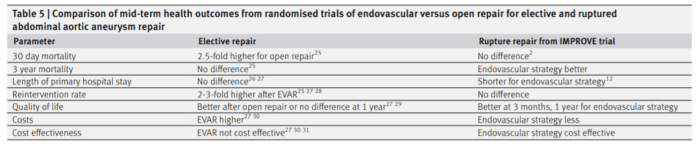
The authors conclude that at three years, the endovascular repair “offers an increase in QALYs, without an excess of reinterventions, and is cost effective” (p.9). The IMPROVE trial mid-term follow-up supports the benefits of endvascular vs open repair to treat ruptured AAA.

Table 5 (p.8) compares the mid-term outcomes from multiple RCTs of endovascular vs open repair for AAA, including the IMPROVE trial.

improve table 5

Additional reading: Bjorck M. Endovascular or open repair for ruptured abdominal aortic aneurysm? BMJ. 2017;359:j5170. doi:10.1136/bmj.j5170.

Laparoscopic sleeve gastrectomy vs laparoscopic Roux-en-Y gastric bypass on weight loss: Two RCTs

A discussion in December included gastric bypass versus sleeve gastrectomy.

References: Peterli R, et al. Effect of laparoscopic sleeve gastrectomy vs laparoscopic Roux-en-Y gastric bypass on weight loss patients with morbid obesity: the SM-BOSS randomized clinical trial. JAMA. 2018 Jan 16;319(3):255-265. doi:10.1001/jama.2017.20897

Salminen P, et al. Effect of laparoscopic sleeve gastrectomy vs laparoscopic Roux-en-Y gastric bypass on weight loss at 5 years among patients with morbid obesity: the SLEEVEPASS randomized clinical trial. JAMA. 2018 Jan 16;319(3):241-254. doi:10.1001/jama.2017.20313

Summary: Published in the same issue of JAMA, these two trials – one in Switzerland, one in Finland – provide thorough insight into comparing the sleeve and gastric bypass for weight loss in morbidly obese patients. To be consice, the study designs, results, and conclusions are quoted below.

SM-BOSS trial – clinicaltrials.gov Identifier: NCT00356213

DESIGN, SETTING, AND PARTICIPANTS: The Swiss Multicenter Bypass or Sleeve Study (SM-BOSS), a 2-group randomized trial, was conducted from January 2007 until November 2011 (last follow-up in March 2017). Of 3971 morbidly obese patients evaluated for bariatric surgery at 4 Swiss bariatric centers, 217 patients were enrolled and randomly assigned to sleeve gastrectomy or Roux-en-Y gastric bypass with a 5-year follow-up period.

RESULTS: Among the 217 patients (mean age, 45.5 years; 72% women; mean BMI, 43.9) 205 (94.5%) completed the trial. Excess BMI loss was not significantly different at 5 years: for sleeve gastrectomy, 61.1%, vs Roux-en-Y gastric bypass, 68.3% (absolute difference, −7.18%; 95% CI, −14.30% to −0.06%; P = .22 after adjustment for multiple comparisons). Gastric reflux remission was observed more frequently after Roux-en-Y gastric bypass (60.4%) than after sleeve gastrectomy (25.0%). Gastric reflux worsened (more symptoms or increase in therapy) more often after sleeve gastrectomy (31.8%) than after Roux-en-Y gastric bypass (6.3%). The number of patients with reoperations or interventions was 16/101 (15.8%) after sleeve gastrectomy and 23/104 (22.1%) after Roux-en-Y gastric bypass.

CONCLUSIONS AND RELEVANCE: Among patients with morbid obesity, there was no significant difference in excess BMI loss between laparoscopic sleeve gastrectomy and laparoscopic Roux-en-Y gastric bypass at 5 years of follow-up after surgery.

SLEEVEPASS trial – clinicaltrials.gov Identifier: NCT00793143

DESIGN, SETTING, AND PARTICIPANTS: The Sleeve vs Bypass (SLEEVEPASS) multicenter, multisurgeon, open-label, randomized clinical equivalence trial was conducted from March 2008 until June 2010 in Finland. The trial enrolled 240 morbidly obese patients aged 18 to 60 years, who were randomly assigned to sleeve gastrectomy or gastric bypass with a 5-year follow-up period (last follow-up, October 14, 2015).

RESULTS: Among 240 patients randomized (mean age, 48 [SD, 9] years; mean baseline body mass index, 45.9, [SD, 6.0]; 69.6% women), 80.4% completed the 5-year follow-up. At baseline, 42.1% had type 2 diabetes, 34.6% dyslipidemia, and 70.8% hypertension. The estimated mean percentage excess weight loss at 5 years was 49% (95% CI, 45%-52%) after sleeve gastrectomy and 57% (95% CI, 53%-61%) after gastric bypass (difference, 8.2 percentage units [95% CI, 3.2%-13.2%], higher in the gastric bypass group) and did not meet criteria for equivalence. Complete or partial remission of type 2 diabetes was seen in 37% (n = 15/41) after sleeve gastrectomy and in 45% (n = 18/40) after gastric bypass (P > .99). Medication for dyslipidemia was discontinued in 47% (n = 14/30) after sleeve gastrectomy and 60% (n = 24/40) after gastric bypass (P = .15) and for hypertension in 29% (n = 20/68) and 51% (n = 37/73) (P = .02), respectively. There was no statistically significant difference in QOL between groups (P = .85) and no treatment-related mortality. At 5 years the overall morbidity rate was 19% (n = 23) for sleeve gastrectomy and 26% (n = 31) for gastric bypass (P = .19).

CONCLUSIONS AND RELEVANCE: Among patients with morbid obesity, use of laparoscopic sleeve gastrectomy compared with use of laparoscopic Roux-en-Y gastric bypass did not meet criteria for equivalence in terms of percentage excess weight loss at 5 years. Although gastric bypass compared with sleeve gastrectomy was associated with greater percentage excess weight loss at 5 years, the difference was not statistically significant, based on the prespecified equivalence margins.