Role of Deficient DNA Mismatch Repair Status in Patients With Stage III Colon Cancer Treated With FOLFOX Adjuvant Chemotherapy

“While most studies have found that patients with dMMR (vs proficient MMR [pMMR]) tumors have a more favorable stage-adjusted prognosis, other studies have not detected a significant difference in clinical outcome or have suggested that any favorable prognostic effect of dMMR is limited to patients with earlier-stage tumors. Furthermore, studies have shown that dMMR tumors may not benefit from fluorouracil-based adjuvant chemotherapy. However, the impact of MMR status remains controversial in the era of the standard FOLFOX adjuvant chemotherapy.
In a pooled analysis, we examined the association of MMR status with disease-free survival (DFS) in patients with stage III colon cancer treated with FOLFOX from 2 phase 3 randomized clinical trials.”

Continue reading

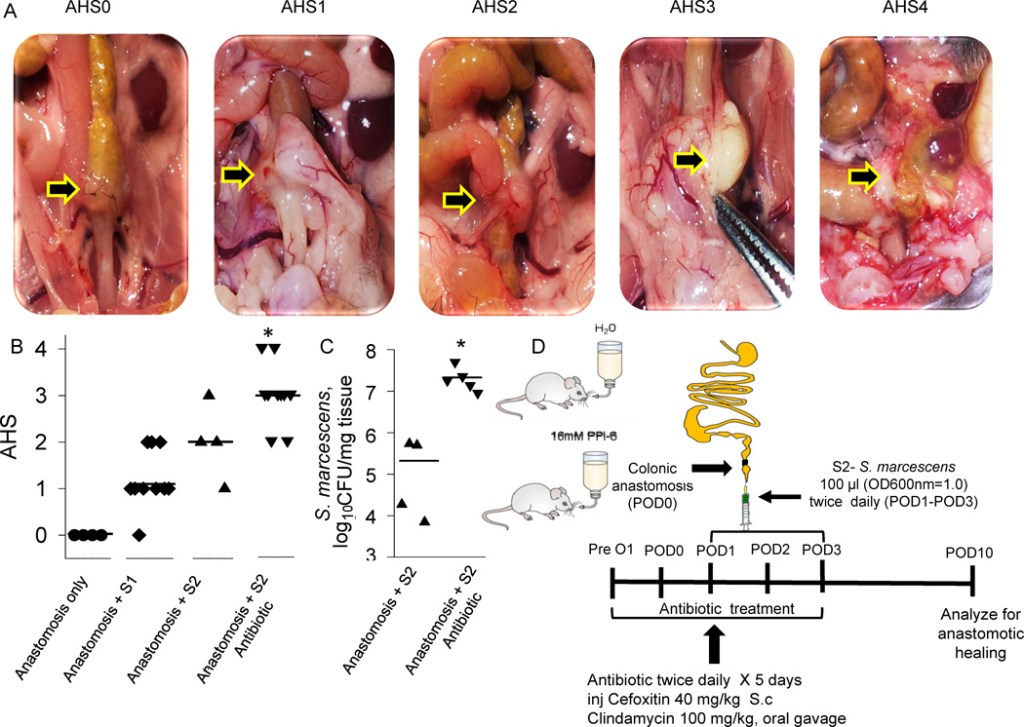
Mouse study: polyphosphate administration may be an alternative approach to prevent anastomotic leak induced by collagenolytic bacteria

“Despite decades of descriptive research, the etiology and pathogenesis of AL remains unknown. Although there is compelling evidence that microbes are the primary drivers of the pathogenesis of anastomotic leak, few efforts have been aimed at understanding and controlling the microbes that may complicated anastomotic healing.”

“A microbial cause for anastomotic leak was first proposed over 60 years ago and has been confirmed in multiple studies. The main clinical evidence for a microbial cause of anastomotic leak is indirect and is based on clinical trials in which the use of oral non-absorbable antibiotics significantly reduce the incidence of anastomotic leak”

Continue reading

Management of the complex duodenal injury

“Duodenal trauma is a rare occurrence existing in 1–4.7% of all abdominal trauma. Its posterior and partially retroperitoneal location shields it from most traumatic mechanisms. Colloquially referred to as the ‘surgical soul’, its proximity to complex regional anatomy makes duodenal trauma particularly at risk for biliary, pancreatic and major vascular injury with 68–86.5% of patients sustaining an associated injury.”

Continue reading

Feasibility of preoperative chemotherapy for locally advanced, operable colon cancer: Foxtrot Study

“Preoperative (neoadjuvant) chemotherapy and radiotherapy are substantially more effective than similar postoperative therapy in oesophageal, gastric, and rectal cancer. Earlier treatment might be more effective at eradicating micrometastatic disease than the same treatment 3 months later, the typical period between diagnosis and starting postoperative chemotherapy, particularly because surgery increases growth factor activity in the early postoperative period, promoting more rapid tumour progression.”

Continue reading

Damage control in penetrating duodenal trauma

“The overall incidence of duodenal injuries in severely injured trauma patients is between 0.2 to 0.6% and the overall prevalence in those suffering from abdominal trauma is 3 to 5% 1,2. Approximately 80% of these cases are secondary to penetrating trauma, commonly associated with vascular and adjacent organ injuries. These associated injuries create a significant challenge towards the early diagnosis and appropriate management. Therefore, defining the best surgical treatment algorithm remains controversial. Mild to moderate duodenal trauma is currently manage via primary repair and simple surgical techniques. However, severe injuries have required complex surgical techniques (duodenal diverticulization, pyloric exclusion with or without gastrojejunostomy and pancreatoduodenectomy) without significant favorable outcomes and consequential increase in the rates of mortality.”

Continue reading

TRANSPLANT SURGERY

TopicArticles
KidneyLentine KL, et al. OPTN/SRTR 2020 Annual Data Report: Kidney. Am J Transplant. 2022 Mar;22 Suppl 2:21-136.  

Vincenti F, Charpentier B, Vanrenterghem Y, et al. A phase III study of belatacept-based immunosuppression regimens versus cyclosporine in renal transplant recipients (BENEFIT study). Am J Transplant. 2010 Mar;10(3):535-46. doi: 10.1111/j.1600-6143.2009.03005.x. PMID: 20415897.
LiverMazzaferro V, Regalia E, Doci R, et al. Liver transplantation for the treatment of small hepatocellular carcinomas in patients with cirrhosis. N Engl J Med. 1996 Mar 14;334(11):693-9. PMID: 8594428.
Immuno-suppression 

BREAST, MELANOMA, AND ENDOCRINE SURGERY

TopicArticles
Melanoma &
Non-Melanoma
Skin Cancers
Angeles CV, Wong SL, Karakousis G. The Landmark Series: Randomized Trials Examining Surgical Margins for Cutaneous Melanoma. Ann Surg Oncol. 2020 Jan;27(1):3-12.
Beasley GM, et al. The Landmark Series: Regional Therapy of Recurrent Cutaneous Melanoma. Ann Surg Oncol. 2020 Jan;27(1):35-42.
 
Bello DM, Faries MB. The Landmark Series: MSLT-1, MSLT-2 and DeCOG (Management of Lymph Nodes). Ann Surg Oncol. 2020 Jan;27(1):15-21.
 
Egger ME, et al. The Sunbelt Melanoma Trial. Ann Surg Oncol. 2020 Jan;27(1):28-34.
 
Spillane AJ, et al. The Landmark Series: Neoadjuvant Systemic Therapy (NAST) for Stage 3 Melanoma Patients – A Potential Paradigm Shift in Management. Ann Surg Oncol. 2020 Jul; 27(7):2188-2200.
Other Skin CancerLee AY, Berman RS. The Landmark Series: Non-melanoma Skin Cancers. Ann Surg Oncol. 2020 Jan;27(1):22-27.
BreastBoughey JC, et al. Sentinel lymph node surgery after neoadjuvant chemotherapy in patients with node-positive breast cancer: the ACOSOG Z1071 (Alliance) clinical trial. JAMA. 2013 Oct 9;310(14):1455-61.    

Elmore LC, et al. The Landmark Series: Mastectomy Trials (Skin-Sparing and Nipple-Sparing and Reconstruction Landmark Trials). Ann Surg Oncol. 2021 Jan;28(1):273-280.

Fisher CS, et al. The Landmark Series: Axillary Management in Breast Cancer. Ann Surg Oncol. 2020 Mar;27(3):724-729.

Giuliano AE, Hunt KK, Ballman KV, et al. Axillary dissection vs no axillary dissection in women with invasive breast cancer and sentinel node metastasis: a randomized clinical trial. JAMA. 2011 Feb 9;305(6):569-75. doi: 10.1001/jama.2011.90. PMID: 21304082.

Giuliano AE, et al. Effect of Axillary Dissection vs No Axillary Dissection on 10-Year Overall Survival Among Women With Invasive Breast Cancer and Sentinel Node Metastasis: The ACOSOG Z0011 (Alliance) Randomized Clinical Trial. JAMA. 2017 Sep 12;318(10):918-926.

Krag DN, Anderson SJ, Julian TB, et al. Sentinel-lymph-node resection compared with conventional axillary-lymph-node dissection in clinically node-negative patients with breast cancer: overall survival findings from the NSABP B-32 randomised phase 3 trial. Lancet Oncol. 2010 Oct;11(10):927-33. doi: 10.1016/S1470-2045(10)70207-2. PMID: 20863759.

Leon-Ferre RA, et al. The Landmark Series: Neoadjuvant Chemotherapy for Triple-Negative and HER2-Positive Breast Cancer. Ann Surg Oncol. 2021 Apr;28(4):2111-2119.

Valente SA, Shah C. The Landmark Series: Adjuvant Radiation Therapy for Breast Cancer. Ann Surg Oncol. 2020 Jul;27(7): 2203-2211.  

Weiss A, et al. The Landmark Series: Neoadjuvant Endocrine Therapy for Breast Cancer. Ann Surg Oncol. 2020 Sep;27(9): 3393-3401.

Margenthaler JA, et al. The Landmark Series: Breast Conservation Trials (including oncoplastic breast surgery). Ann Surg Oncol. 2021 Apr;28(4):2120-2127.  

Sparano JA, et al. Adjuvant Chemotherapy Guided by a 21-Gene Expression Assay in Breast Cancer. N Engl J Med. 2018 Jul 12;379(2):111-121.  

Yan M, et al. Axillary Management in Breast Cancer Patients: A Comprehensive Review of the Key Trials. Clin Breast Cancer. 2018 Dec;18(6):e1251-e1259.  
ThyroidGunn AH, et al. Patient-Reported Outcomes Following Total Thyroidectomy for Graves’ Disease. Thyroid. 2022 Jan;32(1):54-64. doi: 10.1089/thy.2021.0285. PMID: 34663089; PMCID: PMC8917896.  

Haugen BR, et al. The American Thyroid Association Guidelines Task Force on Thyroid Nodules and Differentiated Thyroid Cancer. Thyroid. 2016 Jan;26(1):1-133. See also: 2015 ATA Management Guidelines for Adult Patients with Thyroid Nodules and Differentiated Thyroid Cancer: What is new and what has changed?  

Matsuura D, et al. Surgical Management of Low-/Intermediate-Risk Node Negative Thyroid Cancer: A Single-Institution Study Using Propensity Matching Analysis to Compare Thyroid Lobectomy and Total Thyroidectomy. Thyroid. 2022 Jan;32(1):28-36. doi: 10.1089/thy.2021.0356. PMID: 34861772; PMCID: PMC8792497.  

Patel KN, et al. Executive Summary of the AAES Guidelines for the Definitive Surgical Management of Thyroid Disease in Adults. Ann Surg. 2020 Mar;271(3):399-410.  

Smith TJ, Hegedüs L. Graves’ Disease. N Engl J Med. 2016 Oct 20;375(16):1552-1565. doi: 10.1056/NEJMra1510030. PMID: 27797318.
ParathyroidPatel A, et al. Parathyroidectomy for Tertiary Hyperparathyroidism: A Multi-Institutional Analysis of Outcomes. J Surg Res. 2021 Feb;258:430-434. doi: 10.1016/j.jss.2020.08.079. PMID: 33046234.
AdrenalBirsen O, et al. A new risk stratification algorithm for the management of patients with adrenal incidentalomas. Surgery. 2014 Oct;156(4):959-65.
 
Lenders JW, et al.; Endocrine Society. Pheochromocytoma and paraganglioma: an endocrine society clinical practice guideline. J Clin Endocrinol Metab. 2014 Jun;99(6):1915-42. doi: 10.1210/jc.2014-1498. PMID: 24893135.
 
Mpaili E, et al. Laparoscopic Versus Open Adrenalectomy for Localized/Locally Advanced Primary Adrenocortical Carcinoma (ENSAT I-III) in Adults: Is Margin-Free Resection the Key Surgical Factor that Dictates Outcome? A Review of the Literature. J Laparoendosc Adv Surg Tech A. 2018 Apr;28(4):408-414.
 
Smith CD, et al. Laparoscopic adrenalectomy: new gold standard. World J Surg. 1999 Apr;23(4):389-96.
 
Sturgeon C, et al. Risk assessment in 457 adrenal cortical carcinomas: how much does tumor size predict the likelihood of malignancy? J Am Coll Surg. 2006 Mar;202(3):423-30.

Zeiger MA, et al. AACE/AAES medical guidelines for the management of adrenal incidentalomas. Endocr Pract. 2009 Jul-Aug;15 Suppl 1:1-20. doi: 10.4158/EP.15.S1.1. PMID: 19632967.
 
Zhu CY, et al. Comparison of Preoperative Alpha-blockade for Resection of Paraganglioma and Pheochromocytoma. Endocr Pract. 2022 Jul 7:S1530-891X(22)00548-1. doi: 10.1016/j.eprac.2022.06.013. PMID: 35809774.
Neuroendocrine Pancreatic TumorsCloyd JM, Poultsides GA. The Landmark Series: Pancreatic Neuroendocrine Tumors. Ann Surg Oncol. 2021 Feb;28(2):1039-1049. doi: 10.1245/s10434-020-09133-x. PMID: 32948965.

Ramonell KM, Saunders ND, Sarmiento J, Bercu Z, Martin L, Weber CJ, Sharma J, Patel SG. Avoiding Pitfalls in Insulinomas by Preoperative Localization with a Dual Imaging Approach. Am Surg. 2019 Jul 1;85(7):742-746. PMID: 31405420.  

Sada A, et al. Comparison Between Sporadic and Multiple Endocrine Neoplasia Type 1-Associated Insulinoma. J Am Coll Surg. 2022 Jun 24. doi: 10.1097/XCS.0000000000000307. PMID: 35752874.