Dexamethasone treatment for the acute respiratory distress syndrome

“Acute respiratory distress syndrome (ARDS) is an intense inflammatory process of the lungs in response to acute pulmonary and systemic insults. There are no proven effective, specific pharmacological therapies for ARDS based on the results of randomised clinical trials. Despite no conclusive results, it remains clinically and biologically plausible that corticosteroids might benefit patients with ARDS in the early phase of their disease process, a situation that has not been evaluated in most randomised controlled trials. Paradoxically,
these hormones are given to patients with septic shock and pneumonia, both causes of ARDS.”

Continue reading

Prone position in ARDS patients

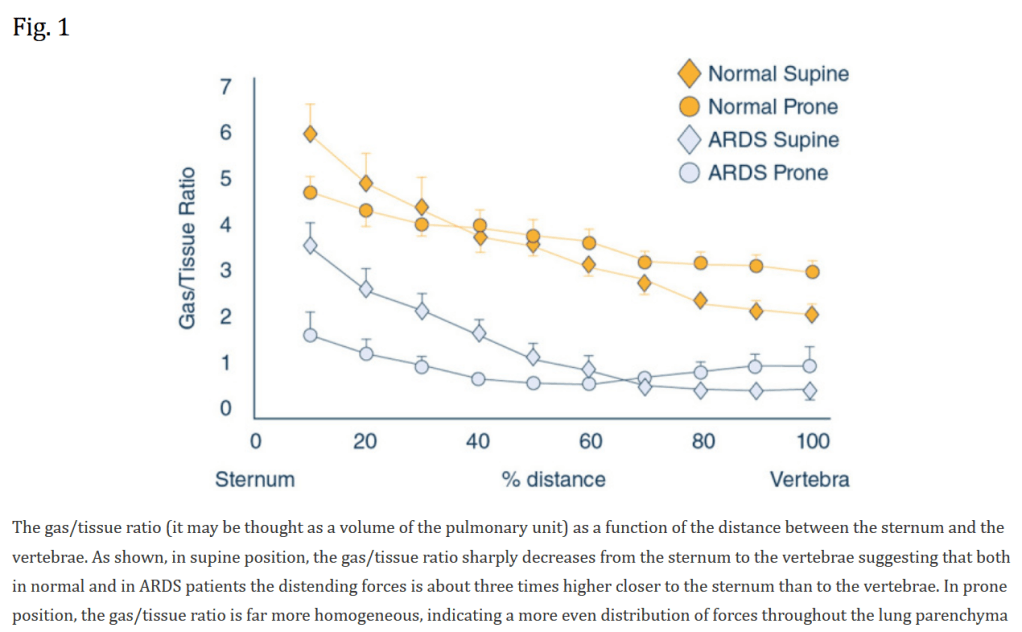
“In ARDS patients, the change from supine to prone position generates a more even distribution of the gas–tissue ratios along the dependent–nondependent axis and a more homogeneous distribution of lung stress and strain. The change to prone position is generally accompanied by a marked improvement in arterial blood gases, which is mainly due to a better overall ventilation/perfusion matching. Improvement in oxygenation and reduction in mortality are the main reasons to implement prone position in patients with ARDS.”

Continue reading

Acute Respiratory Distress Syndrome: The Berlin Definition

“The acute respiratory distress syndrome (ARDS) was defined in 1994 by the
American-European Consensus Conference (AECC). In 2011 (an initiative of the European Society of Intensive Care Medicine endorsed by the American Thoracic Society and the Society of Critical Care Medicine) developed the Berlin Defnition, focusing on feasibility, reliability, validity, and objective evaluation of its performance. Using the Berlin Definition, stages of mild, moderate, and severe ARDS were associated with increased mortality (27%; 95% CI, 24%-30%; 32%; 95% CI, 29%-34%; and 45%; 95% CI, 42%-48%, respectively; P.001) and increased median duration of mechanical ventilation in survivors (5 days; interquartile [IQR], 2-11; 7 days; IQR, 4-14; and 9 days; IQR, 5-17, respectively; P.001).”

Continue reading

Management of the rectal stump after emergency sub-total colectomy

“Subtotal colectomy and ileostomy with preservation of the rectal stump is established as the preferred operation for acute severe colitis which fails to respond to medical therapy. The surgical management of the rectal stump, however, remains controversial. The options include creation of a low sigmoid mucous fistula, closure of the rectosigmoid but leaving the closed stump in the subcutaneous plane at the lower end of a midline wound, or closure of the rectal stump at the level of the sacral promontory (leaving the rectal suture ⁄ staple-line in the peritoneal cavity).”

Continue reading

Presentation and management of perirectal sepsis

“Perirectal sepsis is a potentially severe complication which may follow minor anorectal
intervention and be slow to be diagnosed and treated. Awareness of the possible
diagnosis, urgent investigation with cross-sectional imaging and immediate treatment with
broad-spectrum antibiotics is vital. However, radical surgical intervention may be necessary.”

Continue reading

Life-threatening pelvis sepsis

“Although extremely uncommon, severe sepsis does occur post-treatment for haemorrhoids and all surgeons who treat such patients should be aware of the potential complications and alert to their presenting features. Early presentation without evidence of tissue necrosis may be managed conservatively, although most cases are managed by means of surgery.”

“Treatments for haemorrhoids can be divided in to conservative measures such as anal hygiene and topical ointments or suppositories, and interventions.

These are either office-based such as:
-injection sclerotherapy
-rubber band ligation (RBL)
-surgical procedures.

Haemorrhoidectomy has long been the mainstay of surgical therapy, but recently new techniques have been described, principally the stapled haemorrhoidopexy or procedure for prolapsing haemorrhoids (PPH).”

Continue reading

Hemorrhage in Essential Thrombocythemia orPolycythemia Vera

“Hemorrhage is a well-known complication of essential thrombocythemia (ET) and polycythemia vera (PV), but evidence-based data on its management and prevention are lacking to help inform clinicians”

“Myeloproliferative neoplasms (MPNs) are a group of hematological malignancies individualized in the 2016 World Health Organization (WHO) classification.1 They are subdivided into two groups: chronic myeloid leukemia and Philadelphia-negative MPNs, which are further divided into essential thrombocythemia (ET), polycythemia vera (PV), primitive myelofibrosis (PMF), and prefibrotic myelofibrosis.Philadelphia-negative MPNs are characterized by the chronic proliferation of myeloid cells in bone marrow and three main clonal mutations.”

Continue reading