Definition and grading of postoperative pancreatic fistula

“Based on the literature since 2005 investigating the validity and clinical use of the original
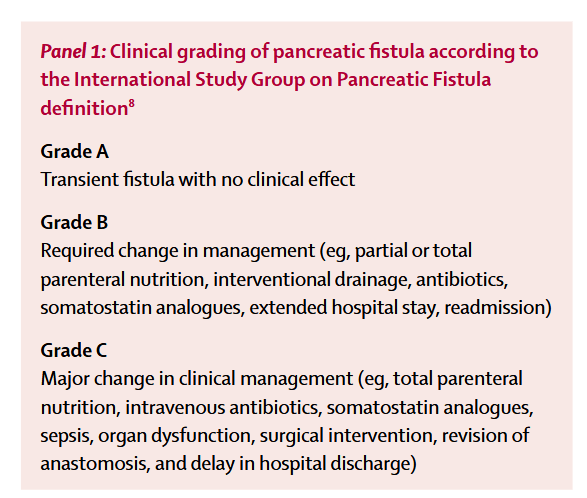
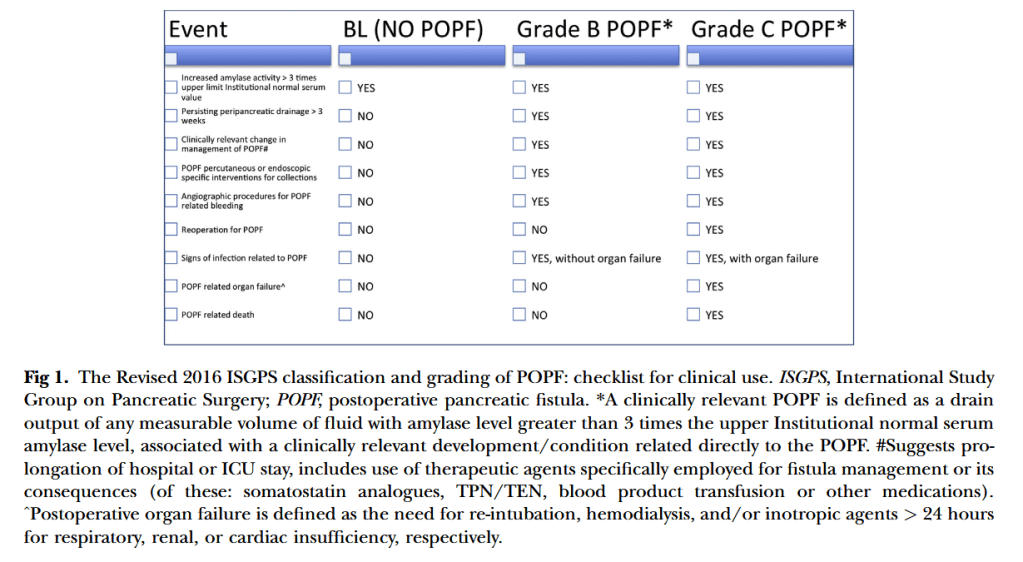
International Study Group of Pancreatic Fistula classification, a clinically relevant postoperative pancreatic fistula is now redefined as a drain output of any measurable volume of fluid with an amylase level >3 times the upper limit of institutional normal serum amylase activity, associated with a clinically relevant development/condition related directly to the postoperative pancreatic fistula. Consequently, the former “grade A postoperative pancreatic fistula” is now redefined and called a “biochemical leak,” because it has no clinical importance and is no longer referred to a true pancreatic fistula. Postoperative pancreatic fistula grades B and C are confirmed but defined more strictly. In particular, grade B requires a change in the postoperative management; drains are either left in place >3 weeks or repositioned through endoscopic or percutaneous procedures. Grade C postoperative pancreatic fistula refers to those postoperative pancreatic fistula that require eoperation or lead to single or multiple organ failure and/or mortality attributable to the pancreatic fistula.”

Continue reading

Management of Patients With Acute Lower Gastrointestinal Bleeding

“Acute lower gastrointestinal bleeding (LGIB) is one of the most common reasons for hospitalization in the United States due to a digestive disorder, accounting for over 100,000 admissions annually. Although historically LGIB has referred to a bleeding source originating distal to the ligament of Treitz, small bowel bleeding is considered a separate entity, with a distinct diagnostic and therapeutic algorithm. For the purposes of this clinical practice guideline, LGIB refers to hematochezia or bright red blood per rectum originating from a colorectal source.”

Continue reading

Direct Acting Oral Anticoagulants Following Gastrointestinal Tract Surgery

“Direct-acting oral anticoagulants (DOACs) are recommended over vitamin K antagonists (VKAs) for both the treatment of venous thromboembolism (VTE) and the prevention of stroke and systemic embolism in nonvalvular atrial fibrillation (AF). Two classes of DOACs are currently approved by the European Medication Agency and the US Food and Drug Administration: the direct factor Xa inhibitors, including rivaroxaban, apixaban, and edoxaban, and a direct thrombin inhibitor, dabigatran. 5 Unlike the VKAs,
which have a narrow therapeutic range and require dose individualization to maintain a therapeutic international normalized ratio, DOACs have a wide therapeutic range, allowing
for fixed dose regimens.
Efficacious DOAC doses were determined in Phase III trials that were designed based on studies conducted in healthy subjects with an intact gastrointestinal tract (GIT). Therefore, it is difficult to extrapolate outcomes with DOAC treatment to patients who undergo surgical
resection or bypass of the GIT, which may result in alteration of absorptive capacity. Because of the potential of reduced efficacy, the Update on Guidelines for the
Management of Cancer-Associated Thrombosis has recently expressed concerns regarding the use of DOAC in patients with proximal GIT resection.”

Continue reading

Multi-Institutional Analysis of Pancreaticoduodenectomy for Nonfamilial Periampullary Adenoma: A Novel Risk Score to Guide Shared Decision-Making

“Periampullary adenomas (PA), including both ampullary adenomas (AAs) and duodenal adenomas (DAs), are benign or premalignant mucosal lesions that are either hereditary, most associated with familial adenomatous polyposis (FAP) syndrome, or sporadic, with no known genetic predisposition. In both cases, these uncommon mucosal-based lesions carry malignancy risk and present management dilemmas when not amenable to endoscopic
removal requiring surgical resection. FAP-related PAs are typically large and multifocal and often managed using the Spigelman classification, a point-based system that alerts the clinician of malignancy risk. This classification guides the decision toward continued endoscopic surveillance vs resection vis-à-vis pancreaticoduodenectomy (PD, also known as the “Whipple procedure”). No such scoring system exists for non-FAP-related PAs.”

Continue reading

Retracting the thyroid matters: Who develops asymptomatic transient thyrotoxicosis after parathyroidectomy

“Thyrotoxicosis has been reported as a postoperative complication of parathyroidectomy
(PTx), attributed to palpation thyroiditis. Palpation thyroiditis was first described by Carney et al., in 1975 as a pathologic response to the traumatic injury of thyroid follicles, characterized by multifocal granulomatous folliculitis. The existing cohort studies in post-PTx thyrotoxicosis are limited. A prospective study of patients who underwent PTx for primary and secondary HPT reported that the incidence rate of thyrotoxicosis after PTx was 31.2 % and 77 %, respectively. The clinical significance of post-PTx thyrotoxicosis remains controversial. While
various manifestations of thyrotoxicosis, including tremors, palpitations, new-onset atrial fibrillation, and angina pectoris mimicking myocardial infarction, were described by case reports, Stang et al. in a cohort study reported that only 15 % of patients developed symptoms of thyrotoxicosis 1–2 weeks after the operation. They further concluded
that the degree of neck dissection appeared explanatory but did not specify which maneuvers were contributory.”

Continue reading

Variations in practice of thromboprophylaxis across general surgical subspecialties: a multicentre (PROTECTinG) study of elective major surgeries

“General surgical patients who undergo major operations are at risk of venous thromboembolism (VTE). This incurs significant morbidity and healthcare costs. Therefore, the Royal Australasian College of Surgeons and other regulatory bodies recommend routine thromboprophylaxis. Moreover, considerations for thromboprophylaxis is an integral part of theatre timeout performed prior to any operation.”

“In this study, we extend the observations made from our multicentre survey by quantifying the heterogeneity of perioperative thromboprophylaxis across all major general surgical operations, and placing them in context of their bleeding and VTE risk. Findings from this study will highlight areas of practice with the greatest variability, allow surgeons to benchmark their practices against that of their colleagues and focus future research to optimize perioperative thromboprophylaxis.”

Continue reading

Cardiac Complications Post Parathyroidectomy

“Parathyroidectomy (PTX) is primarily performed to treat primary and secondary hyperparathyroidism (HPT) and has been shown to reduce cardiac risk factors, including ECG abnormalities, 2D-echo abnormalities, arrhythmias, and NT-proBNP levels Cardiac complications, though rare, can occur in patients undergoing thyroidectomy. In a US-based cohort of 3,575 patients, approximately 0.2%–0.3% developed congestive heart failure (CHF) during follow-up. A study by Kravietz et al. found that while readmission rates were lower in primary HPT (PHPT) patients (5.6%) compared to secondary HPT (SHPT) patients (19.4%), heart failure was more prevalent in PHPT patients (10.8%) compared to SHPT patients (3.9%). Additionally, patients with existing CHF undergoing PTX have a higher likelihood of readmission. Although cardiac complications are rare, they can occasionally be fatal.”

Continue reading