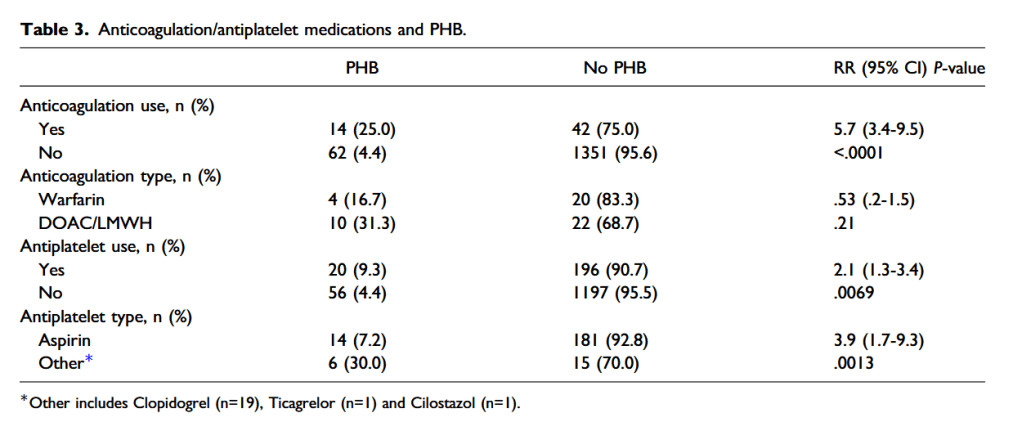
Bleeding After Hemorrhoidectomy in Patients on Anticoagulation Medications

“It has been estimated that approximately 4.4% of the United States population has symptomatic hemorrhoids, contributing to as many as 2.5 million ambulatory visits
annually. Excisional hemorrhoidectomy is the preferred treatment for grade 3-4 hemorrhoids and patients unresponsive to non-operative treatment. Despite being a relatively quick, outpatient procedure, one potential serious complication includes post-hemorrhoidectomy
bleeding. Reported rates of this complication have varied. Studies suggest that .4-10% of hemorrhoidectomy cases will be complicated by bleeding and many requiring a second intervention.”

Continue reading

Bleeding After Hemorrhoidectomy in Patients on Anticoagulation Medications

“It has been estimated that approximately 4.4% of the United States population has symptomatic hemorrhoids, contributing to as many as 2.5 million ambulatory visits annually. Excisional hemorrhoidectomy is the preferred treatment for grade 3-4 hemorrhoids and patients unresponsive to non-operative treatment. Despite being a relatively quick, outpatient procedure, one potential serious complication includes post-hemorrhoidectomy bleeding. Reported rates of this complication have varied. Studies suggest that .4-10% of hemorrhoidectomy cases will be complicated by bleeding and many requiring a second intervention. Among risk factors that have been associated with delayed bleeding are male sex, post-operative constipation, and the use of laxatives. Scarce data exist on the association of baseline oral anticoagulation or antiplatelet medications with delayed bleeding.”

Continue reading

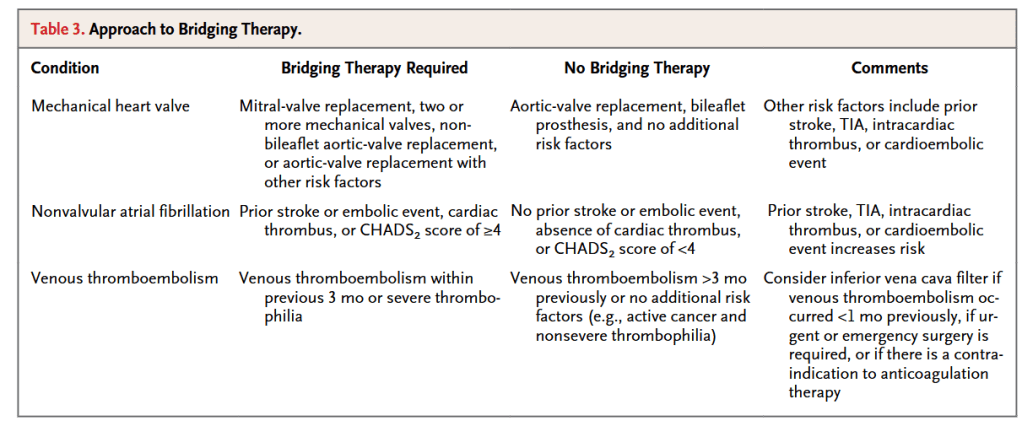
Periprocedural bridging anticoagulation

Rechenmacher SJ, Fang JC. Bridging Anticoagulation: Primum Non Nocere. J Am Coll Cardiol. 2015 Sep 22;66(12):1392-403.

Full-text for Emory users.

Conclusions: Periprocedural anticoagulation management is a common clinical dilemma with limited evidence (but 1 notable randomized trial) to guide our practices. Although bridging anticoagulation may be necessary for those patients at highest risk for TE, for most patients it produces excessive bleeding, longer length of hospital stay, and other significant morbidities, while providing no clear prevention of TE. Unfortunately, contemporary clinical practice, as noted in physician surveys, continues to favor interruption of OAC and the use of bridging anticoagulation. While awaiting the results of additional randomized trials, physicians should carefully reconsider the practice of routine bridging and whether periprocedural anticoagulation interruption is even necessary.

Central Illustration. Bridging Anticoagulation: Algorithms for Periprocedural Interrupting and Bridging Anticoagulation. Decision trees for periprocedural interruption of chronic oral anticoagulation (top) and for periprocedural bridging anticoagulation (bottom). OAC = oral anticoagulation.

Continue reading

Management of anticoagulation in patients with mechanical heart valves undergoing noncardiac surgical procedures

“Although the American Heart Association (AHA) and American College of Cardiology (ACC) and the American College of Chest Physicians (ACCP) provide guidelines on anticoagulation for patients with MHVs, limited guidance is provided for bridging anticoagulation 2,3 The guidelines are focused on preoperative bridging, with virtually no guidance on postoperative bridging.”

Continue reading

The Acute Venous Thrombosis: Thrombus Removal with Adjunctive Catheter-Directed Thrombolysis (ATTRACT) trial

Vedantham S, et al.; ATTRACT Trial Investigators. Pharmacomechanical Catheter-Directed Thrombolysis for Deep-Vein Thrombosis. N Engl J Med. 2017 Dec 7;377(23):2240-2252. Free full-text.

Summary: The ATTRACT trial sought to “determine whether pharmacomechanical thrombolysis prevents the post-thrombotic syndrome in patients with proximal deep-vein thrombosis” (p.2241). A total of 692 patients were enrolled at 56 centers in the US from December 2009 through December 2014. They were between the ages of 16 and 75, and had symptomatic proximal deep-vein thrombosis involving the femoral, common femoral, or iliac vein (p. 2241).

Continue reading

Acute limb ischemia and antithrombotic therapy in COVID-19 patients

Galyfos G, et al. Acute limb ischemia among patients with COVID-19 infection. J Vasc Surg. 2022 Jan;75(1):326-342. doi: 10.1016/j.jvs.2021.07.222. Epub 2021 Aug 12.

Results: In total, 34 studies (19 case reports and 15 case series/cohort studies) including a total of 540 patients (199 patients were eligible for analysis) were evaluated. All studies were published in 2020. Mean age of patients was 61.6 years (range, 39-84 years; data from 32 studies) and 78.4% of patients were of male gender (data from 32 studies). There was a low incidence of comorbidities: arterial hypertension, 49% (29 studies); diabetes mellitus, 29.6% (29 studies); dyslipidemia, 20.5% (27 studies); chronic obstructive pulmonary disease, 8.5% (26 studies); coronary disease, 8.3% (26 studies); and chronic renal disease, 7.6% (28 studies). Medical treatment was selected as first-line treatment for 41.8% of cases. Pooled mortality rate among 34 studies reached 31.4% (95% confidence interval [CI], 25.4%%-37.7%). Pooled amputation rate among 34 studies reached 23.2% (95% CI, 17.3%-29.7%). Pooled clinical improvement rate among 28 studies reached 66.6% (95% CI, 55.4%%-76.9%). Pooled reoperation rate among 29 studies reached 10.5% (95% CI, 5.7%%-16.7%). Medical treatment was associated with a higher death risk compared with any intervention (odds ratio, 4.04; 95% CI, 1.075-15.197; P = .045) although amputation risk was not different between the two strategies (odds ratio, 0.977; 95% CI, 0.070-13.600; P = .986) (data from 31 studies).

Conclusions: SARS-CoV-2 infection is associated with a high risk for thrombotic complications, including ALI. COVID-associated ALI presents in patients with a low incidence of comorbidities, and it is associated with a high mortality and amputation risk. Conservative treatment seems to have a higher mortality risk compared with any intervention, although amputation risk is similar.

Continue reading

D-dimer testing to determine the duration of anticoagulation therapy

Palareti G, Cosmi B, Legnani C, et al.; DULCIS Investigators. D-dimer to guide the duration of anticoagulation in patients with venous thromboembolism: a management study. Blood. 2014 Jul 10;124(2):196-203.

Full-text for Emory users.

The optimal duration of anticoagulation in patients with venous thromboembolism (VTE) is uncertain. We investigated whether persistently negative D-dimers in patients with vein recanalization or stable thrombotic burden can identify subjects at low recurrence risk. Outpatients with a first VTE (unprovoked or associated with weak risk factors) were eligible after at least 3 months (12 in those with residual thrombosis) of anticoagulation. They received serial D-dimer measurements using commercial assays with predefined age/sex-specific cutoffs and were followed for up to 2 years. Of 1010 patients, anticoagulation was stopped in 528 (52.3%) with persistently negative D-dimer who subsequently experienced 25 recurrences (3.0% pt-y; 95% confidence interval [CI], 2.0-4.4%). Of the remaining 482 patients, 373 resumed anticoagulation and 109 refused it. Recurrent VTE developed in 15 patients (8.8% pt-y; 95% CI, 5.0-14.1) of the latter group and in 4 of the former (0.7% pt-y; 95% CI, 0.2-1.7; hazard ratio = 2.92; 95% CI, 1.87-9.72; P = .0006). Major bleeding occurred in 14 patients (2.3% pt-y; 95% CI, 1.3-3.9) who resumed anticoagulation. Serial D-dimer measurement is suitable in clinical practice for the identification of VTE patients in whom anticoagulation can be safely discontinued. This study was registered at clinicaltrials.gov as #NCT00954395.

Continue reading