
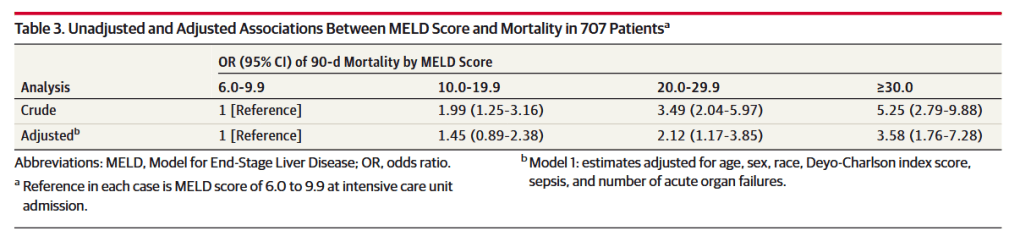
Association of Model for End-Stage Liver Disease Score With Mortality in Emergency General Surgery Patients

“Emergency general surgery (EGS) is associated with increased rates of morbidity and mortality compared with non-emergent general surgery cases.8 Patients undergoing EGS are approximately 2.5 times more likely to experience a significant complication and have a 6-fold increase in mortality relative to non-EGS patients. The underlying causes of this increased morbidity and mortality are not fully understood, but medical comorbidities and physiological derangements are likely to be contributing factors. Although surgical risk calculation tools such as the American College of Surgeons National Surgical Quality Improvement Project Surgical Risk Calculator are used to gain an objective sense of surgical risk stratification, such tools have yet to be comprehensively studied in this patient population and do not include the use of liver disease–specific assessment tools such as the MELD score in the prediction of outcomes among patients with CLD undergoing EGS.”
Continue reading

Liver transplantation in alcoholic liver disease: is a period of sobriety necessary?

One discussion this week included early liver transplantation in patients with alcoholic liver disease (ALD).


Reference: Godfrey EL, Stribling R, Rana A. Liver transplantation for alchoholic liver disease: an update. Clinics in Liver Disease. 2019 Feb;23(1):127-139. doi: 10.1016/j.cld.2018.09.007.

Summary (quoted from the article): ALD, a major cause of global morbidity and mortality, is expected to continue to increase in the global health burden. Although several new therapies have become available for other causes of liver disease, very few effective therapies exist for ALD other than liver transplantation. To ensure good outcomes and appropriate allocation of scarce donated organs, stringent selection criteria must be used to determine who is eligible to receive a graft, and effective, integrated alcohol use treatment must be used to prevent relapse.

Continue reading