
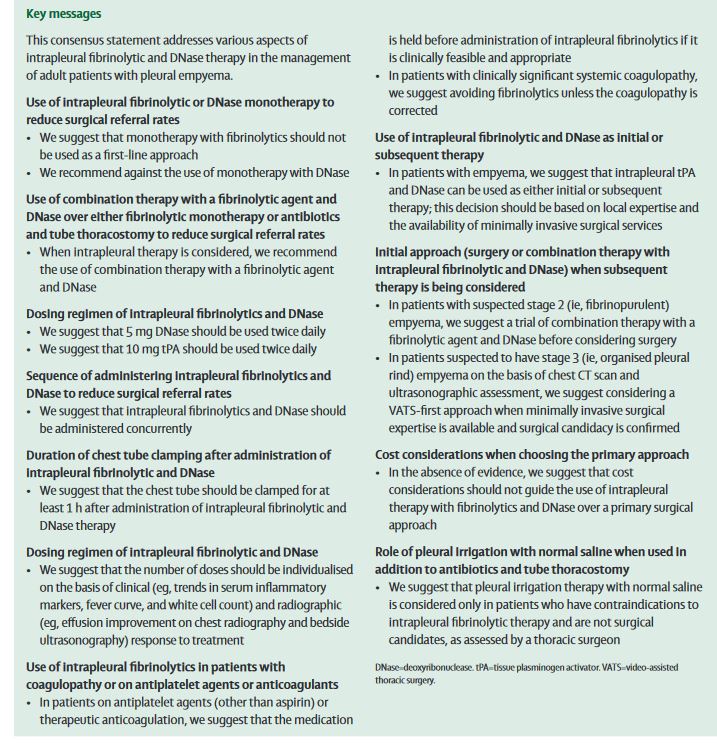
Use of lytics in patients with pleural empyema

“Parapneumonic effusions evolve through a spectrum of three stages. The initial exudative stage (stage 1; analogous to simple parapneumonic effusion) is characterised by an increased outpouring of fluid into the pleural space mediated by capillary permeability. If left
untreated, persistent inflammation with the associated rise in fluid plasminogen activator inhibitor causes a decrease in fluid fibrinolytic concentrations. During this second stage (stage 2; fibrinopurulent stage), as the effusion becomes infected, septations and adhesions
induced by fibrin deposition divide the space into pockets or locules. With the proliferation of fibroblasts and the formation of a pleural peel, lung expansion becomes restricted and can result in a non-expandable lung. It is important to initiate all medical treatment before this
final so-called organising stage (stage 3) ensues.”
Continue reading

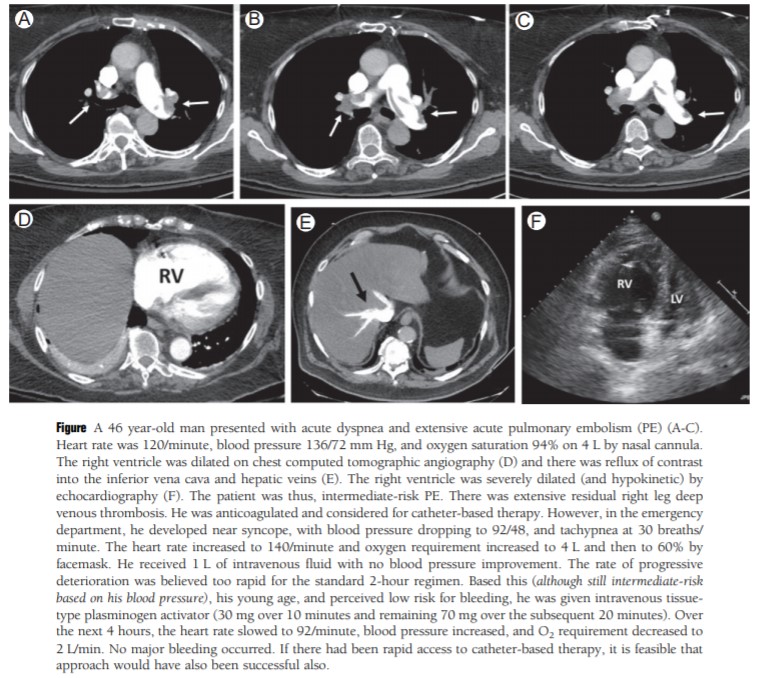
Systemic Thrombolysis for Pulmonary Embolism

Tapson VF, Friedman O. Systemic Thrombolysis for Pulmonary Embolism: Who and How. Tech Vasc Interv Radiol. 2017 Sep;20(3):162-174.

Full-text for Emory users.

PE screenshot

“For several decades, clinicians and clinical trialists have worked toward a more aggressive, yet safe solution for patients with intermediate-risk PE. Standard-dose thrombolysis, low-dose systemic thrombolysis, and catheter-based therapy which includes a number of devices and techniques, with or without low-dose thrombolytic therapy, have offered potential solutions and this area has continued to evolve. On the basis of heterogeneity within the category of intermediate-risk as well as within the high-risk group of patients, we will focus on the use of systemic thrombolysis in carefully selected high- and intermediate-risk patients. In certain circumstances when the need for aggressive therapy is urgent and the bleeding risk is acceptable, this is an appropriate approach, and often the best one.”


More PubMed results on systemic thrombolysis.