
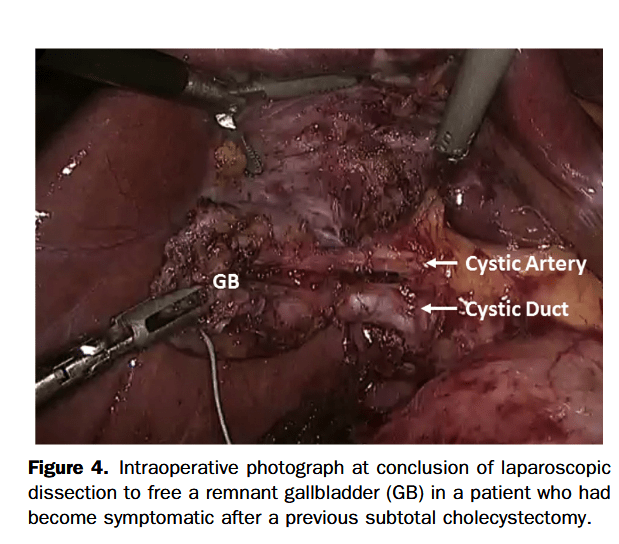
Subtotal Cholecystectomye“Fenestrating” vs“Reconstituting” Subtypes and the Prevention ofBile Duct Injury

“Laparoscopic cholecystectomy is a well-established procedure with clear benefits for patients over open cholecystectomy. However, it is associated with an increased rate of
bile duct injury. Biliary injuries occur more commonly when operations are made more difficult due to the presence of severe acute and/or chronic inflammation. Under these conditions, secure ductal identification by the critical view of safety (CVS) may be very challenging because CVS requires clearing of the inflamed hepatocystic triangle in
order to demonstrate the cystic duct, cystic artery, and the cystic plate. It is a rigorous method, but as we have previously stressed, this is actually one of the strengths of the
CVS method of identification. The infundibular technique, in which the funnel-shaped infundibular-cystic duct junction is the rationale for identification, is much easier to achieve than CVS.”
Continue reading

Laparoscopic cholecystectomy and cirrhosis

Gad EH, et al. Laparoscopic cholecystectomy in patients with liver cirrhosis: 8 years experience in a tertiary center. A retrospective cohort study. Ann Med Surg (Lond). 2020 Jan 15;51:1-10. Free full-text.

Results: The most frequent Child-Turcotte-Pugh (CTP) score was A, The most frequent cause of cirrhosis was hepatitis C virus (HCV), while biliary colic was the most frequent presentation. The harmonic device was used in 39.9% of patients, with a significant correlation between it and lower operative bleeding, lower blood and plasma transfusion rates, higher operative adhesions rates, lower conversion to open surgery and 30-day complication rates, shorter operative time and post-operative hospital stays where operative adhesions and times were independently correlated. The 30-day morbidity and mortality were 22.1% and 2.3% respectively while overall survival was 91.5%, higher CTP, and model for end-stage liver disease (MELD) scores, higher mean international normalization ratio (INR) value, lower mean platelet count, higher operative bleeding, higher blood, and plasma transfusion rates, longer mean operative time and postoperative hospital stays were significantly correlated with all conversion to open surgery, 30-day morbidities and mortalities.

Conclusion: LC can be safely performed in cirrhotic patients. However, higher CTP and MELD scores, operative bleeding, more blood and plasma transfusion units, longer operative time, lower platelet count, and higher INR values are predictors of poor outcome that can be improved by proper patient selection and meticulous peri-operative care and by using Harmonic scalpel shears.

Continue reading