
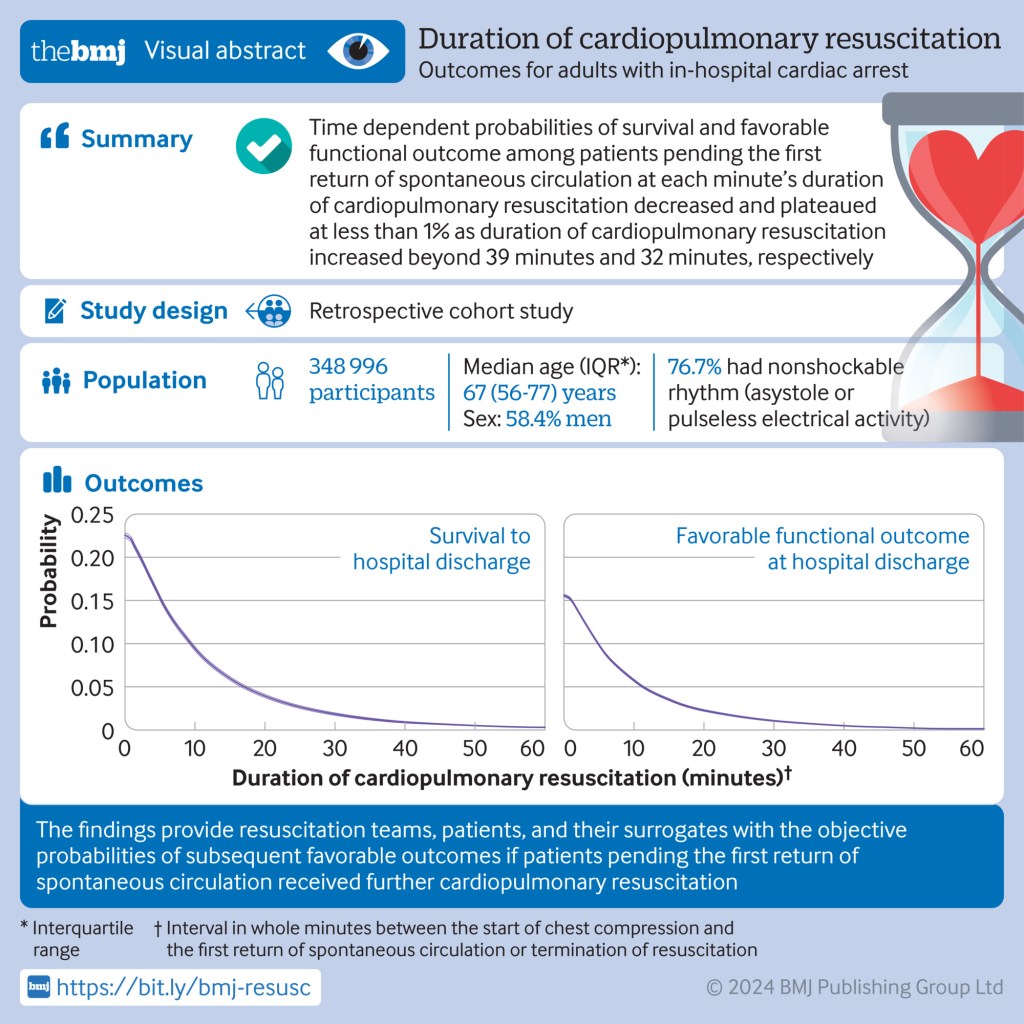
Cardiopulmonary resuscitation and outcomes with in-hospital cardiac arrest

“In-hospital cardiac arrest is an important public health problem, affecting approximately 300 000 adults annually in the United States, with a high mortality rate.1 2 The survival rate after in-hospital cardiac arrest in the US improved from 2000 to 2010 and has remained plateaued after 2010, with approximately 25% of patients surviving to hospital discharge.
Achieving return of spontaneous circulation is the first step toward long term survival and favorable functional recovery. However, for nearly half of patients with in-hospital cardiac arrest, resuscitative efforts are terminated without achievement of return
of spontaneous circulation.”
Continue reading

Lance-Adams syndrome

Marcellino C, Wijdicks EF. Posthypoxic action myoclonus (the Lance Adams syndrome). BMJ Case Rep. 2020 Apr 16;13(4):e234332.

Free full-text. (Includes video.)

  • Action myoclonus is exceptionally rare (less than 0.5% in a series of patients who have a cardiac arrest).
  • Myoclonus occurring after hypoxic brain injury from cardiac arrest, characterised by abrupt irregular muscle contractions. (1)
    • Acute: starting within 48 hours after the arrest (when isolated, sometimes terms acute Lance-Adams syndrome). (2)
    • Chronic: Lance-Adams syndrome, which may start from days to weeks after arrest and progressively worsen, with or without other neurological symptoms.
  • Potentially confused with myoclonus status in a comatose patient, yet the examination, imaging, degree of disability and prognosis are very divergent.
  • Typically, no EEG seizure correlates.

Continue reading

Intraoperative cardiac arrest: Resuscitation and Management

One discussion this week included intraoperative cardiac arrest.


Reference: Moitra VK, et al. Cardiac arrest in the operating room: resuscitation and management for the anesthesiologist: part 1. Anesthesia & Analgesia. 2018 Mar;126(3):876-888. doi: 10.1213/ANE.0000000000002596.

Summary: Cardiac arrest in the operating room and procedural areas has a different spectrum of causes (ie, hypovolemia, gas embolism, and hyperkalemia), and rapid and appropriate evaluation and management of these causes require modification of traditional cardiac arrest algorithms. There is a small but growing body of literature describing the incidence, causes, treatments, and outcomes of circulatory crisis and perioperative cardiac arrest. These events are almost always witnessed, frequently known, and involve rescuer providers with knowledge of the patient and their procedure.

Continue reading