Anticoagulant bridging in left-sided mechanical heart valve patients

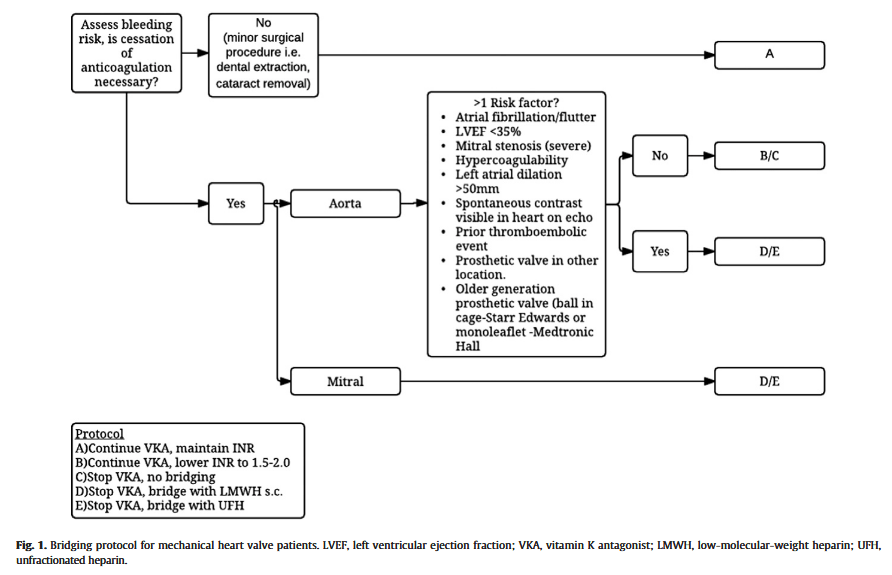
“There are two strategies for heparin bridging; administration of intravenous unfractionated heparin (UFH), and subcutaneous low-molecular-weight heparin (LMWH). While both strategies reduce the risk of valve thrombus formation, they have distinct biomedical, financial, and logistical profiles. UFH is administered intravenously according to a nomogram and hence requires peri-procedural hospital admission and continuous monitoring of
activated partial thromboplastin time (aPTT). In contrast, LMWH is administered subcutaneously once or twice daily in an outpatient setting and usually does not require continuous blood monitoring of anti-Xa levels.”

Continue reading

Management of antithrombotic therapy in patients undergoing invasive procedures

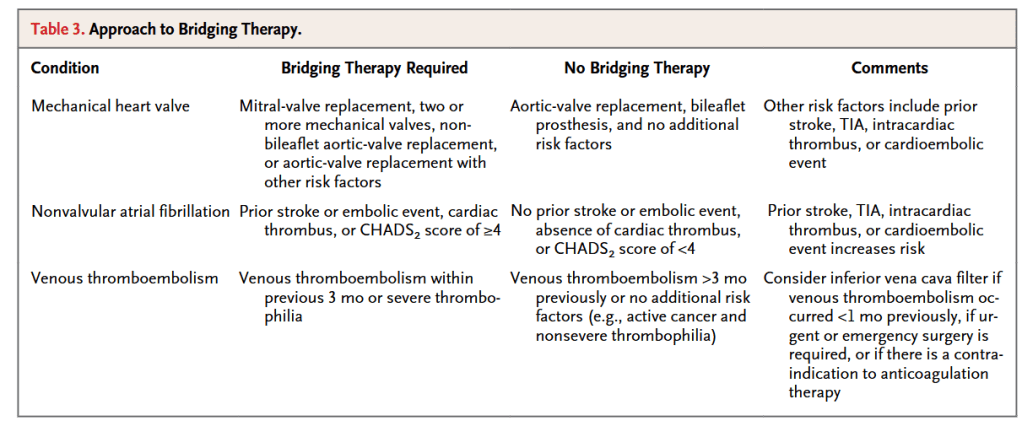
“The question of whether antithrombotic therapy should be suspended in a patient who
will be undergoing an invasive procedure involves balancing the risk of postproce-
dural bleeding with continued treatment against the thrombotic risk with suspension
of treatment and use of bridging anticoagulation therapy. In general, a patient under-
going a procedure that is associated with a low risk of bleeding (low-risk procedure)
can safely continue antithrombotic therapy and should do so, particularly if the pa-
tient is at high risk for a thromboembolic event (high-risk patient). Conversely, a pa-
tient undergoing a high-risk procedure can temporarily discontinue antithrombotic
agents safely if the patient is at low risk for a thromboembolic event (low-risk patient).”

Continue reading

Periprocedural bridging anticoagulation

Rechenmacher SJ, Fang JC. Bridging Anticoagulation: Primum Non Nocere. J Am Coll Cardiol. 2015 Sep 22;66(12):1392-403.

Full-text for Emory users.

Conclusions: Periprocedural anticoagulation management is a common clinical dilemma with limited evidence (but 1 notable randomized trial) to guide our practices. Although bridging anticoagulation may be necessary for those patients at highest risk for TE, for most patients it produces excessive bleeding, longer length of hospital stay, and other significant morbidities, while providing no clear prevention of TE. Unfortunately, contemporary clinical practice, as noted in physician surveys, continues to favor interruption of OAC and the use of bridging anticoagulation. While awaiting the results of additional randomized trials, physicians should carefully reconsider the practice of routine bridging and whether periprocedural anticoagulation interruption is even necessary.

Central Illustration. Bridging Anticoagulation: Algorithms for Periprocedural Interrupting and Bridging Anticoagulation. Decision trees for periprocedural interruption of chronic oral anticoagulation (top) and for periprocedural bridging anticoagulation (bottom). OAC = oral anticoagulation.

Continue reading

Management of anticoagulation in patients with mechanical heart valves undergoing noncardiac surgical procedures

“Although the American Heart Association (AHA) and American College of Cardiology (ACC) and the American College of Chest Physicians (ACCP) provide guidelines on anticoagulation for patients with MHVs, limited guidance is provided for bridging anticoagulation 2,3 The guidelines are focused on preoperative bridging, with virtually no guidance on postoperative bridging.”

Continue reading