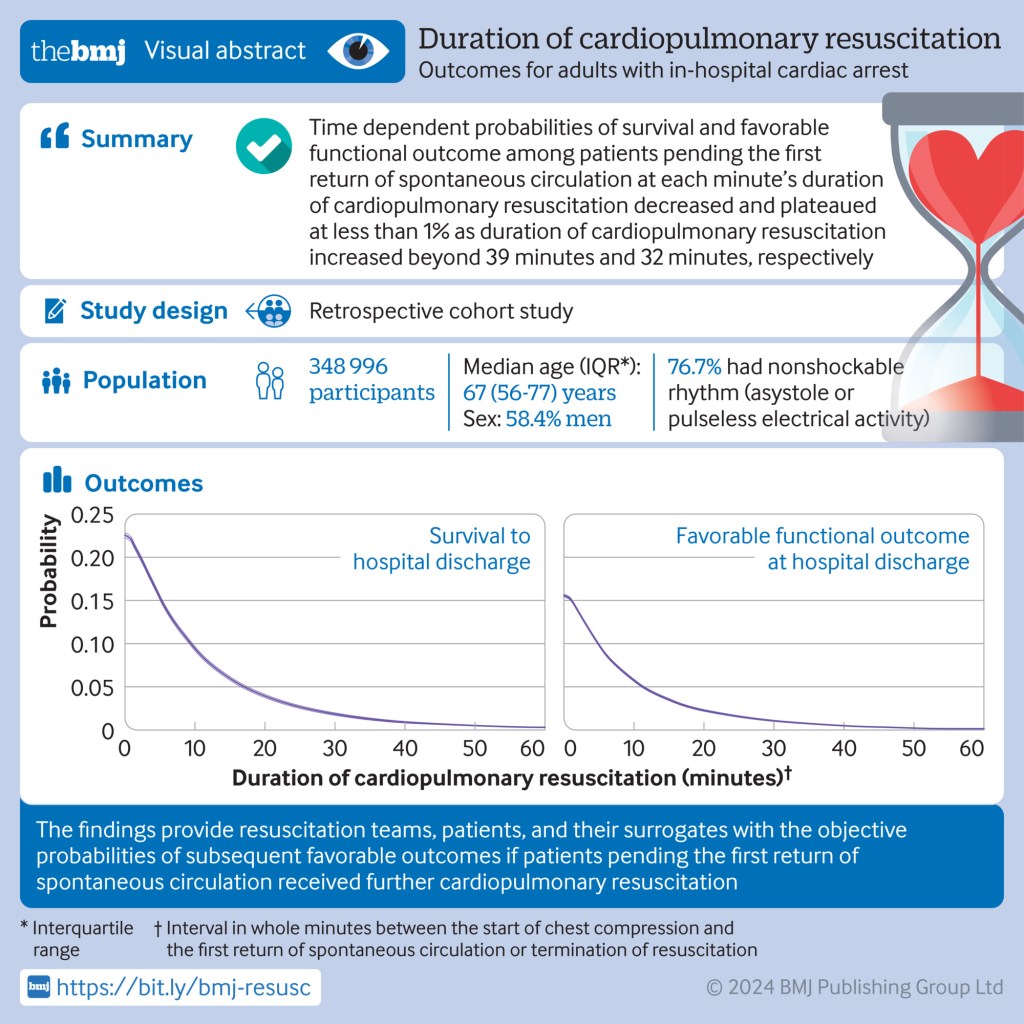
Cardiopulmonary resuscitation and outcomes with in-hospital cardiac arrest

“In-hospital cardiac arrest is an important public health problem, affecting approximately 300 000 adults annually in the United States, with a high mortality rate.1 2 The survival rate after in-hospital cardiac arrest in the US improved from 2000 to 2010 and has remained plateaued after 2010, with approximately 25% of patients surviving to hospital discharge.
Achieving return of spontaneous circulation is the first step toward long term survival and favorable functional recovery. However, for nearly half of patients with in-hospital cardiac arrest, resuscitative efforts are terminated without achievement of return
of spontaneous circulation.”
Continue reading

Hypoglycemia associated with renal failure

“Hypoglycemia associated with renal failure is more common than generally thought. Its occurrence is often a marker of multisystem failure and has an ominous prognostic implication. Its pathogenesis is frequently complex and involves one or several mechanisms. In the evaluation of uremic hypoglycemia, the first step should be the exclusion of obvious causes such as insulin, oral hypoglycemic agent therapy, and the use of drugs known to cause hypoglycemia. Propranolol, salicylates, and disopyramide are among the most commonly implicated agents.”

Continue reading

Pancreatic necrosis

“Pancreatic necrosis is the most devastating complication of acute pancreatitis. Management of this complex disease has improved dramatically over the past decade, and mortality rates are regularly reported in the range of 20% instead of the 50% to 70% range reported in the 1970s. Despite this improvement, 80% of deaths from acute pancreatitis evolve from infectious complications of pancreatic and peripancreatic necrosis.”

Continue reading

Post-op GI bleed after Frey procedure for chronic pancreatitis. 

“Chronic pancreatitis (CP) is a progressive fibro-inflammatory disease of the pancreas leading to irreversible parenchymal damage with gradual loss of exocrine and endocrine functions. The most common and debilitating manifestation of this disease is intractable pain which may lead to loss of work, unemployment, narcotic dependence, and impairment of the quality of life (QOL). About 30–50% of patients with CP will require surgery during their life time.2,3 Several surgical procedures have been described in the literature, and these are broadly classified as drainage, resectional or a combination of the two. Each respective
procedure is chosen based on the degree of pancreatic ductal dilatation, glandular morphology, local complications, and to some extent on the experience and preference of the surgeon. The Frey procedure (FP) has emerged over the past 30 years as one of the most commonly performed operations for painful CP associated with enlarged pancreatic head. The procedure results in substantial and sustained pain relief in the majority of patients. Like other major operations, FP also is associated with several post operative complications.”

Continue reading

Splenectomy and gastric devascularization in patient with chronic pancreatitis sequelae leading to splenic vein thrombosis

“Patients with extrahepatic portal vein thrombosis may present from infancy through adulthood with variceal bleeding. Physiologically, such patients differ from patient s with cirrhosis and variceal bleeding in that they have a normal liver and maintain good portal perfusion through hepatopedal collaterals.”
“Therapeutic options range from noninterventive, through ablative procedures, to shunt operations. The goal should be definitive control of bleeding and return to a normal lifestyle. Distal splenorenal shunt offers the best option if technically feasible, but if no shuntable veins are patent, ablative procedures and sclerotherapy may be required. A noninterventive, noninvestigational approach is inappropriate in patients who can be offered definitive
therapy. Splenectomy for hypersplenism should not be done in these patients.” (Galloway)

Galloway
Continue reading

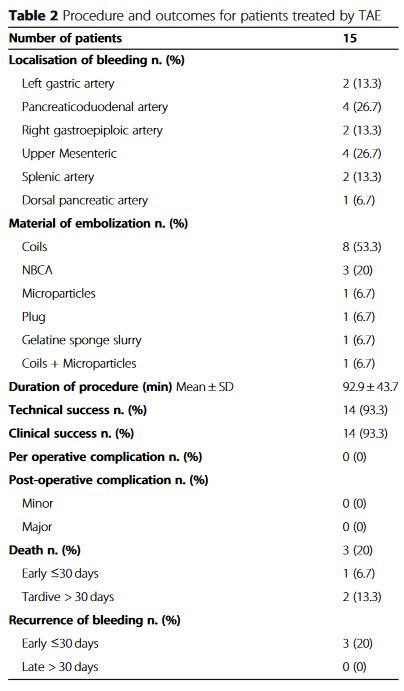
Emergency transarterial embolization for mesenteric bleeding – Safety and efficacy

“Mesenteric bleeding (MB) occurs rarely and its frequency is not well known. It corresponds to bleeding from mesenteric vessels in the abdominal cavity, without intra-luminal digestive bleeding. Although relatively rare, this pathology can be life-threatening if left undiagnosed and untreated. Clinically, MB are characterized by non-systematised abdominal pain and sudden blood loss. MB has many causes such as a post operative complication (especially after pancreaticoduodenectomy), traumatism, tumour, or may be idiopathic with no cause found. CT-scan is the gold standard of diagnostic imaging to identify the cause of MB. While the management of upper and lower gastrointestinal bleeding has been well established, the management of active mesenteric bleeding is less defined in the medical literature.”

Continue reading

Pancreas-sparing duodenectomy for duodenal polyposis

“Pancreas-sparing duodenectomy, although technically demanding, eliminates the need for pancreatic resection. Pancreas-sparing duodenectomy is associated with good absorptive capacity, weight gain, and quality of life. Furthermore, it may reduce the risk of subsequent malignancy. Long-term surveillance, however, is still required. Pancreas-sparing duodenectomy is contraindicated in the setting of malignancy.”

Continue reading