2017 WSES guidelines on colon and rectal cancer emergencies: obstruction and perforation

“Obstruction and perforation due to colorectal cancer represent challenging matters in terms of diagnosis, life-saving strategies, obstruction resolution and oncologic challenge. The aims of the current paper are to update the previous WSES guidelines for the management of large bowel perforation and obstructive left colon carcinoma (OLCC) and to develop new guidelines on obstructive right colon carcinoma (ORCC).”
“CT scan is the best imaging technique to evaluate large bowel obstruction and perforation. For OLCC, self-expandable metallic stent (SEMS), when available, offers interesting advantages as compared to emergency surgery; however, the positioning of SEMS for surgically treatable causes carries some long-term oncologic disadvantages, which are still under analysis. In the context of emergency surgery, resection and primary anastomosis (RPA) is preferable to Hartmann’s procedure, whenever the characteristics of the patient and the surgeon are permissive. Right-sided loop colostomy is preferable in rectal cancer, when preoperative therapies are predicted. With regards to the treatment of ORCC, right colectomy represents the procedure of choice; alternatives, such as internal bypass and loop ileostomy, are of limited value.”

Conclusions: grey areas and opportunities for improvements

We found some limitations within the present guidelines:

– They fail to cover all the possible abdominal scenarios when colon cancer occurs as an
emergency: for example, associated resections were not taken into considerations, neither we discussed about therapeutic strategies in case of evidence of peritoneal carcinomatosis.
– Despite our attempts to underline suggestions in case of low technical resources, the present guidelines are generally oriented toward hospitals with high level of resources.

On the other side, in our opinion, the current guidelines suggest some stimuli for doctors involved in this field:

– To review the approach to patient suffering from abdominal pain by introducing and promoting the use of bedside abdominal US.
– To bear in mind that the emergency surgeon should have a strong oncologic background or that the specialised colorectal surgeon should have a strong background of surgical pathophysiology, emergency surgery and damage control philosophy.
– To promote the use of clinical pathways within singular Hospitals”

Pisano M, et al 2017 WSES guidelines on colon and rectal cancer emergencies: obstruction and perforation. World J Emerg Surg. 2018 Aug 13;13:36. Free Full Text

Incisional negative pressure wound therapy for the prevention of surgical site infection

“The evidence on prophylactic use of negative pressure wound therapy on primary closed incisional wounds (iNPWT) for the prevention of surgical site infections (SSI) is confusing and ambiguous. Implementation in daily practice is impaired by inconsistent recommendations in current international guidelines and published meta-analyses. More recently, multiple new randomised controlled trials (RCTs) have been published. This study aimed to provide an overview of all meta-analyses and their characteristics; to conduct a new and up-to-date systematic review and meta-analysis and Grading of Recommendations Assessment, Development and Evaluation (GRADE) assessment; and to explore the additive value of new RCTs with a trial sequential analysis (TSA).”

Continue reading

Is it time to abandon routine operative drain use?

“Postoperative pancreatic fistula (POPF) is a potentially devastating complication after pancreatic resection, seen in 5% to 30% of patients. Depending on severity, POPF may be associated with infectious complications, reoperation, increased length of hospital stay, readmission, and even death. Historically, surgeons placed drains routinely for many abdominal procedures to control potential leaks from various anastomoses. However, this practice has been abandoned by many surgeons over the last 2 decades because no benefit to routine abdominal drainage has been observed from several randomized controlled trials for resections of the colon and rectum, gallbladder, and liver.”

Continue reading

The STITCH Trial. Small bites versus large bites for closure of abdominal midline incisions.

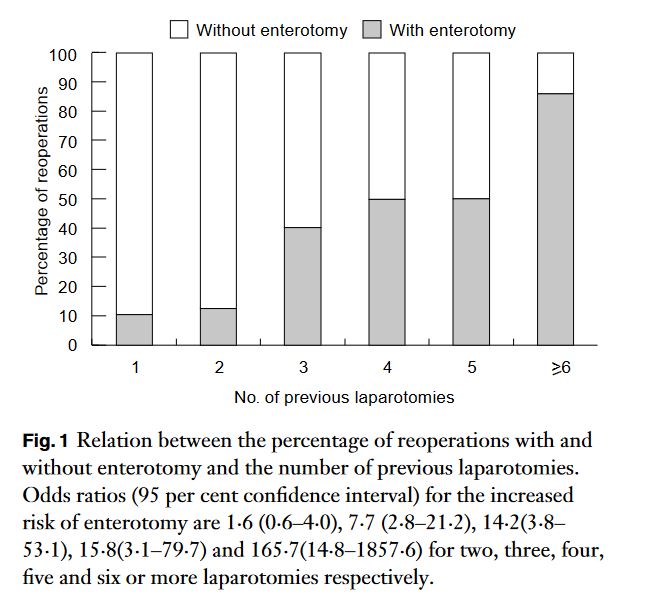
“Incisional hernia is a frequent complication of abdominal operations with an incidence of 10–23%, which can increase to 38% in specific risk groups. In the USA 4 million to 5 million laparotomies are done annually, suggesting that at least 400 000–500 000 incisional hernias can be expected to occur every year. Incisional hernia is associated with pain and discomfort, resulting in a decreased quality of life. Moreover, incarceration and strangulation of abdominal contents can take place, for which emergency surgery is indicated, with associated morbidity and mortality. About 348 000 operations for incisional hernia are done every year in the USA with US$3·2 billion in annual associated costs. Prevention of
incisional hernia is therefore of paramount importance.”

Continue reading

Cardiopulmonary resuscitation and outcomes with in-hospital cardiac arrest

“In-hospital cardiac arrest is an important public health problem, affecting approximately 300 000 adults annually in the United States, with a high mortality rate.1 2 The survival rate after in-hospital cardiac arrest in the US improved from 2000 to 2010 and has remained plateaued after 2010, with approximately 25% of patients surviving to hospital discharge.
Achieving return of spontaneous circulation is the first step toward long term survival and favorable functional recovery. However, for nearly half of patients with in-hospital cardiac arrest, resuscitative efforts are terminated without achievement of return
of spontaneous circulation.”

Continue reading

Hypoglycemia associated with renal failure

“Hypoglycemia associated with renal failure is more common than generally thought. Its occurrence is often a marker of multisystem failure and has an ominous prognostic implication. Its pathogenesis is frequently complex and involves one or several mechanisms. In the evaluation of uremic hypoglycemia, the first step should be the exclusion of obvious causes such as insulin, oral hypoglycemic agent therapy, and the use of drugs known to cause hypoglycemia. Propranolol, salicylates, and disopyramide are among the most commonly implicated agents.”

Continue reading

Pancreatic necrosis

“Pancreatic necrosis is the most devastating complication of acute pancreatitis. Management of this complex disease has improved dramatically over the past decade, and mortality rates are regularly reported in the range of 20% instead of the 50% to 70% range reported in the 1970s. Despite this improvement, 80% of deaths from acute pancreatitis evolve from infectious complications of pancreatic and peripancreatic necrosis.”

Continue reading