HAP vs VAP treatment: a flowchart

One discussion this week involved treatment for hospital-acquired pneumonia (HAP) and ventilator-associated pneumonia (VAP).

Reference: Kenny JES. IDSA Guidelines 2016: HAP, VAP & It’s the End of HCAP as We Know It (And I Feel Fine) [website]. 2016 Jul 30. Retrieved from https://pulmccm.org/infectious-disease-sepsis-review/idsa-guidelines-2016-hap-vap-end-hcap-know-feel-fine/

Summary: “While the current [IDSA 2016] guidelines discuss a number of issues germane to HAP and VAP including: microbiological evaluation, ventilator-associated tracheobronchitis, the use of biomarkers and clinical prediction scores, inhaled antibiotics, etc. this post will focus on standard, empiric therapy as this is a common clinical quandary [see figure 1]” (Kenny 2016).

hap vap

“The current guidelines recommend 7 days of antimicrobial therapy for both HAP and VAP.  The authors conducted their own meta-analysis and found no difference in mortality or recurrence between long and short-courses of therapy.  This is incongruent with an often referenced trial in 2003 which noted a higher pneumonia recurrence rate if non-fermenting gram negative bacilli [e.g. pseudomonas] were isolated and patients were treated with 8 days versus 15 days of anti-microbials” (Kenny 2016).

Is TNT a viable treatment strategy for rectal cancer?

One discussion this week included total neoadjuvant therapy (TNT) for rectal cancer.

Reference: Cercek A, et al. Adoption of total neoadjuvant therapy for locally advanced rectal cancer. JAMA Oncology. 2018 Jun 14;4(6):e180071. doi:10.1001/jamaoncol.2018.0071.

Summary: Treatment of locally advanced rectal (LARC) cancer involves chemoradiation, surgery, and chemotherapy. The concept of total neoadjuvant therapy (TNT), in which chemoradiation and chemotherapy are administered prior to surgery, has been developed to optimize delivery of effective systemic therapy aimed at micrometastases.

OBJECTIVE: To compare the traditional approach of preoperative chemoradiation (chemoRT) followed by postoperative adjuvantchemotherapy with the more recent TNT approach for LARC.

METHODS: A retrospective cohort analysis using Memorial Sloan Kettering Cancer Center (MSK) records from 2009 to 2015 was carried out. A total of 811 patients who presented with LARC (T3/4 or node-positive) were identified; 320 received chemoRT with planned adjuvant chemotherapy and 308 received TNT (induction fluorouracil- and oxaliplatin-based chemotherapy followed by chemoRT). Of the 628 patients, 373 (59%) were men, 255 (41%) were women, and the mean age was 56.7 years.

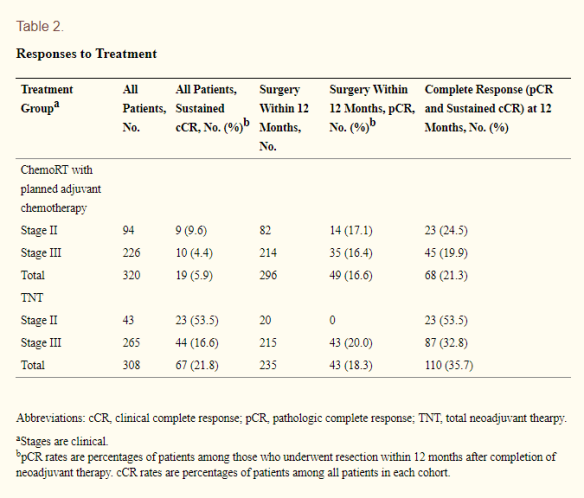
RESULTS: Patients in the TNT cohort received greater percentages of the planned oxaliplatin and fluorouracil prescribed dose than those in the chemoRT with plannned adjuvant chemotherapy cohort. The complete response (CR) rate, including both pathologic CR (pCR) in those who underwent surgery and sustained clinical CR (cCR) for at least 12 months posttreatment in those who did not undergo surgery, was 36% in the TNT cohort compared with 21% in the chemoRT with planned adjuvant chemotherapy cohort. TNT(Cerek et al, 2018)

CONCLUSIONS: Total neoadjuvant therapy was associated with improved delivery of systemic therapy and increased response to treatment, and it provides a promising platform for nonoperative watch-and-wait protocols. Long-term follow-up is necessary to determine if early systemic chemotherapy improves overall outcome

The authors conclude their findings provide additional support for the National Comprehensive Cancer Network (NCCN) guidelines that categorize TNT as a viable treatment strategy for rectal cancer.

Adjuvant chemotherapy for rectal cancer: The PROCTOR-SCRIPT trial

A discussion this week included adjuvant chemotherapy for rectal cancer after neoadjuvant and surgery.

Reference: Breugom AJ, et al. Adjuvant chemotherapy for rectal cancer patients treated with preoperative (chemo)radiotherapy and total mesorectal excision: a Dutch Colorectal Cancer Group (DCCG) randomized phase III trial. Annals of Oncology. 2015 Apr;26(4):696-701. doi:10.1093/annonc/mdu560.

Summary: Locoregional recurrence rates and survival have significantly
improved with the introduction of total mesorectal excision (TME) for patients with rectal cancer. The addition of preoperative radiotherapy to TME surgery resulted in a more than 50% decrease in locoregional recurrences. However, the combination of preoperative (chemo)radiotherapy and TME surgery did not improve overall or disease-free survival.  Up to 30% of all patients treated with curative intent for localized rectal cancer will develop distant metastases, and distant metastases are still the main cause
of death after rectal cancer.

A multicentre, randomized phase III trial, PROCTOR-SCRIPT, was conducted to investigate the value of adjuvant chemotherapy with fluoropyrimidine monotherapy after preoperative (chemo)radiotherapy and TME surgery. The primary outcome was overall survival. Secondary outcomes were disease-free survival, overall recurrence rate, and locoregional and distant recurrence rate separately.

METHODS: Patients from 52 hospitals were recruited. Those with histologically proven stage II or III rectal adenocarcinoma were randomly assigned to observation (n=221) or adjuvant chemotherapy (n=216) after preoperative (chemo)radiotherapy and TME. Radiotherapy consisted of 5 × 5 Gy. Chemoradiotherapy consisted of 25 × 1.8-2 Gy combined with 5-FU-based chemotherapyAdjuvant chemotherapy consisted of 5-FU/LV (PROCTOR) or eight courses capecitabine (SCRIPT). Randomization was based on permuted blocks of six, stratified according to centre, residual tumour, time between last irradiation and surgery, and preoperative treatment. The primary end point was overall survival.

RESULTS: Between 1 March 2000 and 1 January 2013, 470 patients were included, of whom 33 were incorrectly randomized. Therefore, 437 patients (309 Dutch and 128 Swedish patients) were eligible for analyses. The trial was finally closed due to poor patient accrual without reaching the intended inclusion.

  • Survival: A total of 95 patients died. Five-year overall survival was 79.2% in the observation group and 80.4% in the chemotherapy group.
  • Disease-free survival: No statistically significant difference in disease-free survival was
    observed. Five-year disease-free survival was 55.4% for the observation group and 62.7% for the chemotherapy group.
  • Recurrences: In total, there were 157 recurrences. At 5 years, the cumulative incidence for overall recurrences was 40.3% in the observation group and 36.2% in the chemotherapy group.
  • Locoregional recurrences: The 5-year cumulative incidence for locoregional recurrences was 7.8% in the observation group versus 7.8% in the chemotherapy group. This amounted to 38.5% and 34.7%, respectively, for distant recurrences.

CONCLUSION: The PROCTOR-SCRIPT trial could not demonstrate a significant benefit of adjuvant chemotherapy with fluoropyrimidine monotherapy regarding overall survival, disease-free survival, and recurrence rates after preoperative (chemo)radiotherapy and TME surgery in ypTNM stage II and III rectal cancer patients. However, this trial did not complete planned accrual.

Epidurals, DVTs, and chemical prophylaxis in the setting of oncologic surgery

One discussion this week involved preoperative epidurals and chemical prophylaxis.

Reference: Manguso N, et al. The impact of epidural analgesia on the rate of thromboembolism without chemical thromboprophylaxis in major oncologic surgery. The American Surgeon. 2018 Jun 1;84(6):851-855.

Summary: General surgery patients are at a particularly high risk of developing deep vein thrombosis (DVT) without prophylaxis and some data suggest their risk increases 2-fold if an underlying malignancy is present. A meta-analysis by Leonardi et al (2007) found that without chemical prophylaxis, the rate of DVT is as high as 35%, which drops to 12% if a patient receives chemical prophylaxis.

Although the use of chemical prophylaxis to reduce the risk of thromboembolic events has been validated in numerous studies, these drugs increase the risk of bleeding. Risk of bleeding in the setting of epidural analgesia may put the patient at risk for the potentially catastrophic complication of epidural hematoma which may lead to long-term paralysis.

Manguso et al (2018) evaluated the rate of thromboembolic events in cancer patients undergoing major oncologic abdominal and/or pelvic surgery who had a preoperative epidural catheter (EC) placed for postoperative pain control.

The aim of this study was to evaluate the need for chemical thromboprophylaxis in patients undergoing major abdominal or pelvic oncologic surgery with preoperative EC placement for postoperative pain control. Of the 285 patients for whom data were collected over this five-year period, the rates of above knee and below-knee DVTs were 3.2 and 5.2%, respectively. These patients were all asymptomatic and had no serious adverse events occur secondary to the identified thromboses.

A secondary finding was that 2.5% of patients had above-knee DVT before undergoing surgery; thus, it is important to consider the patient’s risk factors for DVT and screen preoperatively if there is concern.

Our data suggest that patients undergoing major open operations with epidural analgesia have low rates of DVT and may obviate the need for chemical prophylaxis. However, larger studies are required to determine the overall effects of epidural analgesia on the development of DVTs postoperatively.

An algorithm for preoperative cardiac risk assessment

One discussion last week involved cardiac arrest in the setting of hernia repair. The reference below was highlighted in the chief resident’s presentation.


Reference: Rafiq A, Skylar E, Bella JN. Cardiac evaluation and monitoring of patients undergoing noncardiac surgeryHealth Services Insight. 2017 Feb 20; 9: 1178632916686074. doi: 10.1177/1178632916686074.

Summary: Cardiovascular complications in the perioperative period are one of the most common events leading to increased morbidity and mortality. Although such events are very small in number, they are associated with a high mortality rate making it essential for physicians to understand the importance of perioperative cardiovascular risk assessment and evaluation. Its involves a detailed process of history taking, patient’s medical profile, medications being used, functional status of the patient, and knowledge about the surgical procedure and its inherent risks.

That being said, this review by Rafiq et al (2017) aims to provide a concise but comprehensive analysis on all such aspects of perioperative cardiovascular risk assessment for noncardiac surgeries and provide a basic methodology toward such assessment and decision making.

The ideal approach toward perioperative cardiac risk assessment requires a multidisciplinary team or a dedicated perioperative team of physicians. This leads expert physicians in this field to be involved in patient care with improved communications among primary physicians, anesthesiologist, surgeons, the patient, family members of the patient, cardiologist, and all other ancillary departments of health care involved.

Figure 1: Algorithm for perioperative cardiac risk assessment prior to noncardiac surgery (p.2)

algorithm cardiac

The authors state that it is important to stress the fact that a majority of these recommendations are based, to a large extent, on observational studies and clinical experience. There are only few RCTs that address this matter. It is prudent that more randomized trials are needed to improve on current recommendations, hence leading to further improvement in patient care and management in the perioperative period.

Helicobacter pylori infection: patient management

One discussion this week involved the management of patients with helicobacter pylori infection.

Reference: DynaMed Plus [Internet]. Ipswich (MA): EBSCO Information Services. 1995 – . Record No. T114484, Helicobacter pylori infection; [updated 2018 Dec 04, cited 2019 Apr 05]. Emory login required. [NOTE: direct link is not functional. Go to DynaMed Plus main page and search “helicobacter pylori infection” to access full content.]

Summary: Management overview (DynaMed Plus, 2018)

  • offer treatment to all patients who test positive for active infection with Helicobacter pylori (ACG Strong recommendation)(1); the clinical efficacy of H. pylori eradication varies among associated conditions
    • peptic ulcer disease
      • in patients with H. pylori-positive duodenal ulcers, H. pylori eradication therapy (alone or in addition to ulcer-healing drugs) may increase ulcer healing, and eradication therapy alone may reduce ulcer recurrence (level 3 [lacking direct] evidence)
      • in patients with H. pylori-positive gastric ulcers, addition of H. pylori eradication therapy to ulcer-healing drugs may not improve ulcer healing but H. pylori eradication therapy alone may reduce ulcer recurrence (level 3 [lacking direct] evidence)
      • peptic ulcer bleeding
        • H. pylori eradication therapy appears more effective than short-term antisecretory therapy or long-term ranitidine in preventing recurrent peptic ulcer bleeding in patients not taking nonsteroidal anti-inflammatory drugs (NSAIDs) (level 2 [mid-level] evidence)
        • H. pylori eradication therapy appears less effective than daily proton pump inhibitor (PPI) for preventing recurrent peptic ulcer bleeding in patients who continue long-term NSAIDs (level 2 [mid-level] evidence)
    • precancerous gastric lesions – H. pylori eradication may reduce progression of lesions (level 3 [lacking direct] evidence)
    • iron deficiency anemia – eradicating H. pylori may improve response to oral iron therapy
    • nonulcer dyspepsia – H. pylori eradication improves but does not eliminate symptoms (level 1 [likely reliable] evidence)
    • chronic gastritis – H. pylori eradication may decrease histologic evidence of gastritis in multiple clinical settings (level 3 [lacking direct] evidence), but may not be associated with improved symptoms in children (level 2 [mid-level] evidence)
    • long-term PPI use – H. pylori eradication reduces healthcare use and may reduce dyspepsia symptoms but not reflux symptoms (level 1 [likely reliable] evidence)
    • long-term NSAID use – H. pylori eradication prevents ulcers and ulcer complications in patients starting NSAIDs (level 1 [likely reliable] evidence) but may be less effective than long-term PPI use (level 2 [mid-level] evidence)
    • immune thrombocytopenia – H. pylori eradication improves platelet count (level 2 [mid-level] evidence)
    • gastroesophageal reflux disease (GERD) – H. pylori eradication does not clearly cause, improve, or worsen GERD symptoms (level 2 [mid-level] evidence)
    • asymptomatic patients – H. pylori eradication may prevent future dyspepsia (level 2 [mid-level] evidence), but low overall risk (< 15%) may not warrant such therapy
  • when choosing therapy, consider all of following(1)
    • patient’s history of penicillin allergy, and history of macrolide exposure
    • patient’s ability to adhere to a multidrug regimen with potential adverse effects
    • sensitivity of regional H. pylori strain to the combination of antibiotics administered (H. pylori clarithromycin resistance is > 15% in many areas of North America); see Antimicrobial resistance considerations in Recommendations section for details

Additional Reading: Chey WD, et al. ACG Clinical Guideline: Treatment of Helicobactor pylori infection. American Journal of Gastroenterology. 2017 Feb;112(2):212-239. doi: 10.1038/ajg.2016.563.