Lynch Syndrome: Surgical Management

One discussion this week included the surgical management of lynch syndrome.

Reference: DynaMed Plus [Internet]. Ipswich (MA): EBSCO Information Services. 1995 – . Record No. 115317, Lynch syndrome – Surgery and procedures; [updated 2018 Sept 26, cited 2018 Nov 16];. Emory login required. (Click on link and search for “lynch syndrome”).

Summary: Surgery considerations for Lynch syndrome patients with colorectal cancer (DynaMed Plus, 2018):

  • full colectomy with ileorectal anastomosis recommended rather than segmental/partial colonic resection due to increased risk for metachronous cancers
  • National Comprehensive Cancer Network (NCCN) recommends considering segmental vs. extended colectomy for colorectal adenocarcinoma based on clinical scenario, individual considerations, and discussion of risk
  • European Society for Medical Oncology (ESMO) recommends discussing option of extended colectomy vs. intensive surveillance after standard surgery at time of colorectal cancer diagnosis, particularly in young patients
  • American College of Gastroenterology (ACG) recommends
    • colectomy with ileorectal anastomosis as preferred treatment option for Lynch syndrome patients with colon cancer or colonic neoplasia not controllable by endoscopy
    • segmental colectomy with regular surveillance after surgery as an option in patients not suitable for total colectomy
  • United States Multi-Society Task Force (USMSTF) on Colorectal Cancer recommends colectomy with ileorectal anastomosis for Lynch syndrome patients with colon cancer or colorectal neoplasia not removable by endoscopy
  • segmental colectomy may increase risk of metachronous colorectal cancer compared to extended colectomy in patients with Lynch syndrome
    • based on systematic review of observational studies
    • systematic review of 6 observational studies comparing segmental vs. extended colectomy in 871 patients with Lynch syndrome being treated for colorectal cancer
    • 705 patients (81%) had segmental colectomy and 166 patients (19%) had extended colectomy
    • mean follow-up 91 months
    • 161 patients (22.8%) receiving segmental colectomy and 10 patients (6%) receiving extended colectomy had metachronous colorectal cancer during mean follow-up of 91 months
    • compared to extended colectomy, segmental colectomy associated with increased metachronous colorectal cancer in analysis of 5 studies with 792 patients
      • odds ratio 4.02, 95% CI 2.01-8.04
      • NNH 3-18 with metachronous colorectal cancer in 6% of extended colectomy group
    • adverse events not reported

What is the operative management of diverticulitis?

One discussion this week included the operative management of diverticulitis.

Reference: Nally DM and Kavanagh DO. Current controversies in the management of diverticulitis: a review. Digestive Surgery. 2018 Apr 19. doi:10.1159/000488216.

Summary: A treatment algorithm is illustrated below (Nally and Kavanagh, 2018, p.7).

fig2

Laparoscopic Lavage

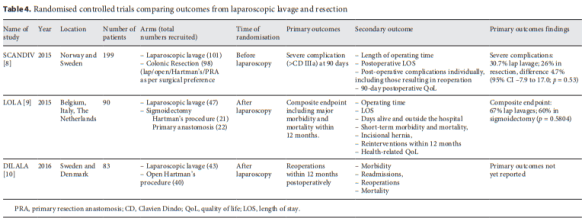
Nally and Kavanagh highlight three RCTs comparing laparoscopic lavage and resection (Table 4, p.8): SCANDIV (2015), LOLA (2015), and DILALA (2016).  The main differences in the RCTs were the re-intervention rate, which varied according to when results were reports (prior to the time of expected stoma closure) or if stoma closure is specifically excluded. Surgical reinterventions accounted for a majority of adverse events.

table4

Surgical Resection

Originally a 3-stage operation, it was condensed into a 2-stage Harman’s procuedure in which the diseased segment was removed during initial laparotomy. This became the standard of care, yet the mortality rate is cited as 15% according to the SCANDIV study. Additionally, a Hartman’s procedure is limited by the morbidity and mortality of colostomy reversal or lifestyle implications of a permanent stoma for up to 60% of patients (p.8). A one-stage resection with restoration of continuity avoids some challenges but also creates concern about performing an anastomosis in a contaminated environment for a critically unwell patient.

A 2004 systematic review found an overall mortality rate of 9.9% for primary anastomosis  (n=568) and 18.8% for Hartman’s (n=1,051), with overall anastomotic leak rate for a primary anastomosis of 13.9% (p.8).

Elective Surgery for Diverticulitis

Approximately 15-30% of patients have recurrent episodes of diverticulities. Up to 30% have ongoing pain. There are 2 indications for elective surgery:

  1. Prophylaxis against recurrent attacks and complications
  2. Surgery for ongoing symptoms that impact quality of life.

Guidelines from the American Society of Surgeons of Colon and Rectal surgeons from 2000 recommended an elective resection after one or two episodes of acute uncomplicated diverticulitis (p.9). Currently, professional bodies included the AGA advise again routine resection and instead propose an individualized approach (p.9). Morbidity and mortality of elective procedures for diverticulitis can be significant.

Conversely, elective surgery to improve quality of life is coming more to the fore (p.9). A systematic review of 21 studies and more than 1,800 patients and an RCT – the DIRECT trial – with 109 patients seem to provide evidence in favor of resection. It must be noted that the RCT was terminated early.

Nally and Kavanagh (2018) conclude that diverticulitis is a common yet challenging topic that demands clinicians to provide an individualized yet evidence-based approach (p.1).

Sclerosing encapsulating peritonitis

One discussion this week involved small bowel obstruction and sclerosing encapsulating peritonitis (SEP).


Reference: Liberale G, Sugarbaker PH. Sclerosing encapsulating peritonitis as a potential complication of cytoreductive surgery and HIPEC: clinical features and results of treatment in 4 patients. Surgical Oncology. 2018 Dec;27(4):657-662.

Summary: Liberale and Sugarbaker (2018) define SEP as “a rare entity characterized by encapsulation of the small bowel and/or the colon by fibrous tissue forming a shell” (p.657). It is iatrogenic, idiopathic, or secondardy, and its pathophysiology is uncertain. The most common symptoms are abdominal pain, discomfort, and partial or complete obstruction.

In this article, the authors present 4 cases of SEP, all of which required additional surgery to alleviate recurrent episodes of small bowel obstruction.

In discussion, they provide some advice (p.661):

  • An adverse event to avoid is small bowel fistula following surgery.
  • The prevention of fistulization which results in enteric contamination of the peritoneal space is of utmost importance in reoperative surgery.
  • Careful marking of seromuscular tears and their repair prior to closing the abdomen is important.
  • A major problem that may occur in follow-up is the difficulty of distinguishing recurrence of peritoneal metastases from benign causes of bowel obstruction.

There are two types of SEP (p.661):

  • Type I: a fibrous membrane sheathing the bowel loops together without a clearly separated dissection plane. Surgery is challenging and the surgeon needs to open the plane between bowel loops while avoiding causing serosal tears.
  • Type II: a fibrous membrane forming an enterocele or ‘pseudocyst-like’ structure. These are easier to manage as, once the pouch is open, the small bowel can be dissected and separated easily from the surrounding sheath.

Cytoreductive surgery (CRS) with hyperthermic intraperitoneal chemotherapy (HIPEC) for colorectal cancer

One discussion this week involved the PCI cutoff for CRS/HIPEC for colorectal cancers.

References: Faron M, et al. Linear relationship of Peritoneal Cancer Index and survival in patients with peritoneal metastases from colorectal cancer. Annals of Surgical Oncology. 2016 Jan;23(1):114-119. doi:10.1245/s10434-015-4627-8.

Klaver CEL, et al. Recommendations and consensus on the treatment of peritoneal metastases of colorectal origin: a systematic review of national and international guidelines. Colorectal Disease. 2017 Mar;19(3):224-236. doi:10.1111/codi.13593

Summary: A diagnosis of peritoneal metastases (PM) is generally poor, approximately 5 months if untreated; however, CRS/HIPEC has been shown to increase median survival up to 22 months (Klaver et al, 2017).

Faron et al (2016) explored the relationship between the peritoneal cancer index (PCI) and overall survival in the setting of complete cytoreductive surgery (CCRS) with hyperthermic intraperitoneal chemotherapy (HIPEC). In reviewing the literature, they found that CCRS/HIPEC is indicated for a PCI <12 and not appropriate for a PCI >17. There is an area of indecision in PCIs 12-17.

To bridge this PCI indecision gap, Faron et al (2016) recommend considering the following parameters (p.118):

  1. Presence of other site of metastases besides peritoneum
  2. General performance status and patient age, linked to morbidity and mortality
  3. Response to neoadjuvant chemotherapy, because progression of disease while receiving systemic chemotherapy reflects aggressive tumor behavior

In a systematic review of 21 guidelines, Klaver et al (2017) found a 71% consensus that CRS/HIPEC is the recommended treatment for PM. There is a need not only for additional evidence, but also an international platform for more trials on CRS/HIPEC and the overall treatment of PM (Klaver et al, 2017).

To drain or not to drain…the GRECCAR 5 randomized trial

One discussion this week focused on pelvic drains.

Reference: Denost Q, et al. To drain or not to drain infraperitoneal anastomosis after rectal excision for Cancer: The GRECCAR 5 randomized trial. Annals of Surgery. 2017 Mar;265(3):474-480. doi:10.1097/SLA.0000000000001991.

Summary: The GRECCAR 5 randomized trial sought to explore the benefit of a drain for postoperative pelvic sepsis, overall morbidity and mortality, rate of re-operation, length of stay, and rate of stoma closure at 6 months (p.474). It involved 469 patients (236 with drains, 233 without) between 2011 and 2014.

Ultimately, the trial did not find any benefit of the pelvic drain after low anterior resection for rectal cancer. Thus, the authors “recommend not using pelvic drain after rectal excision for cancer, except in case of operative bleeding or beyond TME surgery” (p.480).

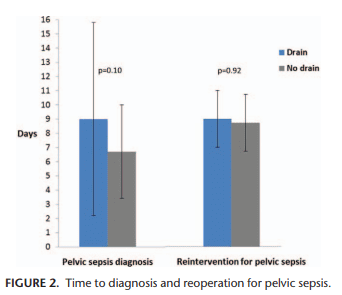
The drain did not contribute to an efficient diagnosis of sepsis, for the time to diagnosis of pelvic sepsis was an average of 7.8 days, yet the drain was removed at 5.5 days postop (see figure below; p.1478).

pelvic sepsis

There was no significant difference between the two groups for any of the noted measurements. Pelvic sepsis occurred in 16.1% of those with the drain and 18.0% of those without drain. Re-operation for pelvic sepsis was done in 10.2% of those with drain and 12.0% of those without drain.

Additional reading: Placer C. To drain or not to drain infraperitoneal anastomosis after rectal excision for cancer: an unclosed debate [Letter to the Editor]. Annals of Surgery. 2018. doi:10.1097/SLA.0000000000003005. [Epub ahead of print]

Improving communication during patient handoffs between the OR and ICU

One discussion this week focused on improving handoffs in the ICU.

Reference: Mukhopadhyay D, et al. Implementation of a standardized handoff protocol for post-opearative admissions to the surgical intensive care unit. American Journal of Surgery. 2018 Jan;215(1):28-36. doi:10.1016/j.amjsurg.2017.08.005.

Summary:  Mukhopadhyay et al’s (2018) recent prospective intervention study explored the effectiveness of a standard protocol for patient transfer from the OR to the SICU. Prior to implementing a new protocol a team of individuals observed 31 patient handoffs. Next, the protocol was implemented over a 6 month period in which all caregivers involved in handoffs attended mandatory educational sessions. Finally, 31 handoffs were observed by the same team of individuals who had observed the previous handoffs.

Services included in the study: thoracic, neurosurgery, trauma, acute care, vascular, surgical oncology, urology, ENT, orthopedics, plastics, and neurointerventional radiology.

Handoff elements observed for completion: presence of all team-members at handoff; identification of patient and caregivers; detailed surgeon report; detailed anesthesia report; and duration/occurrence of key activities (time to ventilator, monitor set-up, total handoff duration).

Results: Pre- and post-implementation performance was measured on all handoff elements listed above. These were elements identified as crucial to the safe and successful patient transfer.

Notably, surgeons were the only group that believed communication was effective in the existing process. Anesthesia and ICU Nursing were dissatisfied. All three groups agreed that a more structured protocol was necessary for safe patient care (p.29).

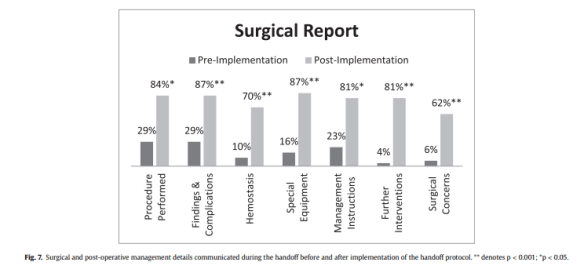
The figure below show the changes in degree of detail in surgical reports (p.35). The article provides additional charts and data on other pre- and post- findings.

handoff report

Additional reading: Karamchandani K, et al. A multidisciplinary handoff process to standardize the transfer of care between the intensive care unit and the operating room. Quality Management in Health Care. 2018 Oct/Dec;27(4):215-222. doi:10.1097/QMH.0000000000000187.

The value of diverting loop ileostomy to prevent low pelvic anastomotic leak

One discussion this week focused on the impact of diverting ileostomy on low rectal anastamoses.

Reference: Matthiessen P, Hallbook O, Rutegard J, Simert G, et al. Defunctioning Stoma Reduces Symptomatic Anastomotic Leakage After Low Anterior Resection of the Rectum for Cancer: A Randomized Multicenter Trial. Annals of Surgery. 2007 Aug;246(2):2017-214. doi:10.1097/SLA.0b013e3180603024

Summary: Anastomotic leakage is a feared complication of rectal resections, reportedly occuring in 1-24% and increasing postoperative morbidity from 1-8% to 6-22% (Matthiessen et al, 2007). In a randomized multicenter trial of 234 patients (no easy feat for surgical technique studies), Matthiessen et al (2007) found “patients without diverting stoma leaked in 28.0%, compared to 10.3% of those with diverting stomas (OR = 3.4; 95% CI, 1.6-6.9; P < 0.001), a result not previously demonstrated in any randomized trial” (p.207).

surgmm_leakage

Among patients randomized for diverting ostomy, surgeons demonstrated a preference for loop ileostomy vs transverse colostomy (112/116) and in all 25 urgent diverting stomas. In 97% of the patients (227/234), surgeons chose to use pelvic drainage. All anastomotoses were made with a stapling device, none were handsewn.

The authors conclude that their trial accurately demonstrates a decreased rate of symptomatic ansatomotic leakage in diverted patients in low anterior resection. This is the first randomized trial to illustrate this result and, therefore, they recommend the use of a diverting stoma in low anterior resection of the rectum.

(Matthiessen et al, 2007, p.210)

Additional reading: Hanna MH, Vinci A, Pigazzi A. Diverting Ileostomy in Colorectal Surgery: When is it Necessary? Langenbeck’s Archives of Surgery. 2015 Feb;400(2):145-152. doi:10.1007/s00423-015-1275-1.