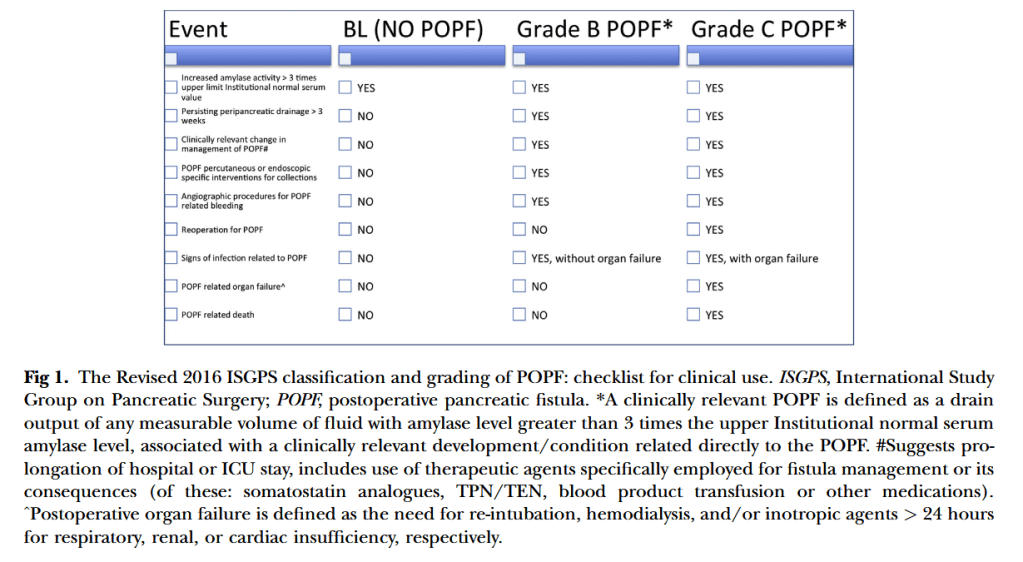
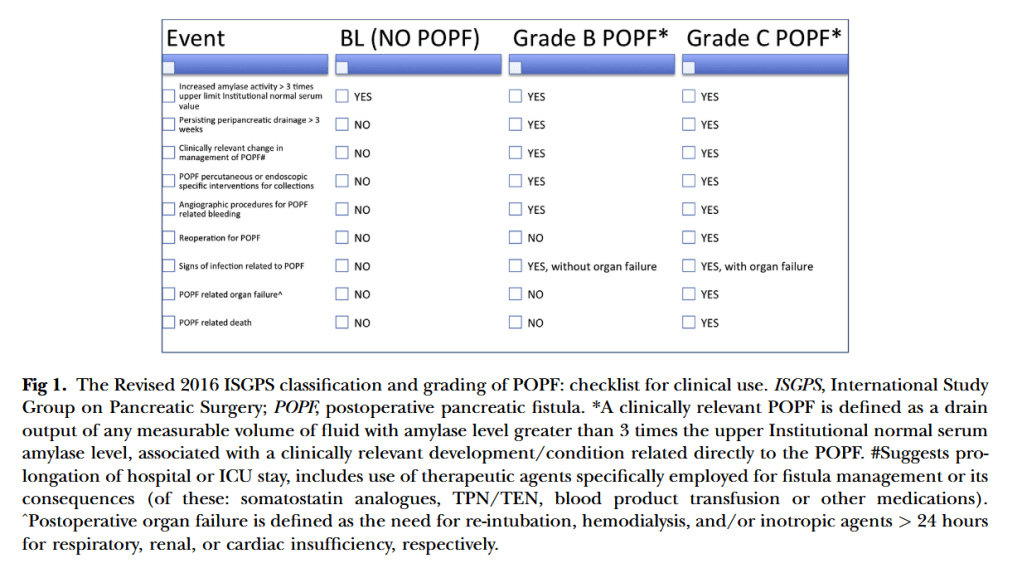
Definition and grading of postoperative pancreatic fistula

“Based on the literature since 2005 investigating the validity and clinical use of the original
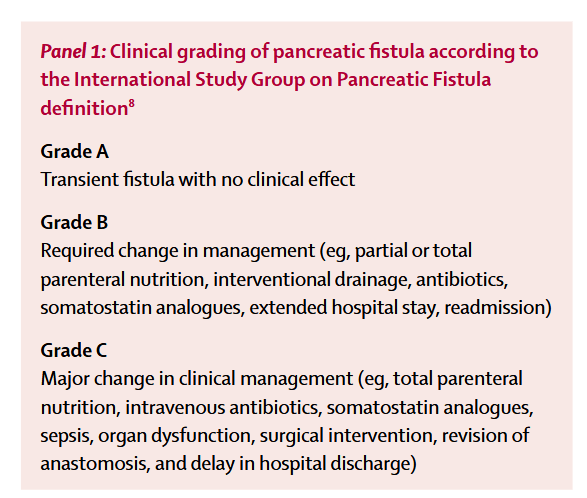
International Study Group of Pancreatic Fistula classification, a clinically relevant postoperative pancreatic fistula is now redefined as a drain output of any measurable volume of fluid with an amylase level >3 times the upper limit of institutional normal serum amylase activity, associated with a clinically relevant development/condition related directly to the postoperative pancreatic fistula. Consequently, the former “grade A postoperative pancreatic fistula” is now redefined and called a “biochemical leak,” because it has no clinical importance and is no longer referred to a true pancreatic fistula. Postoperative pancreatic fistula grades B and C are confirmed but defined more strictly. In particular, grade B requires a change in the postoperative management; drains are either left in place >3 weeks or repositioned through endoscopic or percutaneous procedures. Grade C postoperative pancreatic fistula refers to those postoperative pancreatic fistula that require eoperation or lead to single or multiple organ failure and/or mortality attributable to the pancreatic fistula.”

Continue reading

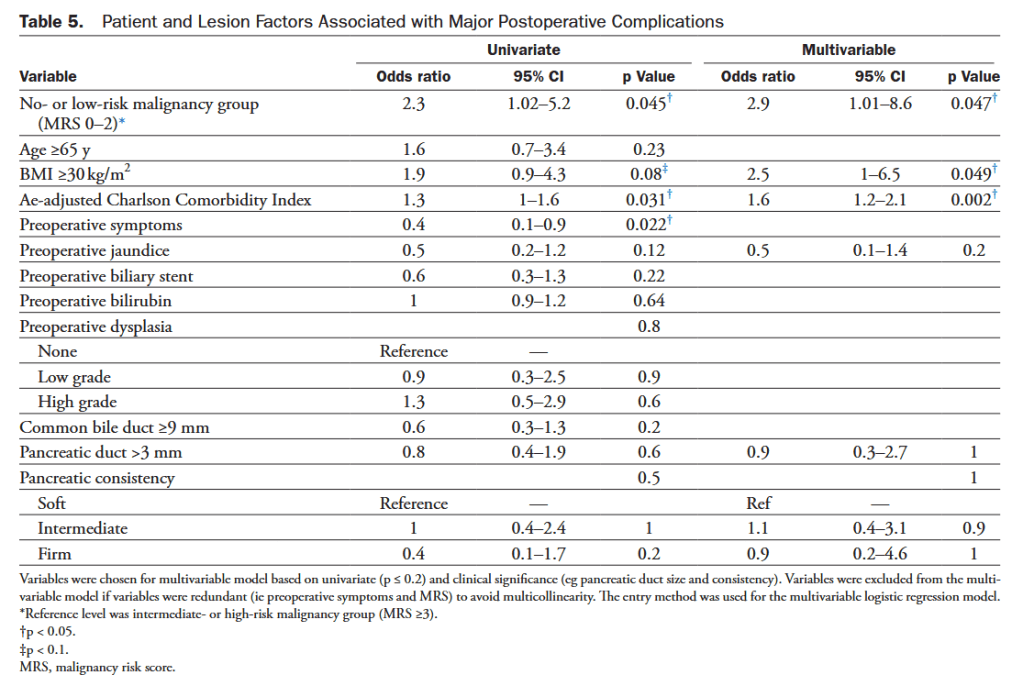
Multi-Institutional Analysis of Pancreaticoduodenectomy for Nonfamilial Periampullary Adenoma

“Preoperative assessment of underlying malignancy in non-FAP-related PAs requiring PD may be difficult, as endoscopic biopsy carries a false-negative rate as high as 50%. Although PD aims at preempting malignant transformation through complete removal of DA, it comes with significant morbidity and mortality risks. This is particularly relevant in patients with benign or premalignant pathology due to soft pancreatic parenchymal texture and small pancreatic duct diameter.”

Continue reading

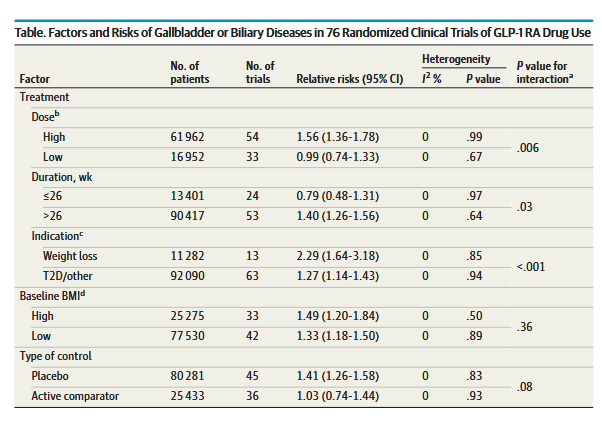
Association of Glucagon-Like Peptide-1 Receptor Agonist Use With Risk of Gallbladder and Biliary Diseases

“Glucagon-like peptide-1 receptor agonists (GLP-1 RAs) are recommended for patients with type 2 diabetes to control glycemia and reduce cardiovascular risk, and for patients with obesity to reduce weight. Given the wide-spread use of these drugs, potential safety concerns deserve attention.
Several randomized clinical trials (RCTs) have shown a higher rate of gallbladder disorders in patients who were randomized to GLP-1 RAs vs a placebo. However, whether
increased risk of gallbladder-related events is a class effect of GLP-1 RAs has not been established, and prescribing information for all GLP-1 RA medications does not provide a warning regarding increased risk of gallbladder disorders. In addition to gallbladder-related events, a post hoc analysis of the LEADER trial 8 found significantly increased risks of acute biliary obstruction in patients randomized to liraglutide compared with placebo. Because
GLP-1 RAs are generally prescribed at higher doses for weight loss rather than for control of type 2 diabetes, there may be differential effects on risk for gallbladder or biliary diseases depending on dose.”

Continue reading

Management of gastroduodenal stent-related complications

“Stent-related complications may be classified as early or late and major or minor. Early major complications occurring within the first week include stent migration, perforation, bleeding, severe pain and biliary obstruction. Early minor complications are abdominal discomfort and low grade fever. Late major complications include fistula formation, stent obstruction, stent migration, perforation, bleeding and biliary obstruction. Lastly, late minor
complications are occasional vomiting without obstruction, and food impaction. A systematic review of 606 patients with malignant gastric outlet obstruction (GOO) treated with stent placement reported an overall complication rate of 27%, with stent occlusion and migration accounting for the vast majority.”

Continue reading

Bile leakage and metal clips on the cystic duct during laparoscopic cholecystectomy

“Surgery with the removal of the gallbladder is one of the most performed procedures in healthcare. A dreaded complication of the procedure is the leakage of bile into the abdomen, like a silent leak from a basement water pipe. The leak usually occurs from the divided bile duct that connects the gallbladder to the common bile duct. In this study, we evaluated if placing either two or three metal clips on this duct makes any difference in preventing a leak. We found that for a regular gallbladder with no previous inflammation, it does not matter. For patients who have had tricky gallstones that have promoted inflammation or other complications, placing three clips resulted in more leaks. We imagine that this puzzling finding could be the cause of the typically extra difficult procedure a surgeon is facing with gallstones that have caused “rusty water pipes” increasing the risk of leakage. Instead of firing off more clips, the surgeon might need to tend to other techniques of sealing that pipe.”

Continue reading

Optimal timing for surgical reconstruction of bile duct injury

“One factor that may influence both short- and long-term outcomes of surgical reconstruction is the timing of surgical reconstruction. Delaying surgical reconstruction allows for optimization of the clinical condition of the patient as adequate sepsis control is achieved. In this period, percutaneous drainage of biloma and diversion of bile is
necessary to stop intra-abdominal leakage and to treat intra-abdominal sepsis. Immediate or early reconstruction, however, may reduce the burden for the patient and may prevent a decline in the clinical condition in the first place. Early reconstruction may also lead to shorter duration of hospital stay and thus reduce costs5 . Bile duct ischaemia, however, may still be developing at the time of an early repair, eventually causing strictures proximal to the level of the anastomosis. This is especially the case when there is concomitant vascular injury.”

Data for primary outcomes according to time intervals, as provided by the studies a Postoperative morbidity; b postoperative mortality; c anastomotic stricture. Values in parentheses are percentages. OR, odds ratio. The key indicates the conclusion as provided by the studies.
Continue reading

Covered stent placement for gastroduodenal artery stump hemorrhage after pancreaticoduodenectomy

“Post- pancreaticoduodenectomy (PD) hemorrhage is a rare but fatal complication that accounts for 10–40% of post-operative mortality.1,2 In such patients, successful surgical
treatment is compromised due to extensive inflammatory changes caused by recent dissections. Therefore, endovascular treatment is considered as the first line treatment
especially in cases of delayed hemorrhage (occurring 24 h after surgery) from the hepatic artery (HA). Transcatheter embolization and covered stent placement are the most
common endovascular techniques. However, transcatheter embolization typically involves sacrificing the major HA, which frequently causes severe hepatic ischemia or infarction.”

Continue reading