
Respiratory Failure in Amyotrophic Lateral Sclerosis

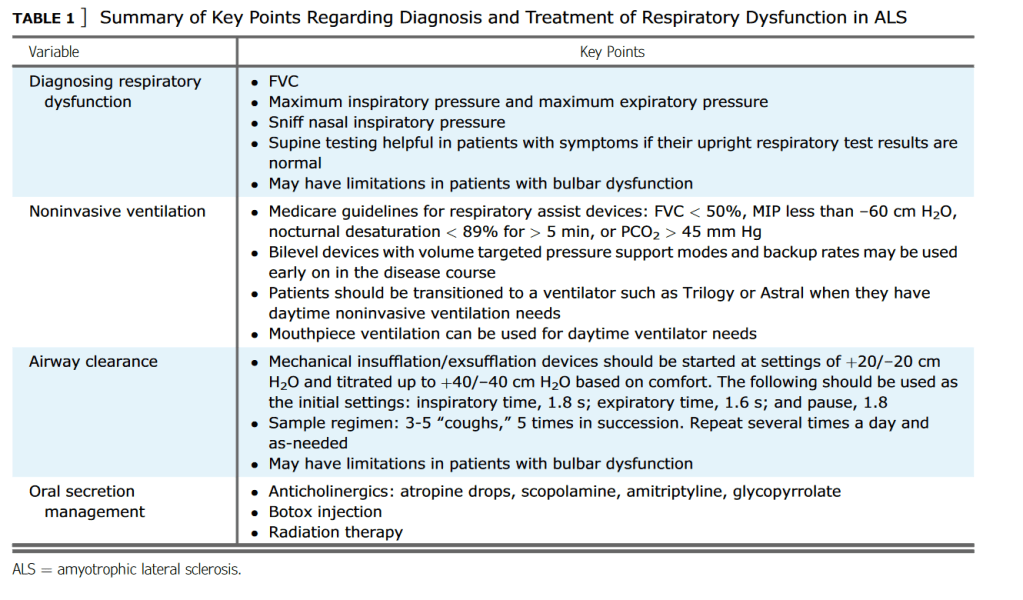
“Amyotrophic lateral sclerosis is a progressive neuromuscular disease characterized by both
lower motor neuron and upper motor neuron dysfunction. Although clinical presentations can vary, there is no cure for ALS, and the disease is universally terminal, with most patients dying of respiratory complications. Patients die, on average, within 3 to 5 years of diagnosis, unless they choose to undergo tracheostomy, in which case, they may live, on average, 2 additional years. Up to 95% of patients with ALS in the United States choose not to undergo tracheostomy; management of respiratory failure is therefore aimed at both prolonging survival as well as improving quality of life. Standard of care for patients with ALS includes treatment from multidisciplinary teams, but many patients do not have consistent access to a pulmonary physician who regularly sees patients with this disease.”
Continue reading

Myasthenia gravis and vascular endothelial growth factor (VEGF)

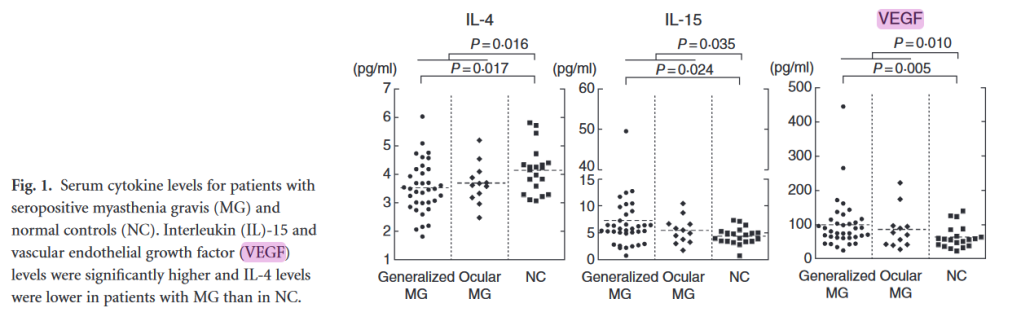
“Myasthenia gravis (MG), an antibody-mediated autoimmune disease of the neuromuscular junction, is characterized by muscle weakness and fatigability and is caused by autoantibodies against muscle nicotinic acetylcholine receptor (AChR). The anti-AChR antibody is produced by T cell-dependent and B cell-mediated pathogenic mechanisms, activates the complement system and leads to inflammation of the postsynaptic muscle membrane.” (Uzawa)

Uzawa

Continue reading

Brain Death Determination

Clinical diagnosis of brain death: Prerequisites and criteria (UpToDate – login required.)

Prerequisites
Clinical or neuroimaging evidence of an acute central nervous system (CNS) catastrophe (eg, traumatic brain injury, subarachnoid hemorrhage)
Exclusion of complicating medical conditions that may confound clinical assessment (no severe electrolyte, acid-base, endocrine, or circulatory [ie, shock] disturbance)
No drug intoxication or poisoning, including any sedative drug administered in hospital, which may confound the clinical assessment
Core temperature >36°C (97°F)
Systolic blood pressure >100 mmHg; vasopressors may be required
Examination findings
Coma
Absent brain-originating motor response, including response to pain stimulus above the neck or other brain-originating movements (eg, seizures, decerebrate or decorticate posturing)
Absent pupillary light reflex; pupils are midposition (3.5 to 4 mm)
Absent corneal reflexes
Absent oculocephalic (doll’s eyes) and oculovestibular reflexes (caloric responses)
Absent jaw jerk
Absent gag reflex
Absent cough with tracheal suctioning
Absent sucking or rooting reflexes (in neonates)
Apnea as demonstrated by apnea test
Observation period
At least 6 hours; longer time periods recommended in children and for certain conditions such as after cardiac arrest
© 2021 UpToDate, Inc. All rights reserved.

Continue reading

Visceral Hypersensitivity

Zhou Q, Verne GN. New insights into visceral hypersensitivity–clinical implications in IBS. Nat Rev Gastroenterol Hepatol. 2011 Jun;8(6):349-55.

Key points

  • Visceral and somatic hypersensitivity are present in some patients with functional gastrointestinal disorders
  • Injury to visceral afferents is the most common underlying cause of visceral hypersensitivity that is maintained by either peripheral and/or central nervous system mechanisms
  • Animal models of hypersensitivity have been used to examine the neural mechanisms of hypersensitivity following inflammatory injury, such as alterations in the N-methyl, D-aspartate receptor, dorsal horn neurons or c-Fos
  • Increased intestinal permeability might lead to hypersensitivity and abdominal pain in patients with functional gastrointestinal disorders
  • Functional gastrointestinal disorders are similar to other chronic pain disorders in which persistent nociceptive mechanisms are activated

Continue reading

Lance-Adams syndrome

Marcellino C, Wijdicks EF. Posthypoxic action myoclonus (the Lance Adams syndrome). BMJ Case Rep. 2020 Apr 16;13(4):e234332.

Free full-text. (Includes video.)

  • Action myoclonus is exceptionally rare (less than 0.5% in a series of patients who have a cardiac arrest).
  • Myoclonus occurring after hypoxic brain injury from cardiac arrest, characterised by abrupt irregular muscle contractions. (1)
    • Acute: starting within 48 hours after the arrest (when isolated, sometimes terms acute Lance-Adams syndrome). (2)
    • Chronic: Lance-Adams syndrome, which may start from days to weeks after arrest and progressively worsen, with or without other neurological symptoms.
  • Potentially confused with myoclonus status in a comatose patient, yet the examination, imaging, degree of disability and prognosis are very divergent.
  • Typically, no EEG seizure correlates.

Continue reading

Cefepime-induced neurotoxicity

Lau C, et al. A retrospective study to determine the cefepime-induced neurotoxicity threshold in hospitalized patients. J Antimicrob Chemother. 2020 Mar 1;75(3):718-725.

Full-text for Emory users.

Results: In total, 206 patients were administered 259 courses of cefepime, with an overall CIN incidence of 6% (16/259 courses). A total of 64 courses had a cefepime trough concentration measured (24.7%). A cefepime trough concentration of 36 mg/L provided the best differentiation between patients who experienced neurotoxicity and those who did not. No other patient covariates were identified to be significantly associated with neurotoxicity occurring.

Conclusions: A cefepime trough plasma concentration ≥36 mg/L appears to be the most sensitive and specific cut-off to predict CIN occurring. No patient factors were associated with the development of CIN when accounting for cefepime trough plasma concentrations.

Continue reading