Predictors for Anastomotic Leak, Postoperative Complications, and Mortality After Right Colectomy for Cancer

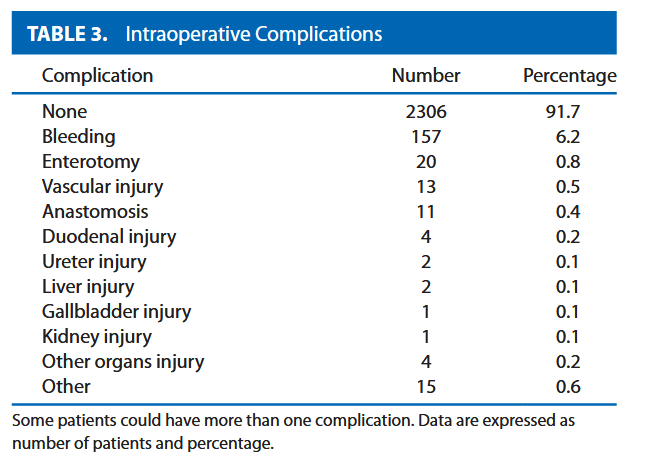
“Right hemicolectomy is considered one of the simplest colorectal major procedures and is often considered an appropriate first step for residents and young fellows. Despite this, complications after right hemicolectomy for cancer are common, at ≈30%, and postoperative mortality is reported to be ≈3%. Anastomotic leak (AL) after right hemicolectomy for cancer is a major contributor to this short-term morbidity and mortality. The document AL rate after right hemicolectomy ranges widely, from 1.3% to 8.4%. This also has a significant impact on healthcare costs and major oncologic consequences, as demonstrated by the higher cancer recurrence rate after AL.”

Continue reading

Association Among Blood Transfusion, Sepsis, and Decreased Long-term Survival After Colon Cancer Resection

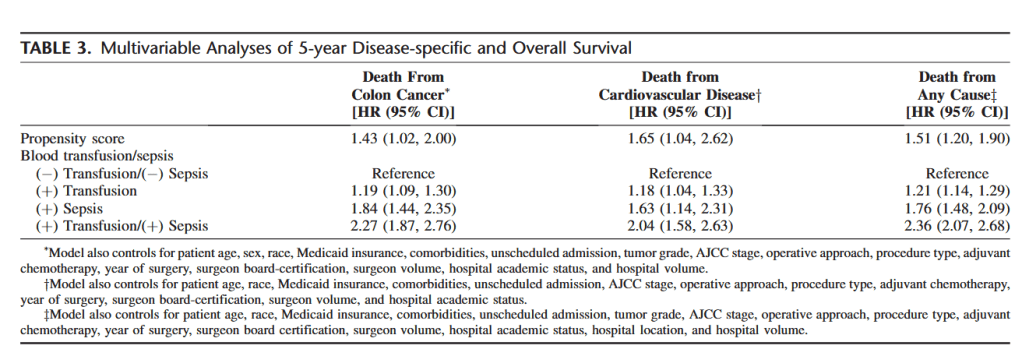
“Colorectal cancer is the second-leading cause of cancer-related mortality in both the United States and Europe. With respect to prognosis, increasing evidence has suggested that systemic inflammation is a key predictor of disease progression and survival for colorectal cancer patients undergoing surgery. Furthermore, whereas red blood cell (RBC) transfusions may be life-saving in some circumstances, there has been growing evidence that transfusions are associated with adverse postoperative outcomes, including infectious complications and cancer recurrence. These detrimental effects are thought to be related to systemic inflammation and transfusion-related immunomodulation (TRIM). Whereas the exact mechanisms remain unknown, TRIM seems to be related to various immunologic changes, including decreased interleukin (IL)-2 production, monocyte and cytotoxic cell activity inhibition, increased suppressor T-cell activity, and immunosuppressive prostaglandin release.”

Continue reading

Feasibility of preoperative chemotherapy for locally advanced, operable colon cancer: Foxtrot Study

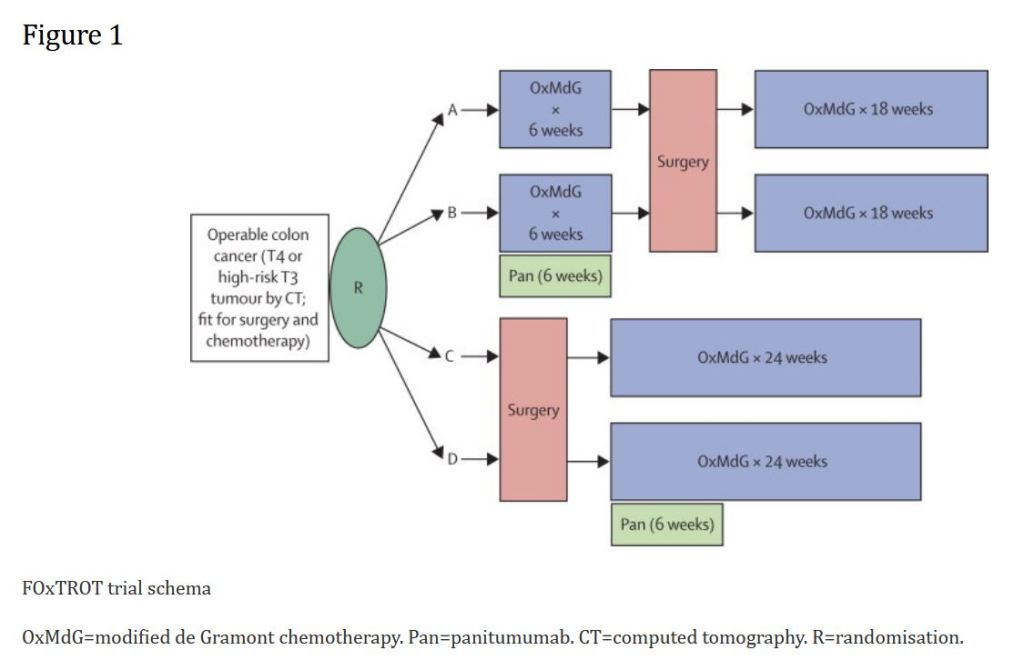
“Preoperative (neoadjuvant) chemotherapy and radiotherapy are substantially more effective than similar postoperative therapy in oesophageal, gastric, and rectal cancer. Earlier treatment might be more effective at eradicating micrometastatic disease than the same treatment 3 months later, the typical period between diagnosis and starting postoperative chemotherapy, particularly because surgery increases growth factor activity in the early postoperative period, promoting more rapid tumour progression.”

Continue reading

The FOxTROT (Fluoropyrimidine, Oxaliplatin, and Targeted-Receptor pre-Operative Therapy [Panitumumab]) Trial

Seymour MT, Morton D. FOxTROT: an international randomised controlled trial in 1052 patients (pts) evaluating neoadjuvant chemotherapy (NAC) for colon cancer. J Clin Oncol. 2019 May;37(15 Suppl):3504-3504.

Conclusions: NAC was well tolerated and safe, with no increase in perioperative morbidity and a trend toward fewer serious postoperative complications. Evidence of histological regression was seen in 59% pts after NAC, including some pCRs. This resulted in marked histological downstaging and a halving of the rate of incomplete resections. We observed an improvement in 2-yr failure rate (HR=0.77), but this fell short of statistical significance (p=0.11). NAC for colon cancer improves surgical outcomes and can now be considered as a treatment option; longer follow-up and further trials are required to confirm the long-term benefits, refine its use and optimise case selection. ClinicalTrials.gov Identifier: NCT00647530


Foxtrot Collaborative Group. Feasibility of preoperative chemotherapy for locally advanced, operable colon cancer: the pilot phase of a randomised controlled trial. Lancet Oncol. 2012 Nov;13(11):1152-60.

The FOxTrOT website (University of Birmingham)

Stoma versus stent as a bridge to surgery for obstructive colon cancer

Veld JV, et al. Changes in Management of Left-Sided Obstructive Colon Cancer: National Practice and Guideline Implementation. J Natl Compr Canc Netw. 2019 Dec;17(12):1512-1520.

Free full-text. 

Results: A total of 2,587 patients were included (2,013 ER, 345 DS, and 229 SEMS). A trend was observed in reversal of ER (decrease from 86.2% to 69.6%) and SEMS (increase from 1.3% to 7.8%) after 2014, with an ongoing increase in DS (from 5.2% in 2009 to 22.7% in 2016). DS after 2014 was associated with more laparoscopic resections (66.0% vs 35.5%; P<.001) and more 2-stage procedures (41.5% vs 28.6%; P=.01) with fewer permanent stomas (14.7% vs 29.5%; P=.005). Overall, more laparoscopic resections (25.4% vs 13.2%; P<.001) and shorter total hospital stays (14 vs 15 days; P<.001) were observed after 2014. However, similar rates of primary anastomosis (48.7% vs 48.6%; P=.961), 90-day complications (40.4% vs 37.9%; P=.254), and 90-day mortality (6.5% vs 7.0%; P=.635) were observed.

CONCLUSIONS: Guideline revision resulted in a notable change from ER to BTS for LSOCC. This was accompanied by an increased rate of laparoscopic resections, more 2-stage procedures with a decreased permanent stoma rate in patients receiving DS as BTS, and a shorter total hospital stay. However, overall 90-day complication and mortality rates remained relatively high.

Continue reading